Choice Overload After the Jam Study
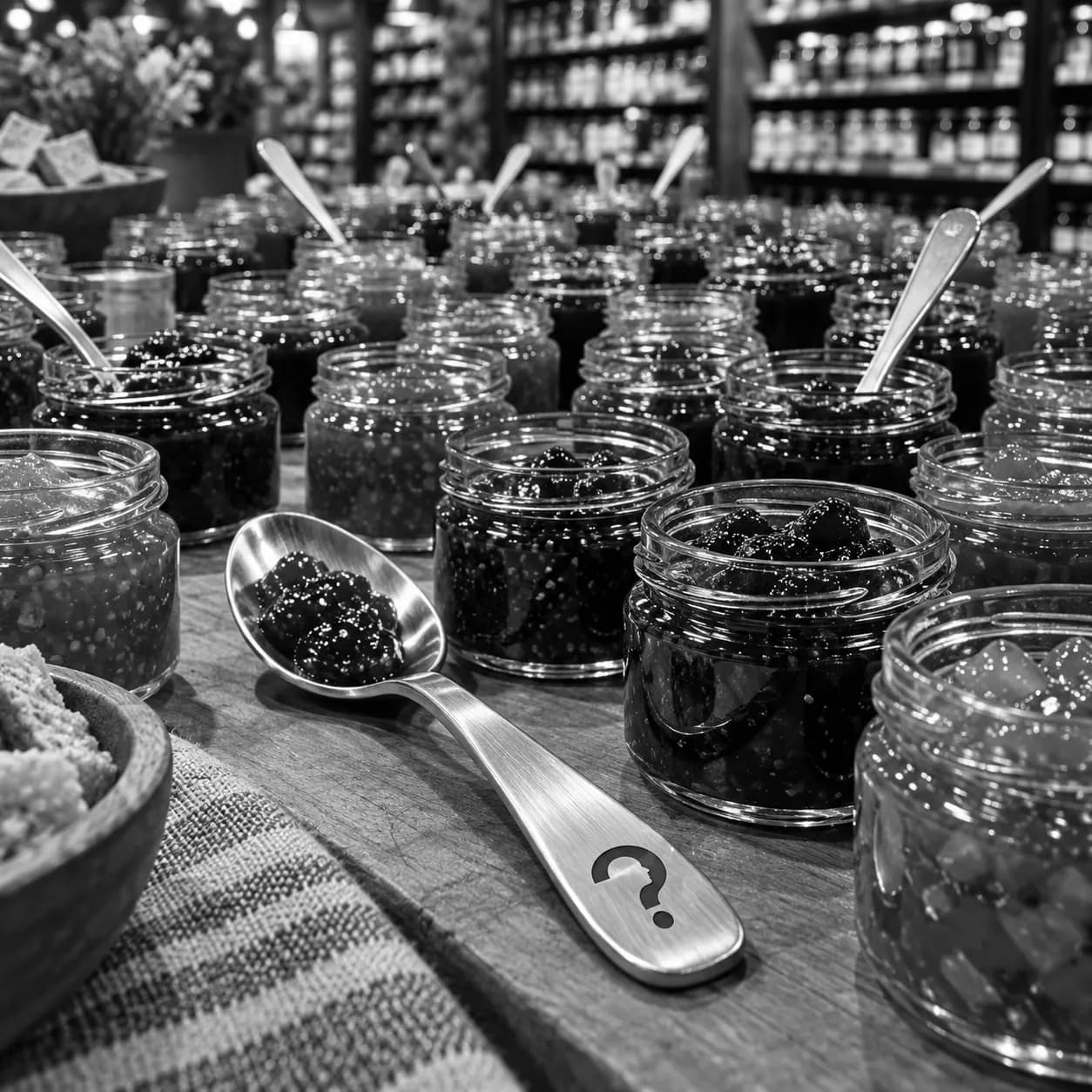
In 2000, shoppers stopped at a table of 24 jams and bought from a table of 6. Anyone who runs a shop has since been told to cut their range because of it.
Answer to the question
Does too much choice stop people buying?
Sometimes, but not as a rule. In Sheena Iyengar and Mark Lepper's 2000 jam study, 30 per cent of tasters bought from 6 jams against 3 per cent from 24, but a repeat in a German supermarket found no effect. A 2015 meta-analysis found choice overload appears when options are hard to compare and buyers are unsure what they want.
Key takeaways
- In Sheena Iyengar and Mark Lepper's 2000 jam study, 60 per cent of passers-by stopped at 24 jams and 40 per cent at 6, but 30 per cent of tasters bought from 6 against 3 per cent from 24.
- Benjamin Scheibehenne's 2008 repeat in a German supermarket found no choice overload, and a 2010 meta-analysis of 50 experiments put the average effect at virtually zero.
- A 2015 meta-analysis by Alexander Chernev and colleagues found choice overload likely when options are complex, the decision is difficult, preferences are uncertain and people want to minimise effort.
In a supermarket in Menlo Park, California, two research assistants dressed as store staff stood behind a tasting table and invited shoppers to try jam. Every hour they swapped the display, a small range for a large one, while an observer counted who stopped and who walked on.
2000: two tables of jam
That table became the founding study of choice overload, the idea that more options can leave people less likely to choose. The supermarket was Draeger's, picked because it stocked hundreds of jams and its shoppers were used to tasting booths. Sheena Iyengar and Mark Lepper wanted to know whether that kind of abundance helps people choose or gets in their way, and the jam table was the first of three experiments they reported in the Journal of Personality and Social Psychology.
The jams came from a single British maker, and the researchers removed familiar flavours such as strawberry and raspberry before setting out the rest. Their stated aim was a product that shoppers would recognise, though not so well that their preferences were already fixed. Anyone who stopped could taste as many jams as they liked and was given a coupon for a dollar off. To use it, a shopper had to walk to the jam shelf, where every flavour sat together, so buyers from both tables faced the full range at the moment of purchase.
The large display won the first contest easily. More passers-by stopped at it, and those who stopped tasted about as many jams as tasters at the small display, usually one or two. The contest that mattered to the shop went the other way, and by a wide margin, because far fewer of the people drawn in by the large display went on to buy.
The paper's two other experiments, run with students, found a similar pattern. People choosing among a small set of chocolates were more satisfied with their pick than people choosing from a large set, and more willing to take chocolates rather than cash as payment. Students offered a short list of topics for an optional essay were more likely to write one, and wrote better essays, than students given a long list.
| Study | Year | What was tested | Result |
|---|---|---|---|
| Iyengar and Lepper | 2000 | 6 against 24 jams in a supermarket | 60 per cent of passers-by stopped at 24 jams, 40 per cent at 6; 30 per cent of tasters bought from 6, 3 per cent from 24 |
| Scheibehenne | 2008 | Three replications, including a German supermarket | The effect did not reappear |
| Scheibehenne, Greifeneder and Todd | 2010 | 50 experiments pooled | Average effect virtually zero, wide variation |
| Chernev, Böckenholt and Goodman | 2015 | 99 observations pooled | Overload likely under four conditions |
In the paper's own counts, nearly 30 per cent of the people who tasted at the six-jam table bought a jar, 31 shoppers, against 3 per cent at the 24-jam table, which was 4 shoppers. Four years later Iyengar and two colleagues took the idea from jam to pensions. Across 401(k) retirement plans covering nearly 800,000 employees, participation was higher in plans that offered a handful of funds than in plans that offered many. That was a comparison between workplaces rather than an experiment, but it turned choice overload into a policy question as well as a retail one.
A large display attracted shoppers and then sold to very few of them, and that contrast made the study famous.
2008 to 2010: repeats fail
Benjamin Scheibehenne, working on a doctoral dissertation in Berlin, tried to reproduce the effect. His 2008 thesis reports three replications in the field and the laboratory with 850 participants, and the effect did not reappear. One of them aimed to repeat the jam study itself in an upscale German supermarket and found no sign of choice overload. A laboratory study by Rainer Greifeneder, with exotic chocolates, found no difference between small and large assortments.
In 2009 Scheibehenne and two colleagues reported three more studies, with 598 participants, in Psychology & Marketing. They varied how many options people saw, how attractive those options were and whether people had to explain what they chose. They also looked at how much people searched, how expert they were in the product category and how strongly they tended to seek the very best option. Of all those factors, only choice justification changed the result, which left choice overload looking far less general than the jam table had suggested.
The team then combined the published and unpublished evidence. Their 2010 meta-analysis in the Journal of Consumer Research pooled 63 conditions from 50 experiments with 5,036 participants and reported "a mean effect size of virtually zero but considerable variance between studies". Some experiments found overload, while others found that more choice helped. Published papers were somewhat more likely than unpublished ones to report overload, which the authors read as a slight publication bias in its favour, and more recent experiments were less likely to find it.
By 2010 the evidence averaged close to nothing, with large swings in both directions.
2015: four conditions emerge
Alexander Chernev and two colleagues asked a different question in a 2015 meta-analysis in the Journal of Consumer Psychology. Rather than whether large assortments hurt on average, they asked when they do, pooling 99 observations from earlier research. Four conditions made choice overload more likely: a complex set of options, a difficult decision task, uncertainty about what you prefer, and a goal of finishing the decision with as little effort as possible. Once those conditions were included, the overall effect of assortment size was significant, and the authors note that this contradicts the earlier meta-analytic findings.
The 2015 team also compared the outcomes studies use to detect choice overload, namely satisfaction or confidence, regret, putting off the decision and the urge to switch to another option, and found the four about equally sensitive.
The 2010 paper had already named possible preconditions, such as unfamiliar options and the lack of a clear favourite, and had found that none of them was enough on its own. The 2015 paper measured four conditions directly and found each of them reliable. The original jam table met at least one by design, since its flavours were chosen precisely so that shoppers would lack settled preferences.
2022 onwards: sharper tests
The argument for the effect has found new advocates. A working paper by Mark Dean and two colleagues, first posted in 2022 and revised several times since, argues that standard tests lack the statistical power to detect choice overload and reports strong evidence of it in experimental data using more powerful tests. It is still a working paper, but it is a serious case that the near-zero average partly reflects weak methods.
The study also reached marketing books. Richard Shotton's The Illusion of Choice (2023) gives the jam result with exact figures on page 27, including purchase rates of 12 and 1.7 per cent, which are shares of everyone who walked past rather than of those who stopped. On page 28 the book adds: "But before you rush to pare back your offering, it's worth considering follow-up research that suggests the genuine story is a little more nuanced." It then sets out Chernev's meta-analysis and four conditions under which overload occurs, and tells readers to check whether any apply to their own category.
For a shop owner, the jam study and everything since support a modest conclusion. A large range can put off buyers who do not know what they want, facing many similar options that are hard to compare, and in that situation a default, a recommendation or clearer groupings are worth trying before cutting products. A shop whose customers arrive knowing what they like has little to fear from a long shelf, given the repeats that found no effect and the near-zero average across 50 experiments. What the owner cannot conclude is that a long shelf, on its own, will cost sales.
What the owner cannot conclude is that a long shelf, on its own, will cost sales.
Common questions
Does too much choice stop people buying?
Sometimes, but not as a rule. In Sheena Iyengar and Mark Lepper's 2000 study, 30 per cent of tasters bought from a table of 6 jams against 3 per cent from 24, but a repeat in a German supermarket found no effect, and a 2010 meta-analysis of 50 experiments put the average effect close to zero.
What did the jam study actually find?
More shoppers stopped at the big display, 60 per cent of 242 passers-by against 40 per cent of 260 at the small one, but fewer bought. Nearly 30 per cent of tasters at the 6-jam table bought a jar, 31 people, against 3 per cent at the 24-jam table, 4 people.
When does choice overload happen?
Mostly under specific conditions. A 2015 meta-analysis by Alexander Chernev and colleagues found overload more likely when the options are complex, the decision is difficult, people are unsure what they prefer, and they want to decide with as little effort as possible.
Has the jam study been replicated?
Not at its original size. Benjamin Scheibehenne's 2008 dissertation reported three replications with 850 participants, including a jam tasting in an upscale German supermarket, and the effect did not reappear. A lab study with exotic chocolates also found no difference between small and large assortments.
Sources
Iyengar, S. S., & Lepper, M. R. (2000). 'When choice is demotivating: can one desire too much of a good thing?' Journal of Personality and Social Psychology, 79(6), 995-1006. doi:10.1037/0022-3514.79.6.995. Full text read: Draeger's, Menlo Park, two Saturdays; Wilkin & Sons jams, 6 against 24; 242 and 260 passers-by; 60 per cent (145) and 40 per cent (104) stopped; nearly 30 per cent (31) against 3 per cent (4) of those who stopped bought; $1 coupon; sampling 1.50 against 1.38 jams; Studies 2 and 3 on essays (6 against 30 topics) and chocolates (6 against 30).
Iyengar, S. S., Huberman, G., & Jiang, W. (2004). 'How much choice is too much? Contributions to 401(k) retirement plans.' In Pension Design and Structure: New Lessons from Behavioral Finance. Oxford University Press. Abstract read (Pension Research Council working paper record and Columbia Business School page): data on nearly 800,000 employees; participation higher in plans offering a handful of funds.
Scheibehenne, B. (2008). The effect of having too much choice. Doctoral dissertation, Humboldt-Universität zu Berlin. doi:10.18452/15740. Abstract read: three replications, field and lab, 850 participants, effect did not reappear. The supermarket jam replication is described in Scheibehenne, Greifeneder and Todd (2010).
Scheibehenne, B., Greifeneder, R., & Todd, P. M. (2009). 'What moderates the too-much-choice effect?' Psychology & Marketing, 26(3), 229-253. doi:10.1002/mar.20271. Abstract read, with the opening of the full text (first study's design): three studies, 598 participants; only choice justification proved an effective moderator.
Scheibehenne, B., Greifeneder, R., & Todd, P. M. (2010). 'Can there ever be too many options? A meta-analytic review of choice overload.' Journal of Consumer Research, 37(3), 409-425. doi:10.1086/651235. Full text read (author copy): 63 conditions from 50 experiments, 5,036 participants; mean effect virtually zero (D = 0.02) with considerable variance; slight publication bias in favour of choice overload results; more recent experiments less likely to find it; Scheibehenne (2008) German supermarket jam replication and Greifeneder (2008) chocolate study reported as finding no effect.
Chernev, A., Böckenholt, U., & Goodman, J. (2015). 'Choice overload: a conceptual review and meta-analysis.' Journal of Consumer Psychology, 25(2), 333-358. doi:10.1016/j.jcps.2014.08.002. Abstract read: 99 observations; four moderators (choice set complexity, decision task difficulty, preference uncertainty, decision goal); overall effect significant once moderators are included, contradicting earlier meta-analytic findings.
Dean, M., Ravindran, D., & Stoye, J. (2022, revised 2026). 'A better test of choice overload.' arXiv working paper 2212.03931. Abstract read: existing tests likely underpowered; more powerful tests find strong evidence of choice overload in experimental data.
Shotton, R. (2023). The Illusion of Choice: 16½ Psychological Biases That Influence What We Buy. Harriman House. Read in full by this publication, with a reliability audit. pp. 27 to 28: Iyengar and Lepper with stopping rates of 40 and 60 per cent and purchase rates of 12 and 1.7 per cent; the warning against paring back a range in a rush; Chernev's meta-analysis and four conditions.