The Endowed Progress Effect at Work
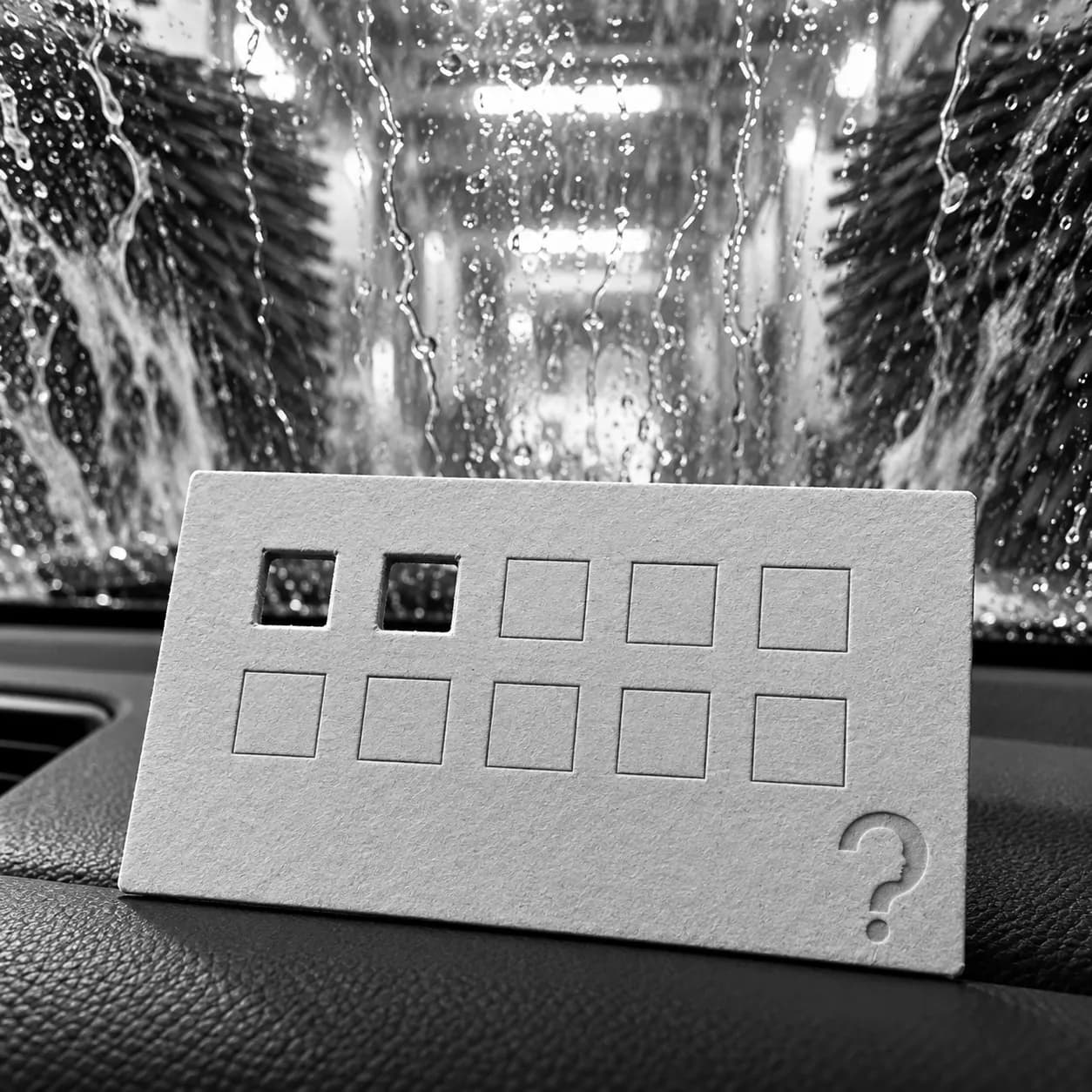
If a loyalty card has ever arrived with stamps already on it, you have met the endowed progress effect. In a car wash study, that free head start nearly doubled the share of customers who finished their card.
Answer to the question
Why do loyalty cards come with free stamps?
Because a head start makes people more likely to finish. In a 2006 car wash study by Joseph Nunes and Xavier Drèze, 34 per cent of customers given two free stamps completed their card, against 19 per cent with a blank card needing the same eight washes. Progress bars and onboarding checklists borrow the same endowed progress effect, with weaker evidence.
Key takeaways
- In Joseph Nunes and Xavier Drèze's 2006 car wash study, 34 per cent of customers given a card with two free stamps completed it, against 19 per cent with a blank card needing the same eight washes.
- The '82 percent higher completion rate' quoted in Hooked is a relative figure; the two completion rates behind it are 34 and 19 per cent.
- In a 2006 café test by Ran Kivetz and colleagues, two bonus stamps cut the time to complete ten purchases from 15.6 days to 12.7.
- A 2013 meta-analysis of 32 experiments found that steady progress bars did not reduce survey drop-off, while bars that moved fast at the start did.
- Head starts have limits: Andrea Bonezzi's 2011 study found motivation can sag mid-goal, and unearned loyalty status drew scepticism as well as gratitude in a 2015 study.
Most people have been handed a head start at some point. A coffee card arrives with its first stamps already inked, a new app greets you with a setup bar that is partly full, or a course dashboard shows a lesson ticked before you have watched anything. Each is a small gift of progress, and each is meant to change what you do next. The idea behind these gifts is called the endowed progress effect: people work harder to finish a goal they believe they have already started, even when the work left is unchanged. The examples below come first, followed by the evidence behind them and the places where that evidence thins out.
Three real head starts from studies and Hooked
The three below are real cases rather than made-up ones. Two come from field experiments with paying customers, and the third comes from Nir Eyal's Hooked, which uses it to show the idea at work in software.
Each involves a single move. The target stays exactly where it was, and the starting line is shifted so that some of the distance already looks covered.
The effect is easy to confuse with generosity. A shop that knocks the price of two washes off a customer's bill is giving a discount. A shop that prints two stamps on a longer card gives nothing away in washes, yet changes how far the customer feels from the reward, and only that second shop is using the endowed progress effect.
1. Car wash loyalty cards. Customers given a card with two free stamps finished it far more often than customers given a blank card.
2. Coffee cards. Bonus stamps on a café card made customers finish the required purchases faster.
3. LinkedIn's profile meter. Hooked (pp. 89 to 90) says the completion bar "jump-starts the perception of progress".
Between them they cover the three places the idea is used most: shops, cafés and sign-up screens.
What links them is that the reward never moves closer. A car wash card with two stamps on it is two squares longer than a blank one. A café card with bonus stamps asks for the same number of coffees. A profile meter shows a partly filled bar to someone who has typed almost nothing. The change lies in where a person appears to start, and the research question is whether that half-finished look alone alters behaviour. Hooked adds a line about the effect of LinkedIn's bar on the new user: "For the new user, a proper LinkedIn profile does not seem so far away."
What happened when a car wash gave away two stamps
Joseph Nunes and Xavier Drèze, two marketing researchers, set up the test at a car wash. Some customers received a blank card that needed eight stamps for a free wash. Others received a card with ten squares, two of them stamped on the spot, which also needed eight paid washes. Completion ran at 34 per cent for the pre-stamped card against 19 per cent for the blank one, and the paper appeared in the Journal of Consumer Research in 2006. Hooked (p. 89) gives the gap as an 82 per cent higher completion rate, which is the relative difference between those two rates.
The paper's abstract adds two findings about how the effect works. Customers seemed to respond to the task looking partly done, rather than to a wish not to waste the free stamps. The effect also depended on the reason given for the head start and on the units in which progress was counted. How the gift is explained and what it is counted in belong to the effect itself, which makes the details of the card part of the design rather than decoration around it.
How the gift is explained and what it is counted in belong to the effect itself, which makes the details of the card part of the design rather than decoration around it.
Loyalty cards are where most businesses meet the endowed progress effect, and anyone copying the car wash design should keep two of its features, both easy to miss. The card was lengthened to match the free stamps, so the number of washes required did not change. And the result comes from a field experiment with a modest sample, which has not been repeated in a registered replication.
Where a gift of progress loses its pull
Other studies show where a head start stops helping. Andrea Bonezzi and colleagues reported in Psychological Science in 2011 that motivation can sag in the middle of a goal and run higher near the start and the end. Which pattern appears depends on whether people measure their progress from where they began or from where they are heading. A head start changes where on that curve someone begins, and it still leaves the middle to cross.
Ying Zhang and Szu-chi Huang, writing in the Journal of Consumer Research in 2010, found that the same amount of progress can raise or lower commitment depending on whether people credit it to themselves or to circumstance, and on how far along they are. Late in a goal, progress that people put down to their own effort strengthened their commitment. Progress printed on a card before the first visit is circumstance by definition, so its pull is likely to be strongest early and weakest near the finish.
Gifts of standing behave in a similar way. In 2015 Andreas Eggert and colleagues studied loyalty status given to hotel and airline customers who had not earned it, using scenario experiments and a customer survey. The gift produced gratitude and scepticism at once. Status that was handed over drew about as much gratitude as status that was earned, but noticeably more scepticism, which fell when customers chose to accept the status and when they were already close to qualifying.
Those findings fit a simple pattern, and they shape how a head start should be offered. We think a head start is worth using when it is small, believable and given at the very beginning, and of little use once someone is halfway or suspects a trick. The progress-bar research below adds that showing progress is no guarantee of anything.
We think a head start is worth using when it is small, believable and given at the very beginning, and of little use once someone is halfway or suspects a trick.
Progress bars, onboarding lists, online courses and fitness challenges
Progress bars have been tested more than any other example. A 2013 meta-analysis led by Ana Villar pooled 32 randomised experiments on progress indicators in online surveys. A bar moving at a steady rate did not, overall, reduce the share of people who gave up partway, and in surveys that promised a small incentive it increased quitting. A bar that moved fast at the start and slowed later did reduce quitting, while one that started slow and sped up increased it. Early, visible progress is what helped, which fits the endowed progress effect.
The authors' own summary is that whether a progress indicator works depends on how fast it appears to move, and a steady bar in a long survey mostly reports slow going.
If your app's setup list opens with "Create your account" already ticked, it is borrowing the LinkedIn move. The evidence behind it comes from the car wash and the café rather than from tests of app checklists. Keep the ticked step real, since in the Eggert study unearned status drew scepticism as well as gratitude.
If an online course of ten lessons counts its welcome video as lesson one, a learner's tracker reads one of ten before any real study begins. The design follows the café card closely: the course is no shorter, but the learner starts partway along. No experiment has checked whether courses behave like car washes. The music-rating study described below is the nearest evidence, since its members sped up as a reward came into view.
If you join a month-long walking challenge that credits two days for signing up, you are being handed endowed progress too. Hooked describes a Bible app that marks each day of reading with a check, and says that "Skipping a day would mean breaking the chain of checked days, employing the endowed progress effect" (p. 188). A walking challenge with a calendar of ticked days works on a similar principle. Expect your pace to drop once the month ends, since effort tends to fall back after a reward is earned.
Why effort rises as the reward comes into view
Ran Kivetz and two colleagues explained the pattern behind all these examples in the Journal of Marketing Research in 2006. Their starting point was the goal gradient, an old idea from animal learning research associated with the psychologist Clark Hull, which holds that effort rises as a reward gets closer. Using a café's real coffee card, they found that customers bought coffee more often as a free one approached. Across nearly a thousand completed cards, the gap between purchases shrank by about a fifth from the first stamp to the last.
They found the pattern online as well. On a music website that gave members a gift voucher for rating 51 songs, members visited more often and rated more songs per visit as the voucher came closer. Effort then fell back once a reward was earned, which the authors call post-reward resetting, and the largest share of visits that ended in quitting came straight after a voucher was won.
The café data also linked pace to loyalty. Customers whose purchases sped up more on their first card were more likely to go on to earn a second reward, and they came back to the programme sooner, which turns the rush near the end of a card into an early sign of who will stay.
The café study also contained the authors' own version of the car wash test, and it gives the clearest measure of what a head start does to pace. In their test with 108 café customers, those whose cards came with two bonus stamps completed the ten required purchases in 12.7 days on average, against 15.6 days for customers holding a plain ten-stamp card.
Common questions
Why do loyalty cards come with free stamps?
Because a head start makes people more likely to finish. In Joseph Nunes and Xavier Drèze's 2006 car wash study, 34 per cent of customers given a card with two free stamps completed it, against 19 per cent with a blank card, although both needed eight more washes. Researchers call this the endowed progress effect.
What are examples of the endowed progress effect?
Pre-stamped loyalty cards are the tested example. In a 2006 study by Joseph Nunes and Xavier Drèze, 34 per cent of car wash customers given two free stamps completed their card, against 19 per cent with a blank one. Progress bars, onboarding checklists, course trackers and fitness challenges apply the same idea, with less direct evidence.
How does the endowed progress effect relate to the goal gradient?
They are close relatives. The goal gradient says effort rises as a reward nears, and Ran Kivetz and colleagues showed it with coffee cards in 2006. The endowed progress effect moves people closer artificially; in Kivetz's own test, two bonus stamps made customers finish ten purchases in 12.7 days rather than 15.6.
Does the endowed progress effect always work?
No. A 2013 meta-analysis of 32 experiments found that steady progress bars did not reduce quitting in online surveys, and Andrea Bonezzi's 2011 study found motivation often sags in the middle of a goal. Unearned loyalty status drew scepticism as well as gratitude in 2015, and the car wash result has not been repeated in a registered replication.
Sources
Nunes, J. C., & Drèze, X. (2006). 'The endowed progress effect: how artificial advancement increases effort.' Journal of Consumer Research, 32(4), 504-512. doi:10.1086/500480. Abstract read (journal abstract via the RePEc/IDEAS record; bibliographic details confirmed on Crossref): artificial advancement increases persistence and completion; driven by perceived task completion rather than reluctance to waste credited progress; moderated by the reason for the endowment and the currency of progress. The author-hosted full text could not be retrieved. The completion rates of 34 and 19 per cent are taken from this publication's verified concept note and published summaries of the field study.
Kivetz, R., Urminsky, O., & Zheng, Y. (2006). 'The goal-gradient hypothesis resurrected: purchase acceleration, illusionary goal progress, and customer retention.' Journal of Marketing Research, 43(1), 39-58. doi:10.1509/jmkr.43.1.39. Full text read: café reward programme; illusionary progress experiment with 108 customers, 12-stamp card with 2 bonus stamps against 10-stamp card, ten purchases completed in 12.7 against 15.6 days on average; music-rating site with 148 members and a voucher for rating 51 songs; post-reward resetting.
Villar, A., Callegaro, M., & Yang, Y. (2013). 'Where am I? A meta-analysis of experiments on the effects of progress indicators for web surveys.' Social Science Computer Review, 31(6), 744-762. doi:10.1177/0894439313497468. Abstract read: 32 randomised experiments; constant indicators did not significantly reduce breakoff overall and increased it where a small incentive was promised; fast-to-slow indicators reduced breakoff; slow-to-fast increased it.
Bonezzi, A., Brendl, C. M., & De Angelis, M. (2011). 'Stuck in the middle: the psychophysics of goal pursuit.' Psychological Science, 22(5), 607-612. doi:10.1177/0956797611404899. Abstract read: motivation can be higher far from and close to the end state and lower in the middle, depending on whether progress is monitored from the initial or the end state.
Zhang, Y., & Huang, S.-C. (2010). 'How endowed versus earned progress affects consumer goal commitment and motivation.' Journal of Consumer Research, 37(4), 641-654. doi:10.1086/655417. Abstract read: the same progress raises or lowers commitment depending on whether it is attributed to oneself or to circumstance, and on the stage of goal pursuit.
Eggert, A., Steinhoff, L., & Garnefeld, I. (2015). 'Managing the bright and dark sides of status endowment in hierarchical loyalty programs.' Journal of Service Research, 18(2), 210-228. doi:10.1177/1094670514566797. Full text read: four studies (qualitative, hotel and airline scenario experiments, survey); endowed status raised both gratitude and scepticism; active choice and proximity to the status threshold reduced scepticism.
Eyal, N., with Hoover, R. (2014). Hooked: How to Build Habit-Forming Products. Penguin Business, updated edition 2019. Read in full by this publication, with a reliability audit. Ch. 3, pp. 89 to 90 (car wash card, “82 percent higher completion rate”, LinkedIn profile-completion meter); p. 188 (Bible app chain of checked days).