The Price Rise Everyone Saw
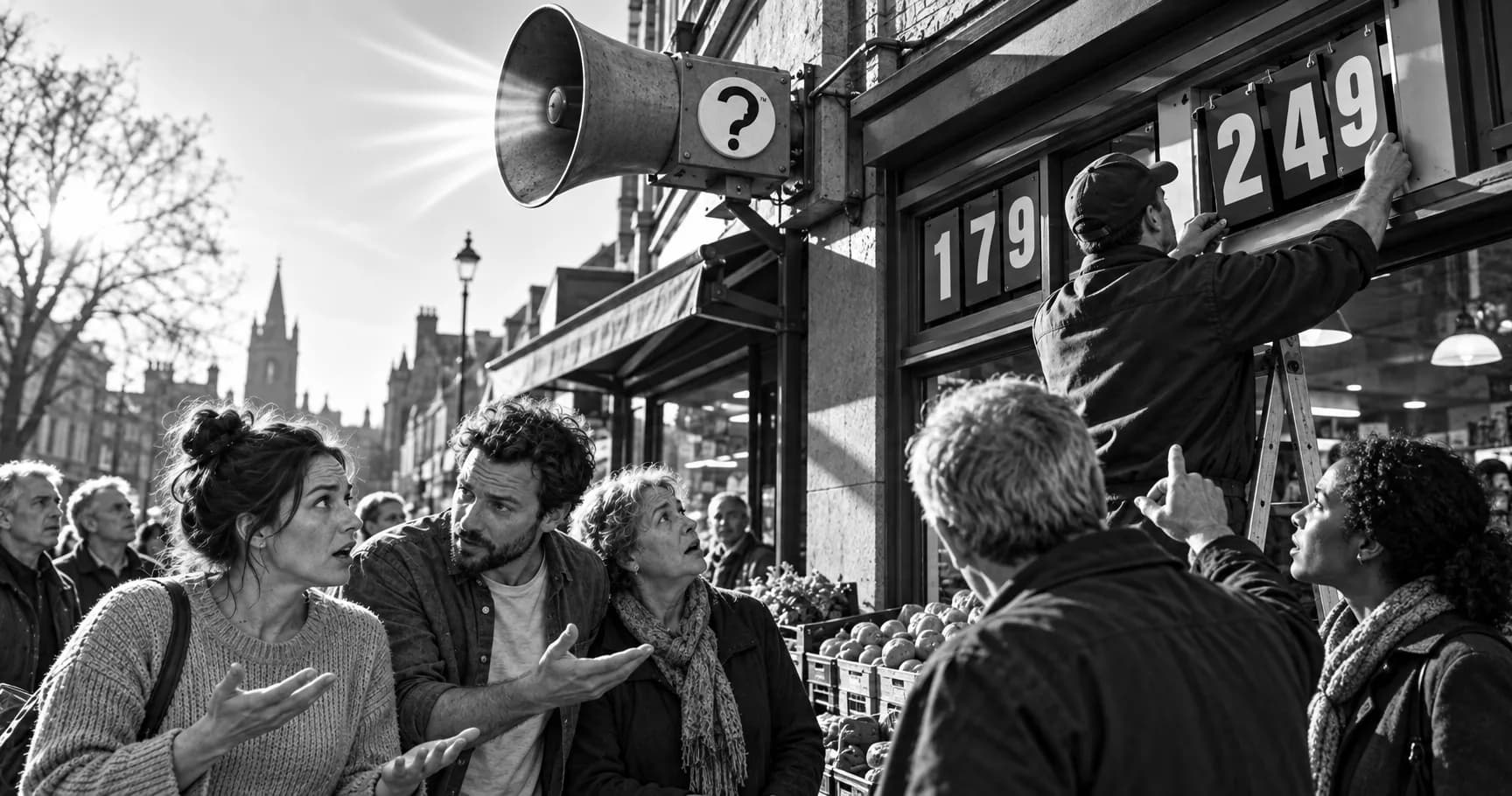
Two identical price rises, one announced and one emailed, produce different reactions. The difference is not what customers believe about the price. It is what they believe about each other.
Key takeaways
- Common knowledge is the recursive state in which each person knows the others know, and it is different from everyone simply knowing.
- Thomas, DeScioli, Haque and Pinker found more participants attempted risky coordination when payoffs were broadcast over a loudspeaker than when delivered by a messenger or revealed privately.
- Bolton, Warlop and Alba found consumers already believe selling prices are substantially above fair prices and overattribute differences to profit.
- Corrective interventions in that study, including historical prices and explanations of cost, were only modestly effective.
- The reading this article offers is that publicity changes what customers believe about each other rather than about the price, and the leap from a coordination game to a boycott is ours.
Two ways the same price rise can reach you. As an announcement, where you see the complaints and know everyone else has seen them. Or in an email addressed to you alone, subject line about updated terms, with no way of knowing whether anybody else noticed.
A thought experiment, not a case study. The money is identical. What differs is whether everybody knows that everybody knows.
What is common knowledge, exactly?
It is not the same as everyone knowing. It is recursive: I know the price went up, you know it went up, I know that you know, you know that I know, and so on upwards without limit. That state is what allows two people to act together without arranging it, because each can rely on the other having the same information and knowing that they can.
Kyle Thomas, Peter DeScioli, Omar Sultan Haque and Steven Pinker set this out in the Journal of Personality and Social Psychology in 2014, and their point of departure is that psychology has spent most of its attention on altruism, where one person bears a cost to help another. They were interested in the other case, mutualism, where two people can benefit each other at the same time, and in what makes that possible.
Worth noting the provenance. Kyle Thomas is the first author and the paper is credited to him here accordingly. Steven Pinker is the fourth author, and also the author of When Everyone Knows That Everyone Knows, the 2025 book this article started from, so the trade account and one of the primary experiments behind it share a contributor. That makes the chain easy to check, which is the only reason it is worth mentioning.
Does publicity change behaviour, or only feeling?
It does, and the experiment is elegant because the information is held constant and only its publicity varies.
Participants chose between working alone for a certain profit and working together for a potentially higher profit they would only receive if their partner made the same choice. The risk is obvious: commit to cooperating and be left alone, and you get nothing. The payoffs were then conveyed three different ways.
| How the payoffs were conveyed | What each person had | Attempts at risky coordination |
|---|---|---|
| Broadcast over a loudspeaker | Common knowledge | Most |
| Given to both by a messenger | Shared knowledge | Fewer |
| Revealed to each separately | Private knowledge | Fewer |
More participants attempted the risky coordination under the loudspeaker than under either of the others. The authors read this as evidence that people treat common knowledge as a distinct cognitive category, one that licenses acting together for mutual gain, and they extend the argument to public protest among other things.
That is the mechanism behind the streaming example. A quiet email gives every customer private knowledge. A post gives them common knowledge, and common knowledge is what makes a coordinated response feel available rather than futile.
That is the obvious commercial reading, and it runs into a second literature immediately.
Lisa Bolton, Luk Warlop and Joseph Alba published a series of studies in the Journal of Consumer Research in 2003 on perceptions of price unfairness, and the baseline they found is unflattering to everybody. Consumers are inclined to believe that the selling price of a good is substantially higher than its fair price. They are sensitive to reference points, past prices, competitor prices, cost of goods sold, but they underestimate the effects of inflation, overattribute price differences to profit, and fail to account for the full range of a vendor's costs.
Then the part that matters here. The corrective interventions they tested, supplying historical price information, explaining why the price differs, cueing the costs involved, were only modestly effective.
So the suspicion is already installed, and explaining yourself barely shifts it. A company that raises prices quietly is not avoiding the belief that it is gouging. It is avoiding the moment at which everybody discovers they hold that belief simultaneously.
Which of those two findings is doing the work?
This is where the two papers genuinely pull against each other, and we think the tension is the interesting part and not something to resolve away.
Bolton and colleagues found people sensitive to price information and still only modestly moved by attempts to correct the fairness judgment, which is not the same as information being inert and we should not have reached for that word. Thomas and colleagues found information decisive along one dimension, publicity, and did not test the dimension anybody usually argues about, content.
Read together they suggest something specific. What a public announcement changes is not what customers believe about the price. It changes what they believe about each other. The belief was there already; the loudspeaker tells them it is shared.
If that is right, then the standard corporate response to a pricing backlash, a detailed explanation of costs, is aimed at the wrong variable. It addresses content, which the 2003 evidence says is close to immovable, and leaves publicity untouched.
What this does not establish
The largest gap first, then two smaller ones.
The 2014 study is a laboratory coordination game with money and a partner. A boycott is thousands of strangers, no fixed payoff, and no partner whose choice yours depends on in any clean sense. The leap from one to the other is ours, and it is a leap. The authors invoke public protest themselves, which makes it a reasonable extension rather than a validated one.
The 2003 studies are more than twenty years old and predate the entire apparatus by which prices are now discussed in public. The finding that corrective information is only modestly effective was established in a world without the screenshot.
And neither paper is about a price rise. One is about coordination, one is about fairness perceptions. The article joining them is this one.
Where we land
Publicity is a lever separate from price, and it is the one most often pulled by accident.
Our reading is that publicity should matter for the reason the research suggests, and that this is a question about coordination, not about persuasion. Nobody is being convinced the price is fair. They are being prevented from finding out that their neighbour is also annoyed. Whether that translates into fewer cancellations we cannot tell you, because no study here measured a commercial outcome, and we would rather leave the mechanism standing on its own than borrow a result nobody has reported.
We would also say, and this is a judgment and not a finding, that a company relying on that is making a bet on opacity that gets harder every year, because any single customer with a screenshot can manufacture common knowledge that the company declined to create.
The test
Next time a price you pay goes up, notice how you found out.
If it arrived in an email addressed to you alone, ask whether your reaction would have been different had you seen it announced, with the complaints underneath it. If the answer is yes, then what moved you was not the two pounds, and it was not an argument about whether the two pounds was fair either.
It was finding out that you were not the only one.
That is worth knowing about yourself, because it works in both directions. It is the mechanism behind a justified consumer revolt and it is also the mechanism behind a pile-on about nothing, and from the inside those feel identical. The research does not help you tell them apart. It only tells you which lever was pulled.
Sources
Thomas, K. A., DeScioli, P., Haque, O. S., & Pinker, S. (2014). 'The psychology of coordination and common knowledge.' Journal of Personality and Social Psychology, 107(4), 657-676. Participants chose between working alone for a certain profit and working together for a potentially higher profit received only if the partner made the same choice; more participants attempted risky coordination under common knowledge, broadcast over a loudspeaker, than under shared knowledge conveyed by a messenger or private knowledge revealed separately. The authors extend the account to public protest among other phenomena. Verified at the published record 2026-10-01. doi:10.1037/a0037037
Bolton, L. E., Warlop, L., & Alba, J. W. (2003). 'Consumer perceptions of price (un)fairness.' Journal of Consumer Research, 29(4), 474-491. Consumers are inclined to believe the selling price of a good is substantially higher than its fair price; they are sensitive to past prices, competitor prices and cost of goods sold, but underestimate the effects of inflation, overattribute price differences to profit, and fail to account for the full range of vendor costs. Corrective interventions including historical price information, explaining price differences and cueing costs were only modestly effective. Verified at the published record 2026-10-01. doi:10.1086/346244
Pinker, S. (2025). When Everyone Knows That Everyone Knows. Read in full in this vault from 185 photographs across five batches, 2026-09-21, with a reliability audit recording it as the first book on this shelf whose apparatus can carry its own argument. Pinker is also the fourth author of the 2014 experiment above, so the book and its primary evidence share an author.
Chase, S., & Schlink, F. J. (1927). Your Money's Worth. Read in full in this vault, 2026-09-20. Cited for the argument that mass production severed the buyer from any means of knowing what they were buying, which is the ancestor of the suspicion Bolton and colleagues measured.
A note on the limits: the 2014 study is a laboratory coordination game with a partner and fixed payoffs, the 2003 studies predate the screenshot, and neither paper is about a price rise.