When Uncertain Discounts Work
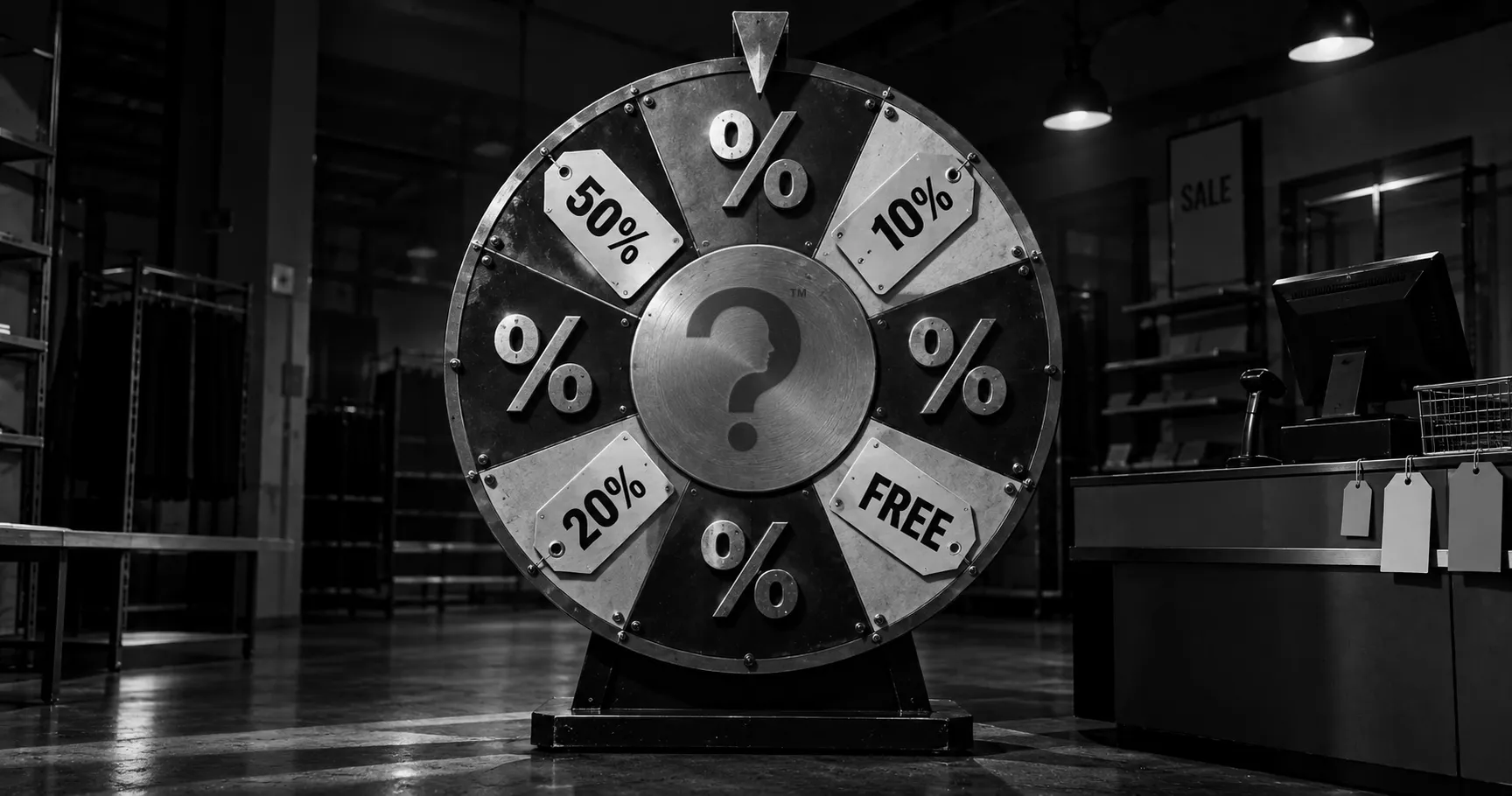
Write a sure discount in cash and a spin-the-wheel offer can lose its advantage, because uncertain discounts win mainly when the certain alternative looks small.
Key takeaways
- Celia Gaertig and Joseph Simmons (2025) ran five studies with 8,969 participants on uncertain discounts against sure discounts of equal value.
- The uncertain offer did better only when the sure discount was, or seemed, trivial.
- Shrinking the sure discount, showing a bigger one beside it, or writing it as a percentage all made the uncertain offer more appealing.
- The authors report the findings as inconsistent with the two standard explanations, diminishing sensitivity and overweighting small chances.
- Our rule for shoppers: convert every offer to cash before comparing.
Write ten per cent off a fifty pound jacket as five pounds off, and a spin-the-wheel offer next to it loses much of its pull. That is the practical upshot of the best recent evidence on uncertain discounts, and it runs against the usual story that shoppers simply enjoy a gamble.
The evidence comes from one large paper, so the confidence has limits, and they are set out at the end. The finding itself is easy to state. Uncertain discounts win when the certain alternative looks small, and how small it looks is often a matter of presentation rather than money.
Start with the rule
An uncertain discount is a chance at a bigger saving, say a one in ten chance of getting the item free, offered in place of a sure saving worth the same on average, such as ten per cent off. Past research suggests uncertain discounts often win that contest. A 2025 paper shows when they win, and the answer is about the sure option.
The rule we draw from it is simple: turn every discount into a cash figure before comparing. It's our inference rather than something the paper tested, so here is why we think it follows. The paper found that the uncertain offer gains ground when the sure discount looks small, and that writing a discount as a percentage makes it look smaller than the same amount in cash. A cash figure removes that framing. It helps less against a bigger number shown beside the sure discount, and not at all when the sure discount really is small, in which case the uncertain offer may simply be the better deal.
Put numbers on the jacket. Ten per cent off fifty pounds saves five pounds. A one in ten chance of getting the fifty pound jacket free is also worth five pounds on average, which is what economists call expected value: the size of the prize multiplied by the chance of winning it. On paper the two offers are identical. In practice people treat them differently, and how they treat them depends on how the sure five pounds is written.
So the question at the checkout isn't whether to take the gamble. It's whether the sure thing has been made to look worse than it is.
Look at the tests
Celia Gaertig and Joseph Simmons ran five studies with 8,969 participants, published in the Journal of Consumer Research. The authors note that past research suggests probabilistic promotions often beat sure discounts of equal value, and that two explanations had become standard. One is diminishing sensitivity: each extra pound of a gain feels worth a little less than the one before, so a big uncertain saving and a small sure one are not weighed in proportion. The other is that people overweight small chances, so a one in ten chance feels better than one in ten.
Their finding is a restriction. Uncertain discounts did better only when the sure discount was, or seemed, trivial. They showed it three ways:
- Make the sure discount actually smaller. The uncertain offer gained ground.
- Show a larger discount beside it. The sure discount felt smaller, and the uncertain offer gained ground again.
- Write it as a percentage instead of cash. Same money, smaller feel, and once more the uncertain offer gained.
Each test pushes the same lever from a different direction. The first changes the real size of the sure discount. The second leaves it alone but puts a bigger number next to it. The third leaves it alone again and only changes how it is written.
The third test is the telling one, because the chance, the prize and the average value were all held constant. Only the presentation of the sure discount changed, and preference moved anyway. Explanations about how people weigh probabilities struggle with that. The authors report their findings as inconsistent with both standard accounts and conclude that people's preference for uncertainty is more strongly tethered to how big the sure outcome looks than to the chance of winning.
The question at the checkout isn't whether to take the gamble. It's whether the sure thing has been made to look worse than it is.
| How the sure discount is shown | How it feels | Appeal of the uncertain offer |
|---|---|---|
| Cash amount, on its own | Larger | Lower |
| Percentage | Smaller | Higher |
| Beside a bigger discount | Smaller | Higher |
The percentage result also sits inside a wider body of work on price framing, which Richard Shotton surveys for marketers in The Illusion of Choice: the same amount, presented differently, is treated differently.
Ignore the lookalikes here
Several familiar tactics resemble uncertain discounts and rest on different evidence. A sale with a hidden end date is time-based scarcity, a separate literature. A lottery has no sure alternative at all, and the sure alternative is exactly what this research says does the work.
Mystery boxes belong in the same group. A box with unknown contents at a fixed price is an uncertain product, not an uncertain discount set against a certain one, and the 2025 findings say nothing about whether people overvalue it.
The closest lookalike is variable reward. Nir Eyal's Hooked builds a product model on unpredictable payoffs that keep people coming back over many encounters, a points scheme with surprise prizes being the familiar case. That is a claim about habit across weeks and months. A probabilistic discount at a single checkout is a one-off comparison between two offers, and nothing in the 2025 paper speaks to habit. Treating them as one mechanism would take a result about comparison and use it as evidence for conditioning.
The boundary matters in practice, because the common commercial version is a wheel shown on its own, with no flat discount in view. The paper compared uncertain offers with sure discounts of equal value. What it establishes is how the two trade off against each other, not how a wheel performs when there is no sure alternative to weigh it against.
Test before the wheel
For a retailer, the same mechanic can be a good idea and a bad one in the same shop on the same day, depending on the sure offer it is judged against. Next to a large saving stated in money, a wheel has little to add. Next to a modest percentage, or a sure discount sitting beside a bigger number, it has room to win.
So look at the sure offer first, in the exact form the customer will see it. If you do run uncertain discounts, check whether winning on preference also means winning on margin. The paper measured choices and willingness within studies, not revenue, and a promotion that wins a preference test can still lose money.
A practical way to check, our suggestion rather than anything the paper did, is to run the same promotion twice: once beside a sure discount written in money and once beside the same discount written as a percentage. If the wheel only wins in the second version, the paper's mechanism is probably at work in your shop, and the win is coming from how the alternative is written rather than from the wheel itself.
There is a fairness question too. A retailer who writes a generous cash saving as a modest-looking percentage in order to steer people towards a wheel is using the finding against customers. The same evidence can be used the other way, to make sure the sure option is presented at its true size, and a business that wants repeat custom has reasons to prefer that.
Two further gaps belong in any plan. Nobody has established how uncertain discounts behave when a customer meets the same offer every week, and the trivial-discount condition may not survive familiarity. And this is a single paper from 2025. Five studies in a strong journal make good initial evidence, and we have found no independent replication yet. The two explanations it challenges were themselves well established once, which is reason enough to hold the new account with some care. If a second team finds the same pattern with different products and shoppers, the case becomes much stronger. Until then it is the best explanation available, not a settled one.
A promotion calendar built around wheels deserves at least one honest test in your own shop first, with the sure discount written in money on one side and as a percentage on the other, before anyone decides the wheel is what customers wanted.
Common questions
When do uncertain discounts work better than sure ones?
In Gaertig and Simmons's five studies, only when the sure discount was or seemed trivial: when it was actually small, shown beside a larger discount, or written as a percentage rather than cash.
What is a probabilistic promotion?
An offer with an uncertain payoff, such as a one in ten chance of getting the item free, set against a sure discount worth the same on average, such as ten per cent off.
Do spin-the-wheel offers always beat flat discounts?
No. In these studies the uncertain offer only did better when the sure discount was small or made to look small. Next to a sizeable saving shown in money, it had little advantage.
Should I convert discounts to cash?
That's our suggestion, not a tested remedy. It removes the percentage framing the paper identified and may help against a bigger number shown alongside. Where the sure discount really is small, the uncertain offer may be the better choice anyway.
Sources
Gaertig, C., & Simmons, J. P. (2025). 'Why (and when) are uncertain price promotions more effective than equivalent sure discounts?' Journal of Consumer Research, 52(5), 1022-1042. Five studies, N = 8,969; probabilistic price promotions are more effective than equivalent sure discounts only when those sure discounts are or seem trivial, demonstrated when sure discounts are actually smaller, when made to feel smaller by presenting them alongside a larger discount, and when framed as a percentage rather than a dollar amount; the findings are inconsistent with diminishing sensitivity and with the overweighting of small probabilities, and preferences for uncertainty are more strongly tethered to the perceived size of the sure outcome than to the chance of winning. Verified at the published record 2026-10-06. doi:10.1093/jcr/ucaf036
Eyal, N. (2014). Hooked. Portfolio. Ch. 4, Variable Reward, pp. 95-133. Read in full by this publication, 2026-08-30. Cited to distinguish repeated-engagement conditioning from a single comparison at a checkout.
Shotton, R. (2023). The Illusion of Choice. Harriman House. Read in full by this publication, 2026-09-21, with a reliability audit. Cited for the framing literature the percentage manipulation belongs to.
A note on scope: outcomes are choice and willingness measures within studies, not margin or revenue; we have found no independent replication; and nobody has established how the effect behaves on repeat exposure. The convert-to-cash advice is this publication's inference, not a finding of the paper.