Why a Fixed Mistake Can Win You Over
A mistake handled well can leave you happier than no mistake at all. The research says it does not reliably bring you back, and the paradox appears mainly under four conditions.
Key takeaways
- A 2007 meta-analysis led by Celso Augusto de Matos found a well-handled failure raised satisfaction, but not repurchase intentions, word of mouth or company image.
- A 2008 study of more than 11,000 bank customer interviews found the paradox rare and small.
- In 2007 role-play experiments, the paradox was most likely when the failure was minor, first, a one-off and outside the company's control.
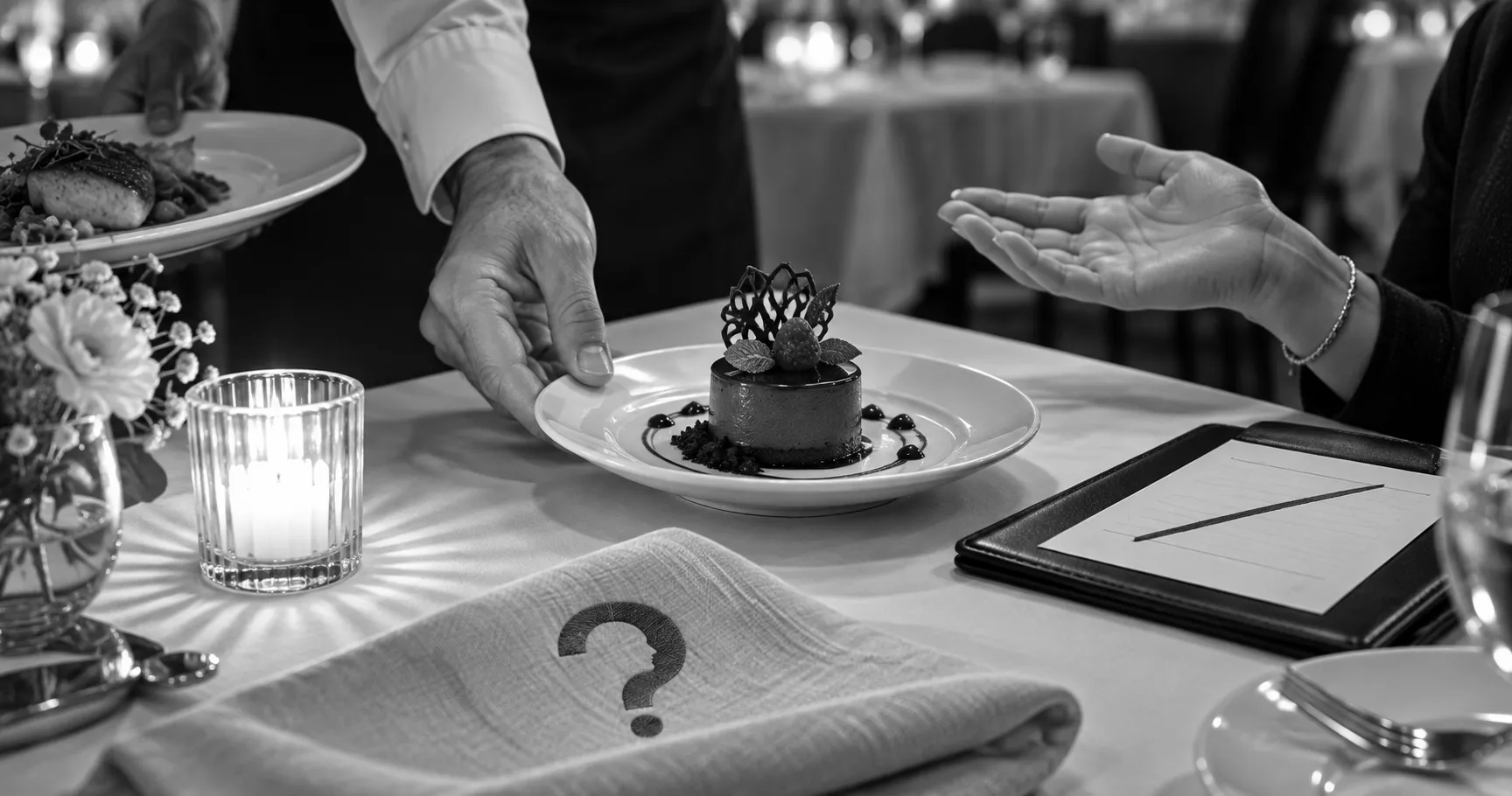
A restaurant brings the wrong dish. The waiter apologises, the right one arrives quickly, and a dessert you did not order comes with the bill crossed out. You leave happier than if nothing had gone wrong at all.
The experience has a name in service research: the service recovery paradox, the claim that a mistake handled well can leave a customer more satisfied than no mistake at all.
The idea sits close to the heart of Will Guidara's Unreasonable Hospitality, his 2022 account of building Eleven Madison Park in New York into one of the world's most celebrated restaurants. His thesis is that giving people more than they expect is what turns customers into loyal ones, and a mistake followed by a generous recovery is that thesis at its most dramatic. The research on the paradox suggests that the restaurant evening is real, and that it misleads.
Do customers really feel better after a mistake is fixed?
The best single summary of the evidence is a 2007 meta-analysis by Celso Augusto de Matos and colleagues in the Journal of Service Research. They pooled studies that compared customers who experienced a failure followed by a good recovery with customers who experienced no failure.
On satisfaction, the paradox held. Across the studies, customers who had a mistake well fixed reported higher satisfaction, on average, than customers whose service went smoothly.
On everything else that a business cares about, it did not. The effect on repurchase intentions was not significant. Nor was the effect on word of mouth, or on the customer's image of the company. Customers felt better about the encounter, without a significant rise in their intention to come back, their willingness to recommend the business or their view of it.
The meta-analysis also found that the result depended on how the studies were done. Whether the design was a one-off snapshot or followed people over time, whether the participants were students, and what kind of service was involved all changed the size of the effect on satisfaction. That is a warning that a good part of the paradox may live in the method.
There is a simple reason the satisfaction effect might appear more easily than the others. A common account of satisfaction holds that people judge an experience against what they expected. Once something has gone wrong, expectations drop, and an excellent recovery then clears a lower bar by a wide margin. The comparison that produces the glow is with the moment of failure, not with an evening in which nothing went wrong. That would lift a satisfaction score taken soon afterwards without changing the larger judgement a customer makes about whether to return.
Scenario studies, in which people imagine a failure and a recovery, may be well suited to capturing that momentary comparison, though the scenario experiments described below found no paradox at all, so method is not the whole story. Studies that follow real customers over time capture more of the larger judgement, which is one reason the meta-analysis found the design of a study changed what it showed.
What happens to customer loyalty after the apology is made?
A large field test points the same way. In 2008 Stefan Michel and Matthew Meuter analysed more than 11,000 customer interviews from a bank, based on real encounters rather than imagined ones. They found the paradox, but described it as a rare event, with differences that were statistically significant and not very large. They concluded that finding a paradox did not make poor service followed by an outstanding recovery a viable strategy.
An earlier set of experiments found no paradox at all. In 2000 Michael McCollough, Leonard Berry and Manjit Yadav ran two studies using scenarios, and reported that satisfaction was lower after a failure and recovery, even when the recovery was excellent, than when the service was simply error-free. Their conclusion was that companies do better in customers' eyes by avoiding failures than by recovering from them brilliantly.
Field data and scenario experiments have different weaknesses. A bank's interviews reflect real customers but cannot control what went wrong for each of them. A scenario controls everything but asks people to imagine their feelings. That both kinds of evidence find the paradox rare or absent is what gives the overall picture its weight.
The feeling after a well-fixed mistake is more generous than the decision about whether to return.
Taken together, the evidence points one way, though not neatly. The warm feeling after a well-handled mistake is real enough to show up in satisfaction scores. It is not reliable enough, or large enough, to change what people do next. And in some studies it does not appear at all.
When does a fixed mistake beat no mistake at all?
A 2007 study by Vincent Magnini and colleagues in the Journal of Services Marketing tried to pin down the conditions. Using role-play experiments, they found the paradox most likely when four things were true: the failure was not severe, the customer had not experienced a previous failure with the company, the customer saw the cause as a one-off rather than something likely to recur, and the customer believed the company had little control over what went wrong. Role-play experiments share the limits of scenario studies, so these conditions are best read as likely rather than proven.
Read together, those conditions describe a narrow case: a small, first-time, unlucky mistake. A wrong dish on a busy night fits. A delayed flight caused by a storm fits. A billing error that happens every quarter does not, and neither does a mistake the customer suspects the business could have prevented.
That is where the restaurant evening misleads. Our guess is that people remember the occasions that fitted the conditions, because those are the ones that ended well. They do not file the second wrong order, or the mistake that was handled politely but still spoiled the evening, under the same heading.
It also explains why Guidara's restaurant is a poor model for most businesses on this point. A place where staff have the time, budget and training to turn every error into a memorable gesture is unusual. Most businesses fixing an error are doing so at a counter, on the phone or by email, where the recovery can at best restore what was lost. The conditions behind the restaurant's gestures are worth naming: a landmark room, staff trained to improvise, and prices that make a generous gesture affordable. None of those are present in most service encounters.
Should any business plan around getting a second chance?
The research supports one lesson: a good recovery protects satisfaction, and preventing the mistake protects everything else.
For businesses, that means two separate budgets of effort. One is for getting it right the first time, since even an excellent recovery did not reliably bring customers back. The other is for fixing errors well when they happen, which keeps a bad moment from becoming a lost customer. The paradox is a reason to do the second well, not a reason to relax about the first. A first mistake handled generously can be forgiven. A second one is evidence of a pattern, and the conditions for the paradox disappear.
Customers can use the research too. If you leave somewhere delighted by how a mistake was handled, notice whether you would actually go back, or whether you simply enjoyed the apology. The studies suggest those are different things, and that the feeling is more generous than the decision. A good apology is worth enjoying. It is just not the same as a reason to return.
Our reading is that Guidara is right about generosity, but that readers who take his recovery stories as a strategy are leaning on the weakest part of the evidence. A gesture after a mistake can make a customer feel cared for. It does not, on the evidence, make them more loyal than a customer whose evening simply went well, and a business that plans around the apology is planning for the wrong evening.
Common questions
What is the service recovery paradox?
The claim that a customer who experiences a mistake followed by an excellent recovery ends up more satisfied than one who experienced no mistake. A 2007 meta-analysis found support for it on satisfaction but not on repurchase intentions, word of mouth or the company's image.
Does fixing a mistake well make customers more loyal?
Not reliably. In the 2007 meta-analysis the effect on repurchase intentions was not significant, and a 2008 study of more than 11,000 bank customer interviews found the paradox rare and small.
When does the recovery paradox happen?
In 2007 role-play experiments, it was most likely when the failure was minor, it was the customer's first, its cause seemed unlikely to recur, and the company seemed to have little control over it.
Sources
de Matos, C. A., Henrique, J. L., & Rossi, C. A. V. (2007). 'Service recovery paradox: a meta-analysis.' Journal of Service Research, 10(1), 60-77. doi:10.1177/1094670507303012. Abstract read: significant positive effect on satisfaction; nonsignificant on repurchase intentions, word of mouth and corporate image; design, subject and service category moderated the satisfaction effect.
Michel, S., & Meuter, M. L. (2008). 'The service recovery paradox: true but overrated?' International Journal of Service Industry Management, 19(4), 441-457. doi:10.1108/09564230810891897. More than 11,000 customer interviews in banking.
Magnini, V. P., Ford, J. B., Markowski, E. P., & Honeycutt, E. D. (2007). 'The service recovery paradox: justifiable theory or smoldering myth?' Journal of Services Marketing, 21(3), 213-225. doi:10.1108/08876040710746561.
McCollough, M. A., Berry, L. L., & Yadav, M. S. (2000). 'An empirical investigation of customer satisfaction after service failure and recovery.' Journal of Service Research, 3(2), 121-137. doi:10.1177/109467050032002.
Guidara, W. (2022). Unreasonable Hospitality: The Remarkable Power of Giving People More Than They Expect. Optimism Press. Read in full by this publication, with a reliability audit.
A note on scope: the expectation account of why satisfaction rises is offered as a reading. Effect sizes from the meta-analysis were not printed because the full text was not read.