Why Paying by Card Feels Cheaper
Forty years of studies suggest, though not unanimously, paying by card loosens the link between money and what it buys. The effect is real, smaller than the first auctions suggested, and smaller in recent studies.
Key takeaways
- In 2001 Drazen Prelec and Duncan Simester found that people told to pay by credit card were willing to pay more, by as much as 100 per cent.
- Raghubir and Srivastava's 2008 studies found people spent more with scrip and gift certificates than with cash, so the effect does not depend on plastic.
- Liu and Dewitte's four studies in 2021, with 692 participants, did not reproduce the card effect on willingness to pay or basket value.
- A 2024 meta-analysis of 392 effect sizes from 71 papers found a small cashless effect that has weakened over time.
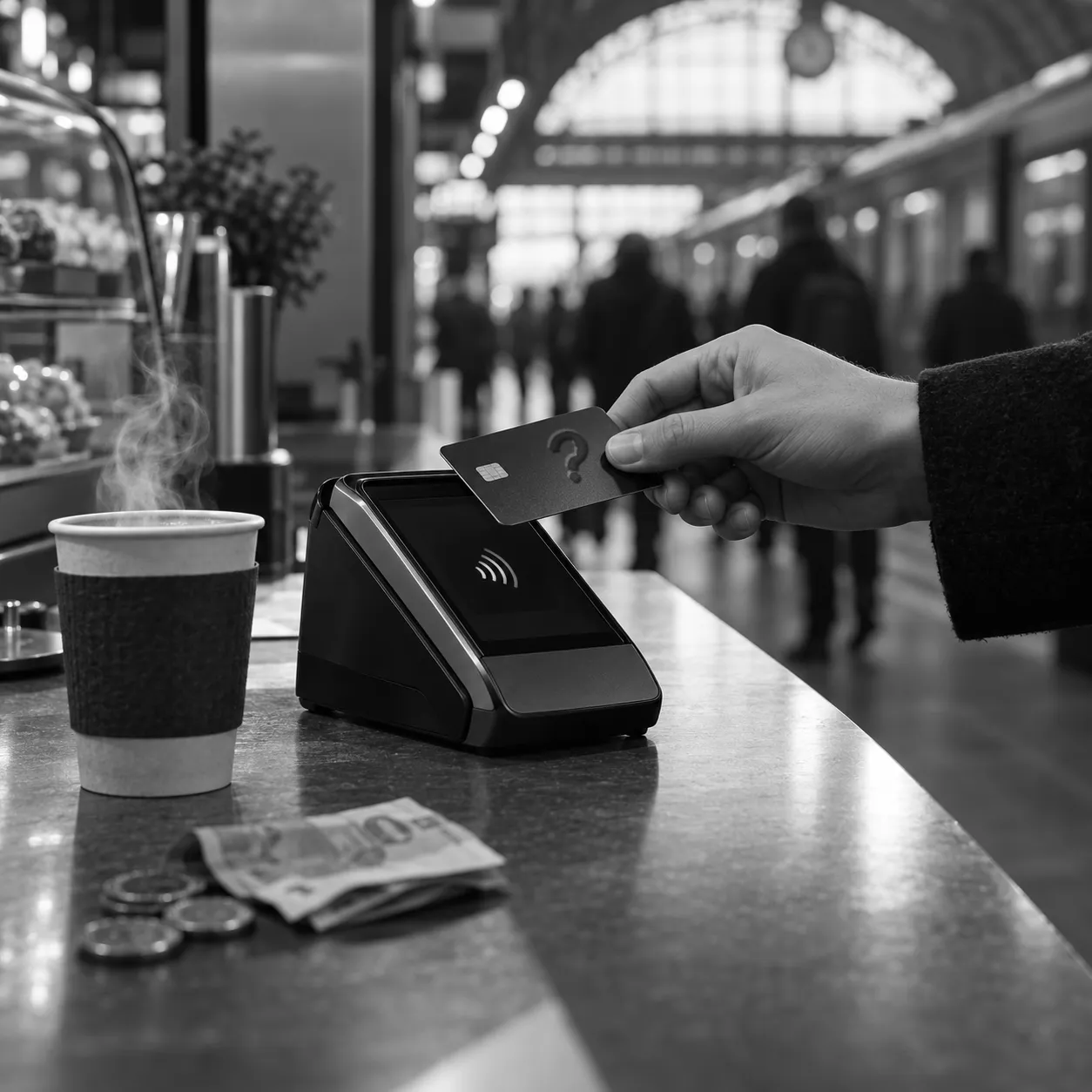
A coffee and a croissant come to £6.40 at a station café. The woman at the front of the queue taps her phone on the reader and is gone. The man behind her counts out coins and breaks a note. They bought the same breakfast, and only one of them felt the money leave. That difference, the sense that paying by card costs less than handing over cash, has been studied for forty years. The record is more interesting than the slogan it produced, because the effect turned out to be real, smaller than first reported, and fading.
1986, a credit card logo sitting on the table
The modern story starts with Richard Feinberg, whose 1986 paper in the Journal of Consumer Research asked whether things linked with spending can prompt spending on their own. Across four experiments and one further study, credit card cues were either present or absent when people had a chance to spend. With the cues in view, spending was more likely, faster or larger. Feinberg read this as conditioning: a card is paired with buying so often that the sight of one starts to work as a signal to buy.
Four years later, James Hunt and three colleagues tested and extended Feinberg's idea and reported in Psychological Reports that a card's presence had no overall effect on spending. Their abstract offers two explanations and does not choose between them. Their sample was small and made up largely of women from working-class backgrounds, which might account for the difference. Or the conditioning account itself might be the problem.
1998, the pain of paying finally gets a name
The idea that gave the field its vocabulary came from Drazen Prelec and George Loewenstein, in a 1998 paper in Marketing Science called "The red and the black", about the mental accounting people apply to savings and debt. In standard economics, the cost of a purchase is whatever else the money could have bought. Prelec and Loewenstein argued that people also feel an immediate pain of paying, which can spoil the pleasure of the thing bought. Their example is a taxi meter, whose ticking takes the shine off the ride.
Their second idea was coupling, the degree to which using something brings payment to mind, and paying brings the thing to mind. Cash, they wrote, produces tight coupling, while credit cards tend to weaken it. On this account paying by card feels lighter because the money and the purchase sit further apart in the mind. The same model predicts that people will prefer flat-rate deals, such as unlimited internet access for a fixed monthly fee, even when that means paying more for the same use.
They tested the model with surveys and a choice exercise that set it against a standard economic account. It fitted the answers better for 60 per cent of participants, against 29 per cent for the standard account. That supports a way of thinking about payment, and leaves open whether people paying by card actually spend more.
2001 to 2008, a card premium in the lab
The direct test came in 2001, when Prelec and Duncan Simester published "Always leave home without it" in Marketing Letters. Participants took part in genuine transactions for items of potentially high value, some told to pay by credit card and some by cash. Those told they would be paying by card were willing to pay more, and the abstract puts the effect as large as 100 per cent. The authors also argued that it was unlikely to arise solely because card payers had more money available to them.
In 2008 Priya Raghubir and Joydeep Srivastava published four studies in the Journal of Experimental Psychology: Applied under the title "Monopoly money". The first found people willing to spend more when a credit card logo was present than when it was absent, an echo of Feinberg. The second found that the gap shrank when people estimated their expenses item by item rather than as a single sum. The third and fourth removed the card altogether. People spent more using scrip, a kind of stored-value certificate, than cash of the same face value, and a gap between cash and gift certificates shrank when the difference between them was made more obvious.
Read together, the 2008 studies move the explanation away from plastic. What seems to matter is how clearly a payment registers as money leaving. A logo, a voucher or a certificate can each loosen that link, and a reminder can tighten it again.
What seems to matter is how clearly a payment registers as money leaving.
2021 to 2024, the effect meets much bigger samples
In 2021 Sachin Banker, Prelec and two colleagues put shoppers in a brain scanner, in a study published in Scientific Reports. Participants bought real items picked to suit their interests, using either their own credit card or their own cash. Paying by card went with strong activity in the striatum, part of the brain's reward network, which began when the card cue appeared and did not track the price. For cash, reward activity only weakly predicted buying, and only for cheaper items.
The authors set out two explanations. Cards might release the brakes by dulling the pain of paying, or they might step on the gas by making spending more attractive. Their data leaned towards the second. The study analysed 27 people, the prices in the task were low, and the authors describe the work as exploratory, so it suggests a mechanism without settling one.
The same year, Yunxin Liu and Siegfried Dewitte tried to repeat the basic effect in four studies with 692 participants in total, three online and one in a laboratory. Across all four, paying by card did not raise willingness to pay or the value of the shopping basket, and their online studies found no effect for mobile payment either. Their own pooling of earlier work still found the card effect, but weaker over the years and dependent on where the data had been collected.
The largest synthesis so far, by Lachlan Schomburgk and colleagues in the Journal of Retailing in 2024, pooled 392 effect sizes from 71 papers. It found what the authors call a small but significant cashless effect. They found no evidence that features of the payment method itself changed it. The setting did: the effect was stronger for conspicuous purchases, weaker for spending on others, stronger in periods of economic growth, and weaker over time.
| Year | Study | What it found |
|---|---|---|
| 1986 | Feinberg, five studies | Card cues raised spending |
| 1990 | Hunt and colleagues | No overall effect |
| 2001 | Prelec and Simester | Card payers willing to pay up to 100 per cent more |
| 2008 | Raghubir and Srivastava | Logos, scrip and vouchers raised spending |
| 2021 | Liu and Dewitte, 692 people | No card effect |
| 2024 | Schomburgk and colleagues, 71 papers | Small effect, weaker over time |
Where we land on paying by card, and why
The idea reached a wide marketing audience through books such as The Choice Factory, Richard Shotton's 2018 collection of 25 biases. Its sixth chapter, The Pain of Payment, at pages 41 to 47, argues that handing over money hurts, that the more tangible the payment the more it hurts, and that anything which distances buyers from their money lowers their sensitivity to price. It leads with the Prelec and Simester auction, reporting, on the book's account, average bids for basketball tickets of $61 by card against $29 in cash among 64 MBA students. It also raises the obvious objection, that card payers had more money to hand, and answers it from the paper's own design.
The chapter adds an experiment of Shotton's own, run with Gabrielle Hobday outside coffee shops in central London. People were asked what they had spent and how, then asked to show the receipt. Cash payers overstated their spending by 9 per cent and contactless payers understated it by 5 per cent. No sample size is given, and the result has not appeared in a journal. Its advice to brands follows from the claim: adopt cashless payment and gift cards, drop currency symbols from menus, and use charm pricing.
The pooled evidence is the better guide. It supports the direction the book describes, a real tendency for paying by card to raise spending, and it puts the size well below what the early auctions suggested. A doubling of willingness to pay came from one study. The later replications and the 71-paper synthesis describe a small effect that depends on what is being bought and when, and that has shrunk over time.
The later replications and the 71-paper synthesis describe a small effect that depends on what is being bought and when, and that has shrunk as cards became ordinary.
It is possible that the shrinking effect reflects habit rather than a weak original finding. People who rarely touch cash may feel little difference between the two methods, while people who still count coins may feel the pain Prelec and Loewenstein described as sharply as ever. Liu and Dewitte's finding that the effect depends on where the data were collected is consistent with that, though nobody has yet shown it directly.
For anyone who wants the old friction back, the evidence offers one modest lever, drawn from a laboratory estimate. Make the money visible again by adding up each item before you pay, which is the move that shrank the cash and card gap in Raghubir and Srivastava's second study in 2008.
Common questions
Do people really spend more when paying by card?
On average, slightly. A 2024 meta-analysis by Lachlan Schomburgk and colleagues pooled 392 effect sizes from 71 papers and found a small but significant cashless effect. It was stronger for conspicuous purchases and has weakened over time. Liu and Dewitte's four studies in 2021, with 692 participants, found no reliable card effect in any of their four studies.
What is the pain of paying?
It is the immediate discomfort of parting with money, a term set out by Drazen Prelec and George Loewenstein in 1998. They argued it can spoil the pleasure of a purchase, and that cash links payment to purchase tightly while credit cards loosen the link, which they called coupling.
Does paying by phone have the same effect as a card?
The evidence is thin. Liu and Dewitte in 2021 found no effect of mobile payment on spending in three online studies, though their laboratory study did find a difference between mobile payment and cash in the value of the basket. The 2024 meta-analysis found no evidence that features of the payment method changed the cashless effect.
Sources
Feinberg, R. A. (1986). “Credit cards as spending facilitating stimuli: a conditioning interpretation.” Journal of Consumer Research, 13(3), 348-356. doi:10.1086/209074. Abstract read: four experiments and one additional study; credit card cues increased the probability, speed or magnitude of spending; interpreted as conditioning.
Hunt, J. M., Chatterjee, A., Florsheim, R. A., & Kernan, J. B. (1990). “Credit cards as spending-facilitating stimuli: a test and extension of Feinberg’s conditioning hypothesis.” Psychological Reports, 67(1), 323-330. doi:10.2466/pr0.1990.67.1.323. Abstract read: no main effect of a credit card's presence; small sample, mostly women from working-class backgrounds; methodological or nomological explanations offered.
Prelec, D., & Loewenstein, G. (1998). “The red and the black: mental accounting of savings and debt.” Marketing Science, 17(1), 4-28. doi:10.1287/mksc.17.1.4. Abstract read: pain of paying, taxi meter example, coupling (credit cards weaken it, cash produces tight coupling), flat-rate preference; model fitted better for 60 per cent of subjects against 29 per cent for discounting.
Prelec, D., & Simester, D. (2001). “Always leave home without it: a further investigation of the credit-card effect on willingness to pay.” Marketing Letters, 12(1), 5-12. doi:10.1023/A:1008196717017. Abstract read: genuine transactions of potentially high value; willingness to pay increased when instructed to use a credit card; effect up to 100 per cent; unlikely to arise solely from liquidity constraints. The $61 and $29 bids and the 64 MBA students are as reported in The Choice Factory, p. 41; the paper's full text was not accessible.
Raghubir, P., & Srivastava, J. (2008). “Monopoly money: the effect of payment coupling and form on spending behavior.” Journal of Experimental Psychology: Applied, 14(3), 213-225. doi:10.1037/1076-898X.14.3.213. Abstract read: four studies; logo present versus absent; decomposition attenuates the credit card effect; scrip versus cash; gift certificates versus cash attenuated by salience manipulations.
Banker, S., Dunfield, D., Huang, A., & Prelec, D. (2021). “Neural mechanisms of credit card spending.” Scientific Reports, 11, 4070. doi:10.1038/s41598-021-83488-3. Full text read (PMC7892835): fMRI shopping task with personal credit card or own cash; 28 completed, 27 analysed; striatal activation at credit card cue onset, unrelated to price; reward activity weakly predicted cash purchases, only for cheaper items; offers from $1.50 to $18; described as exploratory.
Liu, Y., & Dewitte, S. (2021). “A replication study of the credit card effect on spending behavior and an extension to mobile payments.” Journal of Retailing and Consumer Services, 60, 102472. doi:10.1016/j.jretconser.2021.102472. Abstract read: four studies (three online, one lab), total n = 692; no replication of the credit card effect on WTP or basket value; their meta-analysis found the effect but weaker through the years and contingent on location; mobile payment no effect online, a mobile versus cash difference on basket value in the lab study.
Schomburgk, L., Belli, A., & Hoffmann, A. O. I. (2024). “Less cash, more splash? A meta-analysis on the cashless effect.” Journal of Retailing, 100(3), 382-403. doi:10.1016/j.jretai.2024.05.003. Abstract read: 392 effect sizes from 71 papers; small but significant cashless effect; no evidence payment method features influence it; stronger in conspicuous consumption, weaker in pro-social consumption, stronger in economic growth, weakened over time.
Shotton, R. (2018). The Choice Factory: 25 behavioural biases that influence what we buy. Harriman House. Read in full by this publication, with a reliability audit. Bias 6, The Pain of Payment, pp. 41 to 47. The coffee-shop intercept with Gabrielle Hobday (pp. 42 to 43) gives no sample size and is unpublished.