Why Your Name on a Product Works
Your name is one of the few sounds that can break through a noisy room, and the finding has been tested again across more than 60 years. What it buys a brand is real, brief and more modest than the campaigns built on it.
Key takeaways
- In Neville Moray's 1959 study about a third of listeners heard their own name in a message they had been told to ignore; replications found 34.6 per cent in 1995 and 29 per cent in 2021.
- In a 2018 field experiment by Navdeep Sahni and colleagues, adding the recipient's name to an email subject line raised opens from 9.05 to 10.80 per cent and sales leads from 0.39 to 0.51 per cent.
- Five experiments by Miguel Brendl and colleagues in 2005 found people more likely to choose a brand whose name began with letters from their own.
- In a 2001 study, 65 per cent of participants with low working memory capacity heard their name in an ignored message, against 20 per cent with high capacity.
- Uri Simonsohn's 2011 reanalysis concluded that archival claims about names steering marriage, job and moving decisions were most likely caused by confounds and reverse causality.
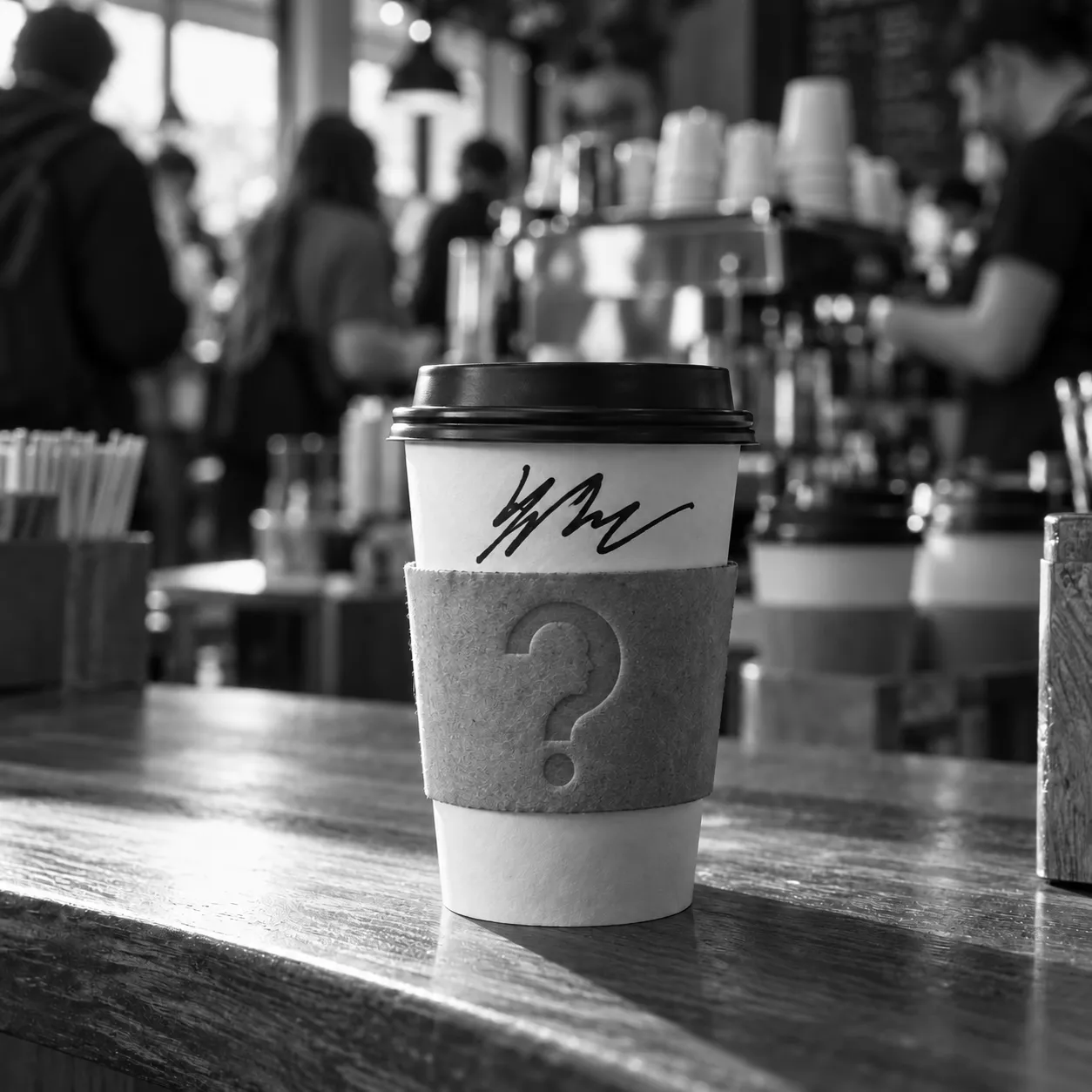
The barista asks for your name, writes it on the side of a paper cup in black marker, and calls it out across a crowded café. You catch it over the grinder, the music and a dozen conversations, though you were not listening for anything in particular and had half forgotten you were waiting.
Richard Shotton builds a chapter of The Choice Factory on that moment. Bias 24, the cocktail party effect (pages 159 to 165), argues that personal relevance is the filter deciding what reaches conscious attention, which makes relevance an advertiser's best route to being noticed. The book credits Colin Cherry of Imperial College with the discovery in the early 1950s and tells it as Cherry hearing his own name across a party. The chapter's practical advice then goes somewhere less obvious: localise a message rather than print the customer's name on it.
The case for putting your name on a product rests on three bodies of evidence. One is a laboratory finding about attention that has now been reproduced across more than 60 years. Another is research on why people like what resembles them. The third is a large field experiment on email. At full strength it is a good case, and its limits concern size and duration rather than whether the effect exists.
How does a name cut through a noisy room?
Cherry's 1953 paper, in the Journal of the Acoustical Society of America, was about listening, not names. He played two messages at once, one to each ear, and asked people to repeat one of them aloud as they heard it, a task psychologists call shadowing. Listeners nearly always noticed when the voice in the ignored ear changed from a man's to a woman's. They could not report a word of what it had said, and when the ignored message switched from English to German, one listener assumed it had been English throughout. Cherry used the phrase "cocktail party problem" for the puzzle of following one speaker among many.
The name came six years later. Neville Moray, using the same shadowing task in 1959, found that almost nothing from the ignored ear got through; even a short list of words played repeatedly left no trace on a later recognition test. His abstract ends: "The only stimulus so far found that will break through this barrier is the subject's own name." About a third of his participants heard theirs.
The finding rested on that one small study for decades. In 1995 Noelle Wood and Nelson Cowan, at the University of Missouri, repeated it with tighter controls on 34 undergraduates. Of those whose names were played, 34.6 per cent recalled hearing their name in the channel they had been told to ignore, almost exactly Moray's figure. Only those participants showed a measurable shift of attention, stumbling in their shadowing for the two words that followed the name.
In 2021 Jan Philipp Röer and Cowan ran a preregistered replication, meaning the method and analysis were fixed in public before any data were collected. Twenty-nine per cent of participants noticed their own name, and they too made more shadowing errors around it. Unexpected words planted in the ignored message were rarely noticed at all. Hearing your name, it seems, has a status that mere surprise does not.
Why do people like what carries their name?
Attention is one route. Liking is another, and it goes deeper than the sound of a name. In 1985 Jozef Nuttin asked people to circle their preferred letter from a series of pairs, without telling them that some letters came from their own names. They favoured the letters of their own name. He called it the name letter effect, and a 1990 follow-up with colleagues found it in Flemish, Hungarian and Thai children, and in two alphabets.
In 2005 Miguel Brendl and colleagues carried the idea into shopping. Across five experiments, published in the Journal of Consumer Research, people were more likely to choose a brand when its name began with letters from their own. The pull was stronger when a matching need was active, such as thirst when choosing a drink. The authors called it name letter branding, a pull on choice that operates below awareness.
The same logic, scaled up from letters to a whole name, sits behind Coca-Cola's Share a Coke campaign. According to the company's own history, it began in Australia in 2011 and replaced the brand name on bottles and cans with the 150 most popular first names in the country, and has since run in more than 70 countries. The sales results published since are company and trade claims rather than independent studies, so they are not repeated here.
Does a name in the subject line pay?
The clearest evidence that a name changes behaviour, and not only liking, comes from email. In a 2018 paper in Marketing Science, Navdeep Sahni and colleagues reported randomised field experiments with three companies that sent marketing emails to millions of people. In the main experiment, adding the recipient's name to the subject line raised the open rate from 9.05 to 10.80 per cent, a rise of about a fifth. Sales leads rose from 0.39 to 0.51 per cent, and unsubscribes fell from 1.2 to 1.0 per cent.
Experiments at the other companies, with goals ranging from winning new customers to keeping past buyers, showed comparable effects. The name told the reader nothing about the product. The authors' explanation is that personal content increases the effort people put into processing the rest of the message, which sits close to the cocktail party effect, moved from the ear to the inbox.
Taken together, the case at full strength runs like this. Your name is one of the few stimuli that can break through an attentional filter, for about a third of listeners. People lean towards things that resemble them, down to the letters. And in a large randomised trial, a name in a subject line moved opens, leads and unsubscribes in the direction a marketer wants.
Your name is one of the few stimuli that reliably break through an attentional filter.
Where does the effect stop working?
The limits come from the same studies, read in full rather than in summary.
1. Most people do not hear it. In every shadowing study, most participants missed their own name: 33 per cent heard it in 1959, 34.6 per cent in 1995 and 29 per cent in 2021. In 2001 Andrew Conway, Cowan and Michael Bunting tested 40 undergraduates and found that 65 per cent of those with low working memory capacity, the amount a person can hold in mind and use at once, heard their name, against 20 per cent of those with high capacity. The authors read this as difficulty blocking out distraction.
2. The capture is brief. In the 1995 study the disruption lasted for the two words after the name. Your name buys a moment of attention, and what a brand does with that moment is a separate question.
3. Some of the name evidence did not survive. Uri Simonsohn's 2011 paper in the Journal of Personality and Social Psychology reanalysed archival studies claiming that people choose spouses, towns and jobs with names like their own. He reproduced the patterns and concluded that they were most likely caused by cohort, geographic and ethnic confounds, together with reverse causality. The Choice Factory relates this result itself, in Bias 22 (page 148). The critique concerned big life decisions in population records and did not test laboratory brand choices like those in the 2005 study.
4. People can object to it. The book's own survey of 304 people (page 160) found that 36 per cent called personalised banner ads completely unacceptable, against 23 per cent for a personalised letter. It is a single survey with a one-line method, but it suggests the cost depends on where your name appears. In the email trial, where the name sat in a subject line, unsubscribes fell.
The book's response to that survey is to localise. In its own test with 500 people (page 162), 10 per cent judged an energy tariff great value when the saving was framed for their city, against 4 per cent for the national version. The chapter also passes on a warning, from one of the people Shotton interviewed, that brands need mass exposure as well as personal messages.
What does the evidence actually support?
The own-name effect on attention has a strong replication record: three studies across six decades with similar rates, the latest preregistered, and a fourth showing who is most likely to notice. The email trial is large, randomised and run in the field. Against that sit Simonsohn's archival reanalysis, the working memory result, and the book's survey of objections, which together say the effect is real but partial and brief.
The case for the effect holds, with its size kept in proportion. A name is a reliable way to earn a brief moment of attention from a minority of people, and in the email evidence a name in the subject line produced measurable action. The weak point is that one paper, with three companies, carries most of the commercial evidence, and a name used everywhere may lose the novelty that made it work. That second point is a reasonable worry that no study we cite has measured.
A name reaches about a third of people who are not listening, for a moment. People lean towards brands that share their letters when a relevant need is active, and a name in an email subject line lifted opens by about a fifth and leads by about 31 per cent in one large trial. The archival claims about names steering big life choices have weak support, and the book's own survey suggests a name in the wrong place can feel intrusive, so your name works best on a product as a brief, well-placed signal of relevance rather than as a substitute for anything the message itself has to say.
Common questions
What is the cocktail party effect?
It is the ability to follow one voice among many while still catching something personally important, such as your name, from a conversation you were ignoring. Colin Cherry described the listening problem in 1953, and Neville Moray showed in 1959 that about a third of listeners heard their own name in an ignored message.
Does putting a customer's name in an email work?
In one large test, yes. Navdeep Sahni and colleagues reported in 2018 that adding the recipient's name to a subject line raised opens from 9.05 to 10.80 per cent and sales leads from 0.39 to 0.51 per cent, while unsubscribes fell. Comparable effects appeared at two other companies.
Do people prefer brands that share their initials?
In laboratory experiments, they can. Miguel Brendl and colleagues found in 2005, across five experiments, that people were more likely to choose a brand whose name began with letters from their own, especially when a relevant need such as thirst was active. Archival claims about bigger life choices are weaker.
Why do some people notice their name and others miss it?
A 2001 study by Andrew Conway, Nelson Cowan and Michael Bunting found that 65 per cent of people with low working memory capacity heard their name in an ignored message, against 20 per cent with high capacity, suggesting that noticing your name reflects difficulty blocking out distraction.
Sources
Shotton, R. (2018). The Choice Factory: 25 behavioural biases that influence what we buy. Harriman House. Read in full by this publication, with a reliability audit. Bias 24, Cocktail Party Effect, pp. 159 to 165 (Cherry credited p. 159; survey of 304 people p. 160; regional energy tariff test with 500 people p. 162); Simonsohn related in Bias 22, p. 148.
Cherry, E. C. (1953). “Some experiments on the recognition of speech, with one and with two ears.” Journal of the Acoustical Society of America, 25, 975-979. doi:10.1121/1.1907229. Full text read: shadowing with two messages; listeners detected a male-to-female voice change in the rejected ear but could not identify words; on a switch to German one listener assumed English; the paper uses the phrase 'cocktail party problem'. Author affiliation Imperial College, University of London, and MIT.
Moray, N. (1959). “Attention in dichotic listening: affective cues and the influence of instructions.” Quarterly Journal of Experimental Psychology, 11(1), 56-60. doi:10.1080/17470215908416289. Abstract read: almost nothing from the rejected message is retained, even a repeated short word list; abstract ends 'The only stimulus so far found that will break through this barrier is the subject's own name.' The 33 per cent detection rate is as reported in Conway, Cowan and Bunting (2001), full text read.
Wood, N., & Cowan, N. (1995). “The cocktail party phenomenon revisited: how frequent are attention shifts to one’s name in an irrelevant auditory channel?” Journal of Experimental Psychology: Learning, Memory, and Cognition, 21(1), 255-260. doi:10.1037/0278-7393.21.1.255. Abstract read (PubMed 7876773): 34 undergraduates; 34.6 per cent recalled hearing their name; attention shifts only for the two items following the name.
Röer, J. P., & Cowan, N. (2021). “A preregistered replication and extension of the cocktail party phenomenon: one’s name captures attention, unexpected words do not.” Journal of Experimental Psychology: Learning, Memory, and Cognition, 47(2), 234-242. doi:10.1037/xlm0000874. Abstract read (PubMed 32833466): 29 per cent noticed their own name; more shadowing errors around it; low-span participants more likely to notice; unexpected words rarely detected.
Conway, A. R. A., Cowan, N., & Bunting, M. F. (2001). “The cocktail party phenomenon revisited: the importance of working memory capacity.” Psychonomic Bulletin & Review, 8(2), 331-335. doi:10.3758/BF03196169. Full text read: 40 undergraduates, 20 high-span and 20 low-span; 65 per cent of low-span and 20 per cent of high-span detected their name.
Nuttin, J. M. (1985). “Narcissism beyond Gestalt and awareness: the name letter effect.” European Journal of Social Psychology, 15(3), 353-361. doi:10.1002/ejsp.2420150309. Abstract not reachable (publisher page blocked); method and result read in secondary descriptions (Wikipedia, Name-letter effect) and in the abstract of the follow-up, Hoorens, V., Nuttin, J. M., Erdélyi Herman, I., & Pavakanun, U. (1990), European Journal of Social Psychology, 20(3), 181-205, doi:10.1002/ejsp.2420200302, abstract read: name letter effect in Flemish, Hungarian and Thai children and in Thai and Roman alphabets.
Brendl, C. M., Chattopadhyay, A., Pelham, B. W., & Carvallo, M. (2005). “Name letter branding: valence transfers when product specific needs are active.” Journal of Consumer Research, 32(3), 405-415. doi:10.1086/497552. Abstract read: in five experiments respondents were more likely to choose a brand whose name started with letters from their names; effect strengthened when a product-specific need, such as the need to drink, was active.
Simonsohn, U. (2011). “Spurious? Name similarity effects (implicit egotism) in marriage, job, and moving decisions.” Journal of Personality and Social Psychology, 101(1), 1-24. doi:10.1037/a0021990. Abstract read (PubMed 21299311): replicates the original findings but shows they are most likely caused by cohort, geographic and ethnic confounds and reverse causality.
Sahni, N. S., Wheeler, S. C., & Chintagunta, P. (2018). “Personalization in email marketing: the role of noninformative advertising content.” Marketing Science, 37(2), 236-258. doi:10.1287/mksc.2017.1066. Abstract read: randomised field experiments with three companies and millions of recipients; recipient's name in subject line raised opens from 9.05 to 10.80 per cent (20 per cent), leads from 0.39 to 0.51 per cent (31 per cent), and cut unsubscribes from 1.2 to 1.0 per cent (17 per cent).
The Coca-Cola Company (2014, 25 September). 'How a campaign got its start down under.' coca-colacompany.com. Full text read: launched in Australia in 2011 with the 150 most popular names; company states it has run in more than 70 countries. Sales figures on the page are company claims and are not used.