Childhood and Society
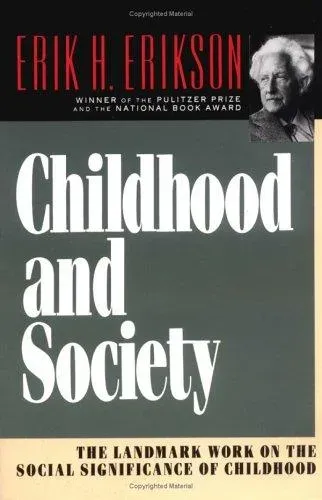
Erikson's book sets out the social significance of childhood, arguing that the growth of the individual and the course of historical change are interdependent. Combining the insights of clinical psychoanalysis with a new approach to cultural anthropology, it deals with the relationships between childhood training and cultural accomplishment, analysing the infantile and the mature, and the modern and the archaic elements in human motivation. Erikson's case is that what a society does with its children, in the ordinary business of feeding, handling, training and instruction, is continuous with what that society goes on to accomplish, so that childhood cannot be treated as a private matter belonging to the family alone. From this the book introduces the ideas with which Erikson's name is most closely associated, the eight stages of psychosocial development and the concept of an identity crisis. His treatment of identity, growth and the life cycle carries psychoanalytic developmental thinking beyond the early years and across a whole life, and underlies much of the subsequent understanding of human development. Childhood and Society was the first of Erikson's books to become popular, and Margaret Mead called it a rare and living combination of European and American thought.
Written from the publisher description, W. W. Norton.
What this vault takes from it
Reliability
Not audited here. 1 note in this vault draws on it.