Creating the Twentieth Century
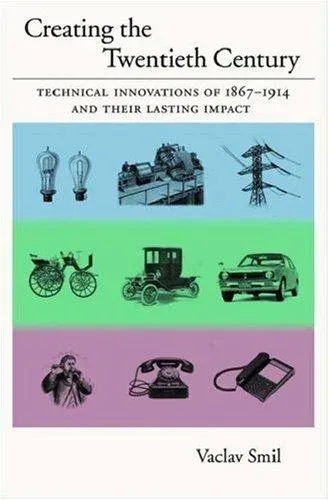
Smil argues that the period between 1867 and 1914 is the greatest watershed in human history since settled agricultural societies emerged, because it is when an expansive civilisation founded on the synergy of fuels, science and technical innovation was born. The eighteen seventies brought dynamite, the telephone, photographic film and the first light bulbs. The eighteen eighties, which he calls the astonishing decade, brought electricity-generating plants, electric motors, steam turbines, the gramophone, cars, aluminium production, air-filled rubber tyres and prestressed concrete. After 1900 came the first aeroplanes, tractors, radio signals, plastics, neon lights and assembly line production. The book is a systematic interdisciplinary account of this outpouring of European and American intellect and of its epochal consequences. Smil organises it around four fundamental classes of epoch-making innovation, the formation, diffusion and standardisation of electric systems, the invention and rapid adoption of internal combustion engines, an unprecedented pace of new chemical syntheses and material substitutions, and the birth of a new information age. He closes by evaluating the lasting impact of these advances on the twentieth century, namely the creation of high-energy societies engaged in mass production aimed at improving standards of living.
Written from the catalogue listing at Blackwell's reproducing the Oxford University Press publisher's synopsis.
What this vault takes from it
Nothing yet. The title appears in the registry because it has been mentioned in passing, and no concept or person note currently draws on it.
Reliability
Not audited here. 0 notes in this vault draw on it.