Descartes' Error
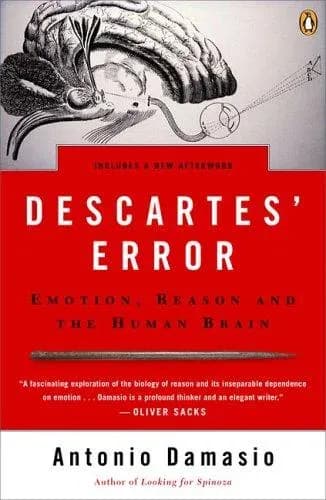
Descartes' Error, subtitled emotion, reason, and the human brain, describes the physiology of rational thought and decision-making, and how those faculties could have evolved through natural selection. The error of the title is Rene Descartes' separation of mind from body, the dualism that treats reasoning as something that happens apart from the flesh. Damasio argues this is wrong, because reasoning requires the guidance of emotions and feelings conveyed from the body, and rationality without emotional input does not function well. Written for the general reader, the book uses the railroad accident that injured Phineas Gage in 1848 as its reference case, and sets alongside it data from a range of modern clinical patients, enumerating the damage to thinking that appears when feeling and reasoning become anatomically decoupled. It analyses clinical evidence contrasting emotional changes after frontal lobe damage with changes following injury to lower regions such as the medulla and to anterior areas including the anterior cingulate. From this Damasio advances the somatic marker hypothesis, a proposed mechanism by which emotions guide or bias behaviour and decision-making. The conclusion is that emotion is not an interference with good reasoning but a condition of it.
Written from the encyclopaedia article on the book at Wikipedia.
What this vault takes from it
Nothing yet. The title appears in the registry because it has been mentioned in passing, and no concept or person note currently draws on it.
Reliability
Not audited here. 0 notes in this vault draw on it.