Manufacturing Consent
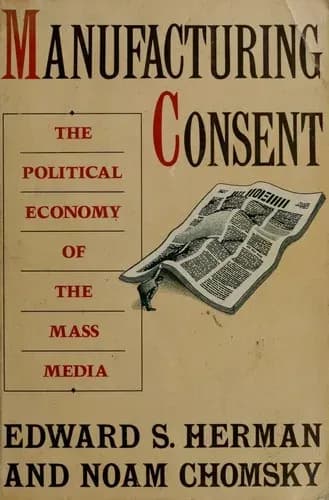
Manufacturing Consent: The Political Economy of the Mass Media is a book of nineteen eighty-eight by Edward S. Herman and Noam Chomsky. Its argument is that the mass media of the United States are powerful ideological institutions which carry out a propaganda function supporting the established order, and that they do so without overt coercion, through market forces, internalised assumptions and self-censorship. The authors set this out as a propaganda model in which news passes through five filters that shape what is reported. The filters are the size, ownership and profit orientation of the dominant media companies; dependence on advertising revenue, which the authors say hands advertisers a licence to decide which outlets are viable; reliance on official and corporate sources, whose subsidised supply of information buys them privileged access while other sources must struggle for it; flak, meaning the organised negative response that complaints, legal action and campaigns can direct at a news organisation; and anticommunism as a control mechanism that marginalises dissent. Herman wrote the preface and the opening chapters and Chomsky the later ones, and the argument is carried through detailed case studies of the reporting of American foreign policy. The title derives from a phrase Walter Lippmann used in Public Opinion. A revised edition of two thousand and two takes account of later developments, including the end of the Soviet Union.
Written from the wikipedia article on the book.
What this vault takes from it
Reliability
Not audited here. 1 note in this vault draws on it.