The Central Italian Painters of the Renaissance
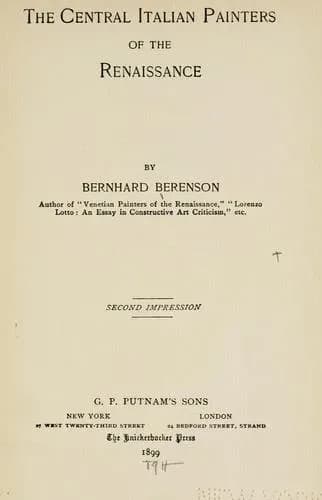
The Central Italian Painters of the Renaissance is one of Bernard Berenson's four short volumes on Italian painting, published in eighteen ninety-seven, a year after the Florentine volume and a decade before the North Italian one. Each consists of a compact essay followed by a list of works attributed to the painters discussed, and the series was carried about as a traveller's guide as much as it was read as criticism. Berenson's general position is that the worth of painting lies in what he calls life enhancement, the capacity of a picture to give the beholder a heightened sense of vitality, and he analyses that capacity into a small number of qualities a painter may command. The Florentine essay had rested on tactile values, the power of a painted form to convey bulk and the sense of touch, and on movement. Here he adds space composition, by which he means the extension of composition beyond height and breadth into depth, so that the beholder is given the feeling of the space itself and not only of the objects standing in it, and he presents this as the particular property of the central Italian schools. He also sets out the distinction between decoration and illustration, illustration being everything in a work of art that is not decorative. The essay opens with the Sienese painters and gives considerable room to the earliest of them, among them Duccio and Simone Martini.
Written from the public record for the book.
What this vault takes from it
Reliability
Not audited here. 1 note in this vault draws on it.