The Interpretation of Dreams
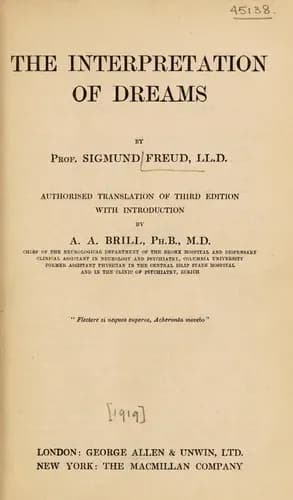
The Interpretation of Dreams argues that dreams can be read, and that reading them opens a route into the unconscious mind. Freud's central claim is that a dream represents the disguised fulfilment of an unconscious wish, and that the strange surface of a dream, its manifest content, is a transformation of a hidden latent content lying beneath it. Between the two sits what Freud calls the dream work, the set of operations that condense, displace and dramatise the underlying material so that it can reach consciousness without disturbing the sleeper. Because the inhibitions of waking life are relaxed in sleep, tensions find expression there, and the analyst who learns the special language of dreams gains access to conflicts a patient cannot report directly. Freud gives particular weight to childhood experience, treating early wishes as a persistent source of the material that dreams rework. The argument is carried by dozens of case histories and by close analyses of actual dreams, many of them his own, so that the method is demonstrated rather than merely asserted. Freud presents the result not as a curiosity about sleep but as a general psychology of the mind, and as a technique of practical value in the treatment of neuroses.
Written from the publisher description, Basic Books.
What this vault takes from it
Reliability
Not audited here. 1 note in this vault draws on it.
People
- Sigmund Freud