The Measure of Man
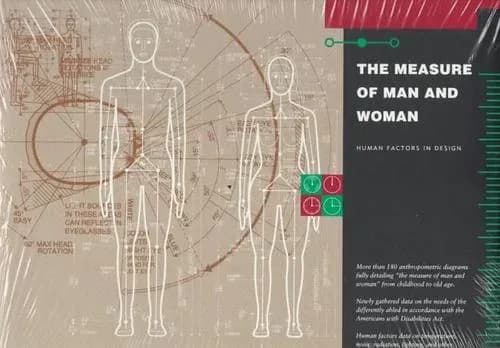
Henry Dreyfuss assembled The Measure of Man as a working reference rather than an argument in prose, and the subtitle, Human Factors in Design, states its case. The sheets collect anthropometric data for standing adult men, adult women and children, each dimension given at a low, middle and high percentile so that a design can be checked against the spread of a population rather than a single imaginary average. The implicit claim is that designers guess at the body, guess badly, and should let measurement replace intuition. Charts set out the visual field, the angles at which displays can be read, and the places where glare and reflection interfere. Others give forces, travel and clearances for pedals, knobs, cranks, hand wheels, push buttons and toggle switches. Reading accuracy is compared across circular, semi-circular, horizontal and vertical dials, so that the choice of instrument follows evidence rather than taste. Further sheets cover seating for work, travel and rest, console and knee-hole dimensions, passage and hatch sizes for clothed and equipped bodies, bicycle postures, tolerance zones for noise and temperature, and three body types, closing with a cut-out articulating template of the average man.
Written from the full text of the scan at the Internet Archive.
What this vault takes from it
Nothing yet. The title appears in the registry because it has been mentioned in passing, and no concept or person note currently draws on it.
Reliability
Not audited here. 0 notes in this vault draw on it.