Verbal Behavior
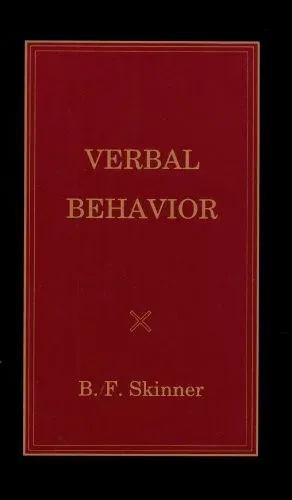
Skinner extends to language the laboratory-based principles of selection by consequences, and argues that what people say, write, gesture and think can be treated as behaviour like any other. His central move is functional rather than formal: rather than asking what a sentence means or how it is structured, he asks what conditions occasion an utterance and what consequences maintain it. Verbal behaviour, he holds, requires a separate analysis because it does not operate on the physical environment directly but through the behaviour of other people, who have been trained by a verbal community to respond to it and so to reinforce it. On that basis he sets out a classification of verbal operants using terminology invented for the analysis, including the mand, which is controlled by deprivation or aversive stimulation and specifies its own reinforcement, the tact, controlled by an object or event in the environment, the echoic, and the autoclitic, which is verbal behaviour about the speaker's own verbal behaviour, together with carefully defined uses of ordinary terms such as audience. From these units and their combined control Skinner builds accounts of composition, grammar, thinking and the behaviour of the listener.
Written from the publisher description, B. F. Skinner Foundation.
What this vault takes from it
Reliability
Not audited here. 6 notes in this vault draw on it.
People
- B.F. Skinner
- David Palmer
- Kenneth MacCorquodale
- Noam Chomsky