Attention Restoration Theory
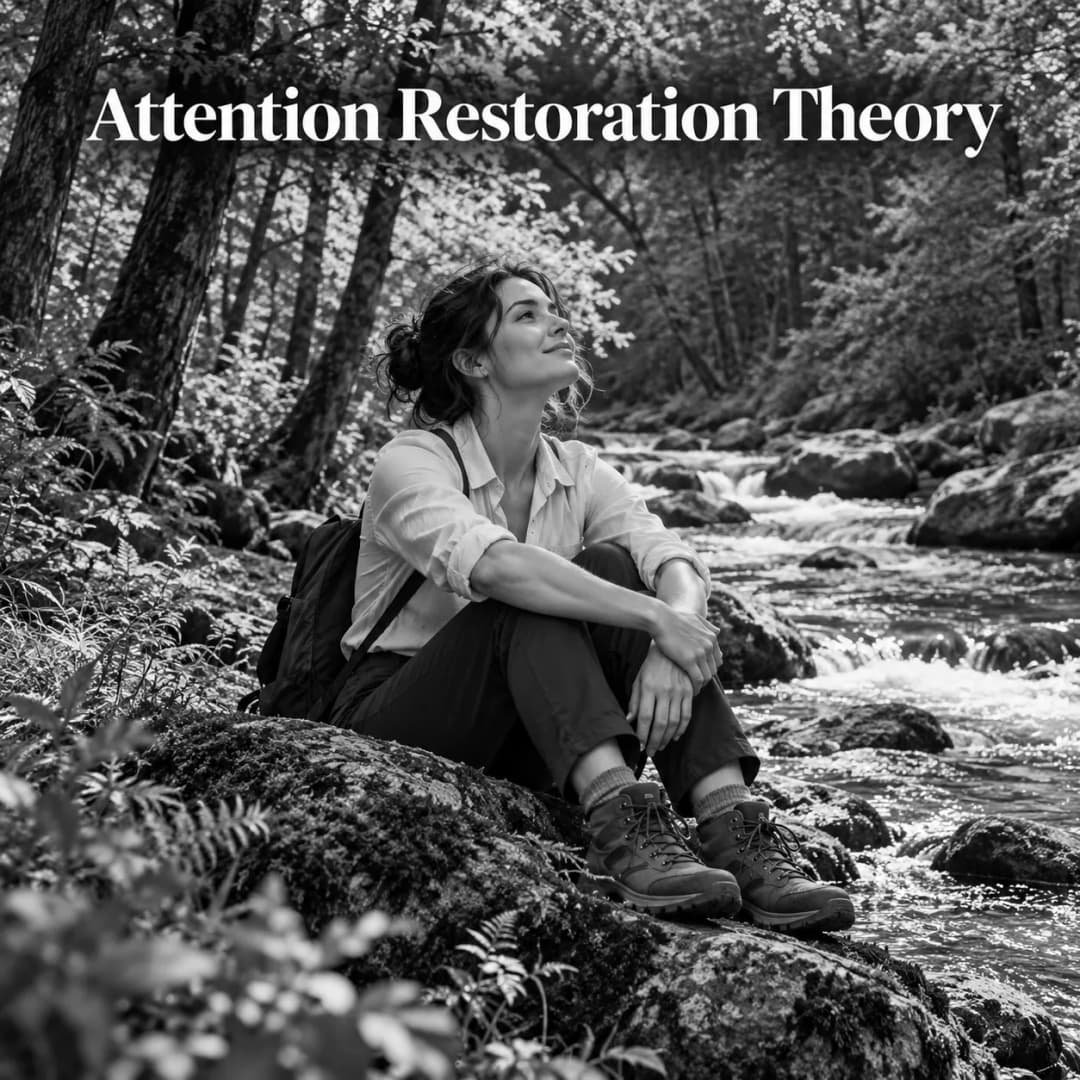
Attention restoration theory holds that directed attention is a resource spent down over the course of a day, and that natural environments replenish it in a way built environments do not. It was formalised by Rachel Kaplan and Stephen Kaplan. The theory splits into two claims that are doing very differently, and the vault treated them as one until 2026. Nature reliably makes people feel better. It does not reliably make them think better.
What it is
The mechanism the Kaplans proposed is a distinction between two modes. Directed attention is effortful, goal-driven and depleting. Soft fascination is involuntary and cheap, the kind of holding that a moving stream or a canopy of leaves does without being asked, and because it runs on the automatic system it leaves the directed system alone rather than asking it to work harder somewhere prettier.
The older line of evidence is Roger Ulrich's 1984 study, in which surgical patients recovering in rooms with a window view of trees needed less pain medication and left hospital sooner than patients facing a brick wall. The sample was small and the finding has been conceptually replicated since. It is a claim about recovery rather than about attention.
The study the attention half of the theory rests on is Marc Berman, John Jonides and Stephen Kaplan's 2008 experiment, in which participants walked either a wooded arboretum path or a busy city centre and were retested on working memory. Several books in this library now build on that one modest experiment, which is a good illustration of why cross-source corroboration is not independent evidence.
In effect
The theory is the counterweight to almost everything else in this library about capturing and holding attention, and it is the intellectual basis for the idea that an environment can be designed to give attention back rather than take it.
The evidence record is uneven and worth setting out plainly. Gazzaley and Rosen grade nature exposure the weakest available grade on their own evidence ladder, a reasonable hypothesis, and cite Kaplan to his own 1995 and 1992 texts rather than to a secondary summary, which is correct practice. Two sentences later they encourage nature exposure for its many benefits on health and mind, and those health benefits are not cited anywhere in the section.
Cal Newport gives the arboretum study at pp. 146 to 148 with no sample size anywhere, credits the theory correctly to Rachel Kaplan and Stephen Kaplan and names Berman as lead author of the 2008 test. He then raises the obvious confound against his own headline study in the running text rather than in a note, that a park walk lifts mood and mood drives performance, and reports that the researchers found mood changed but did not account for the attention effect. Raising the objection to your own best study is a move most of this shelf never makes. The qualification is that he then generalises the finding to conversation, music and playing with your children, none of which was tested.
Zelana Montminy handles the theory well in the prose and badly in the box. She credits Stephen and Rachel Kaplan by name, distinguishes bottom-up from top-down attention, uses soft fascination as the mechanism, and notes that the theory remains the subject of continued research. Her summary box then states that two hours a week in nature can significantly improve focus and attention. The two hours figure comes from White and colleagues in 2019, which is a real and large study of health and wellbeing, cross-sectional and based on recalled contact with nature over the previous week. No study in the chapter measured focus or attention as a function of two hours a week.
What it does not say
It does not say that a walk in the woods restores attention. A direct replication combined with a meta-analysis of fourteen studies, using the executive component of the Attention Network Test, found that nature exposure does not reliably restore executive attention. That is the specific claim the second experiment of the 2008 study rested on, and the claim the popular accounts use. Ohly and colleagues find mixed evidence and heavy heterogeneity of outcome measures across the theory as a whole.
It does not say nothing happens. The mood and affect claims are in better shape, and a 2023 study found walking in nature improved affect but not cognition, which is the pattern across this literature generally. Ulrich's hospital window finding is a separate line of evidence about recovery and is not touched by the attention replication failure.
It does not support the two hours a week figure as an attention claim. That number is usable for wellbeing only, attributed to White and colleagues, with the cross-sectional self-report design stated. It may not be attached to attention, focus or cognition.
It does not license the numbers from the arboretum study either. The advantage of up to twenty per cent that circulates comes from an underpowered experiment whose second part used twelve young adults and has failed to replicate. Use the idea, drop the figures.
It does not establish that directed attention and willpower are the same quantity. Newport equates the two in a footnote at p. 147, concedes some debate and says it does not matter. That welds one contested construct onto another, and the open question left unaddressed is whether either resource depletes at all.
The evolutionary explanation for soft fascination is flagged by the authors who offer it as presumably owing to evolutionary factors, with no citation. Keep it as narrative, not mechanism.
Sources
- Kaplan, S. (1995). Journal of Environmental Psychology. The theory in the Kaplans' own words. This vault records the origin as Rachel Kaplan and Stephen Kaplan, 1989, at medium confidence.
- Ulrich, R. S. (1984). Surgical patients with a window view of trees needed less pain medication and were discharged sooner.
- Berman, M. G., Jonides, J., & Kaplan, S. (2008). Psychological Science, 19(12), 1207-1212. Experiment 2 used 12 young adults, confirmed against the paper. The Experiment 1 sample could not be verified and no figure for it is printed here.
- Crossan, C., & Salmoni, A. (2021). Environment and Behavior, 53(3). A conceptual replication of Experiment 2 with 31 adults, plus a meta-analysis of 14 studies and 612 participants using the executive portion of the Attention Network Test. Simulated nature did not reliably restore executive attention.
- Ohly, H., et al. (2016). Mixed evidence and heavy heterogeneity of outcome measures across the theory.
- White, M. P., et al. (2019). Scientific Reports, 9. The two-hours-a-week figure. Health and wellbeing outcomes, cross-sectional, self-reported exposure.
- Kaplan, S., & Berman, M. G. (2010). Perspectives on Psychological Science, 5.
- Secondary accounts consulted: Alter, A. Drunk Tank Pink. Carr, N. The Shallows. Montminy, Z. Finding Focus. Gazzaley, A., & Rosen, L. D. The Distracted Mind, ch. 10. Newport, C. Deep Work, pp. 146 to 148.