Base-Rate Neglect
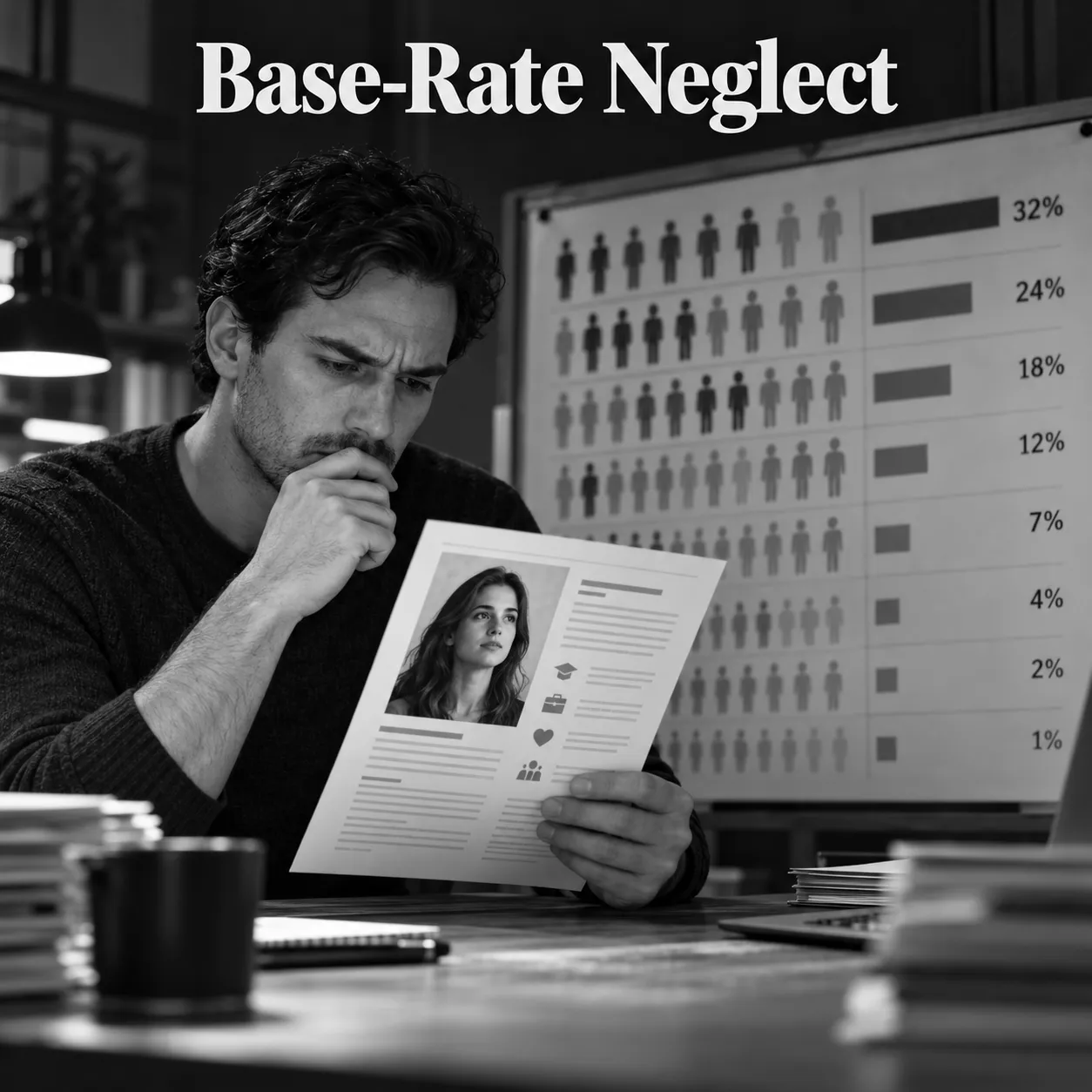
Base-rate neglect is ignoring how common a category is once you have a description of the particular case in front of you. Told that Tom W is tidy and fond of order, people rank him into graduate programmes by how well he matches the stereotype and stop asking how many students are actually enrolled in each field. The founding study is Daniel Kahneman and Amos Tversky's, in 1973, with Kahneman as first author. The finding is real and the blanket version of it is not, and unusually the author did the downgrading himself.
What it is
The Tom W demonstration runs like this. Participants read a stale personality sketch and rank nine fields of graduate specialisation. The prediction study used 114 graduate students in psychology at three major universities, and the finding is the comparison rather than the ranking: rankings by probability did not differ from rankings by similarity. People asked for a probability produced a resemblance ranking instead, which is representativeness caught in the act.
The most useful refinement is Icek Ajzen's, because it says when the neglect happens rather than asserting that it always does. Statistical base rates are facts about a population that say nothing about the individual case, and these get neglected. Causal base rates change your picture of the individual case, because they imply something about the situation the person is in, and these get used.
The cab problem is the demonstration, and it belongs to Tversky and Kahneman rather than to Ajzen. In the statistical version a town's two cab companies are described by their share of the fleet, and the common answer simply restates the witness's reliability with the base rate thrown away. In the causal version the same number is presented as a fact about accident involvement rather than fleet size, so it becomes information about how cabs behave, and judgements move close to the Bayesian answer. Same arithmetic, different answers, and the difference is whether the number tells a story.
In effect
Used carefully, the distinction is the part with the most practical carry. If you want a population fact to be used rather than discarded, present it as something that acts on the case in front of the person rather than as a statistic about a class they belong to.
The evidence record is genuine support with strong moderators. Neglect of stated base rates reproduces reliably with text problems, and its size shrinks with causal framing, with frequency formats, and with base rates people have experienced rather than been told. That is the core of Jonathan Koehler's reconsideration of the fallacy, and it is why the status here is mixed rather than robust.
What it does not say
It does not say that people ignore base rates. Kahneman states at p. 152 of Thinking, Fast and Slow that the original claim was too strong and that explicitly stated base rates do influence people. That is the author retracting the strong version of his own result, and any use of this concept that omits the correction states the claim more strongly than the record supports.
It does not stand unchallenged. Gerd Gigerenzer's frequency-format argument is the standing external objection, and Thinking, Fast and Slow confines it to the endnotes and never names it in the body.
It does not establish why the neglect happens. Kahneman's evidence that it is system two laziness rather than ignorance is the frowning study at p. 152, and facial feedback has a troubled replication record. The 2016 multi-lab registered replication found no effect for the pen-in-mouth paradigm, while the Many Smiles Collaboration in 2022 found small effects for some manipulations. Neither tested frowning and Tom W directly. The finding about base rates is not thereby wrong, but the explanation offered for it is unsupported.
Sources
- Kahneman, D., & Tversky, A. (1973). "On the psychology of prediction." Psychological Review, 80(4), 237-251. The Tom W study. First author Kahneman. Abstract consulted here rather than the full text; the figure of 114 psychology graduate students is consistent with secondary accounts but was not read in the paper itself.
- Ajzen, I. (1977). "Intuitive theories of events and the effects of base-rate information on prediction." Journal of Personality and Social Psychology, 35(5), 303-314. The statistical versus causal distinction. Abstract consulted here.
- The cab problem is a separate Tversky and Kahneman demonstration from the causal schemas work of about 1980.
- Koehler, J. J. (1996). "The base rate fallacy reconsidered." Behavioral and Brain Sciences, 19(1), 1-53. The moderator record. Consulted through secondary sources.
- Wagenmakers, E.-J., et al. (2016). Registered replication report, pen-in-mouth facial feedback, no effect. Coles, N. A., et al. (2022). Nature Human Behaviour. Small effects for some manipulations. Both consulted through secondary sources.
- Kahneman, D. Thinking, Fast and Slow, ch. 14, including p. 152 for the author's own correction. Gigerenzer's critique is present in that book's endnotes and absent from its body.