Blind Notes
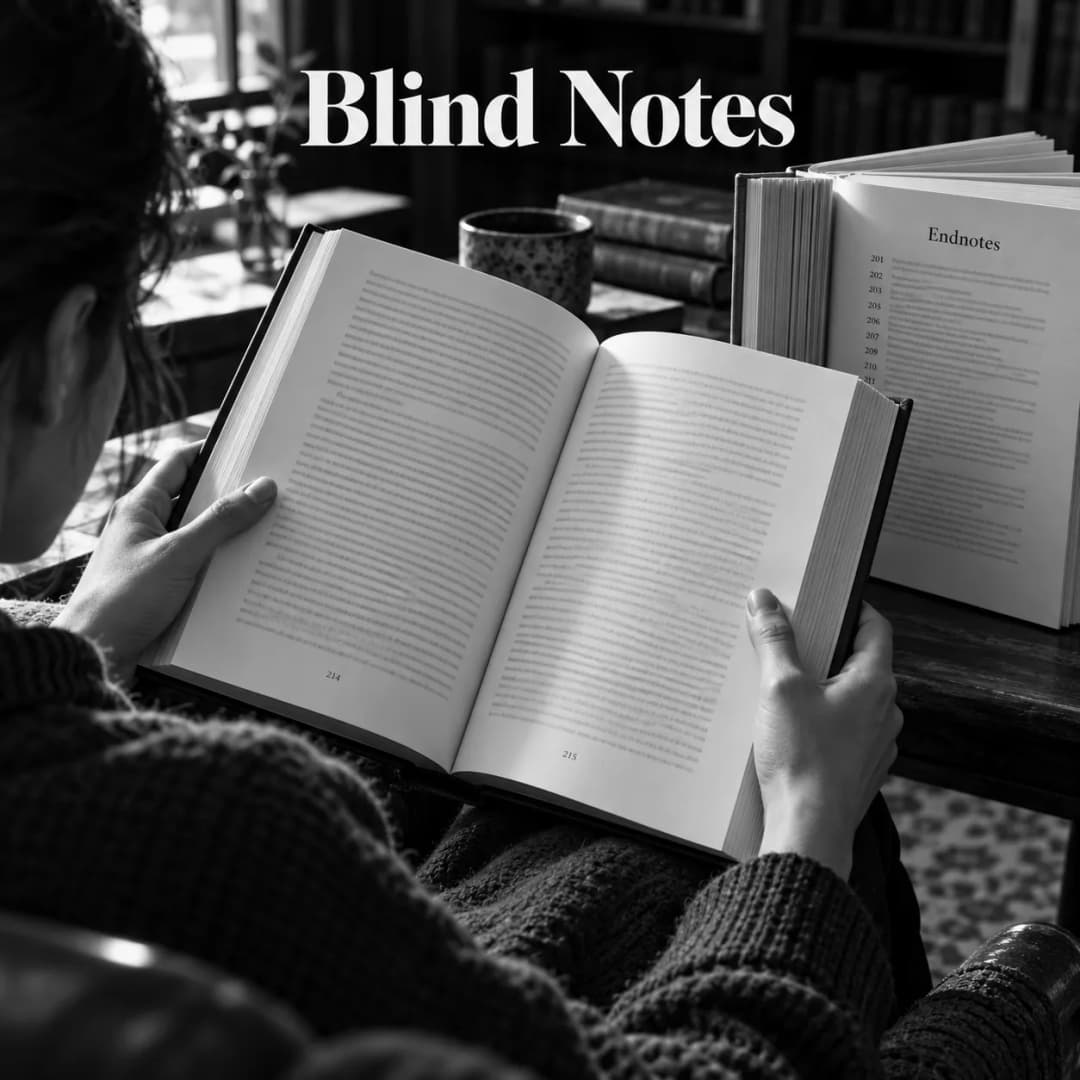
Blind notes is the publishing convention in which a book carries endnotes keyed to a page number plus a short italicised catchphrase lifted from the body text, and carries no superscript numerals or markers of any kind in the running text. The apparatus is therefore invisible to a reader who is reading. It is not a bad-faith choice, publishers use it because superscripts interrupt prose, and what this publication has found behind the wall varies enormously with no cue available to tell one case from another.
What it is
The convention has a precise shape. A note at the back reads as a page number followed by a few italicised words lifted from that page, so a determined reader can work backwards from the page to the note. What is missing is any forward signal. A reader on page thirty-two has no indication that a note for page thirty-two exists, no indication that the sentence in front of them is sourced at all, and no way to distinguish a sourced sentence from an unsourced one without going to the back of the book and checking every page by hand.
The convention is a choice rather than an industry requirement, and this publication can now say so twice over from its own shelf. MIT Press published a general-audience trade book with visible numbered superscripts throughout, and Oxford University Press did the same in a book aimed squarely at general readers. A self-published title on the same shelf also numbers its notes and tells the reader at p. 32 that the apparatus exists. Any claim that superscripts are impossible in popular non-fiction is answered by those volumes.
In effect
The instances this publication has read differ instructively, and the comparison is the whole value of the concept.
Zelana Montminy's Finding Focus runs roughly 188 notes with about seventy-one per cent peer-reviewed journal articles, most with volume, issue, year, page range and identifier. Across roughly 240 pages of running text there are no markers, no author names, no years and no journals. Findings arrive as one study found, research shows, scientists have confirmed. A good apparatus, hidden.
Benjamin Hardy's Personality Isn't Permanent runs about 162 notes, roughly twenty-three per cent peer-reviewed, with the largest single class trade and self-help books at about thirty-four per cent. The good journals are genuinely there, and so is a YouTube interview carrying the book's central mechanism, in the same type. A mixed apparatus, hidden, and the mixture undeclared.
Cal Newport's Deep Work is the worst of the set, and for a structural reason. Its roughly 215 notes carry no page numbers at all. Entries are keyed by a bolded quoted phrase gathered under running subheads, so to check a claim a reader must remember its exact wording, guess the right subhead and hope the claim was quoted rather than paraphrased. Every paraphrased claim across 263 pages is permanently unreachable. Its peer-reviewed share is about eight per cent.
Your Brain on Art adds two axes the concept did not previously have. Roughly forty per cent of its pages carry no note at all and the introduction, where the boldest framing claims sit, carries none, so the backwards route frequently ends in nothing and the negative result is uninformative, because an absent note means either no source or an interview and there is no way to tell which. A single unnumbered line at the head of the notes declares that quotations come from author interviews unless otherwise cited, and not one of the roughly 169 entries reads as an interview.
The counter-instances matter as much. The Elephant in the Brain is the reference case at trade length: numbered notes restarting each chapter, every number keyed to a superscript, short author and date entries resolving to a full alphabetised reference list, and about forty-four per cent peer-reviewed. The Modern Mind shows the convention scales, with about 3,320 numbered endnotes across forty-two chapters, keyed to superscripts, in a book whose source base is by class the weakest on the shelf. Navigability is independent of everything else, which is precisely what a counter-example is for.
Two books fail the test in the opposite direction and are recorded elsewhere. The Art of Clear Thinking has a visible, navigable and almost empty apparatus, a 43-entry chapter bibliography with one footnote in 252 pages. The Molecule of More has nothing to reconstruct at all, only an unmapped per-chapter further reading list, which is a different defect with its own name.
What it does not say
It does not rest on research. This is a description of a publishing convention and of what has been found behind it in particular books, not a tested proposition, and each instance was established by reading the apparatus of the book in question.
It does not say blind notes are a failure in themselves. Many good books use them, serious university presses use them, and a book with blind notes has done more for verifiability than a book with no notes at all, which is what most of this shelf carries. None of the authors named here is doing anything unusual or hiding anything they were obliged to show.
It does not say the defect is invisibility alone. The defect is invisibility combined with undeclared variation. A reader could reasonably form a habit about blind-note books only if the contents behind them were roughly consistent, and they are not: seventy-one per cent journal articles in one case, eight per cent in another, identical from the reading experience.
It does not say that making notes visible fixes the problem. Visibility is necessary and not sufficient. It does nothing about source-class inflation, nothing about the age of a bibliography, and nothing about which category of sentence gets a number. One book on this shelf carries numbered notes and an apparent factual error roughly every two pages, several of them on sentences carrying note markers. A number a reader reads as verification can be attached to a claim nobody checked.
The practical rule this publication takes from all of it: never cite the prose of a blind-note book. Find the note, grade the class of the note, and check the year.
Sources
- Montminy, Z. Finding Focus (2025). Notes at pp. 271 to 289, roughly 188 notes and 200 references, about 71 per cent peer-reviewed. Audited 2026-09-04.
- Hardy, B. Personality Isn't Permanent (2020). Notes at pp. 237 to 247, about 162 notes, about 23 per cent peer-reviewed, largest class trade and self-help at about 34 per cent. Audited 2026-09-11.
- Lembke, A. Dopamine Nation (2021). Roughly 165 bibliography entries, no note markers in 226 pages. Audited 2026-09-10.
- Newport, C. Deep Work. Notes at pp. 265 to 287, about 215 entries, about 8 per cent peer-reviewed, keyed by quoted phrase with no page numbers. Audited 2026-09-13.
- Your Brain on Art. Roughly 169 notes, primary peer-reviewed share roughly 27 to 30 per cent after netting out reviews, framework papers, duplicates and low-visibility venues. About 40 per cent of pages carry no note. Audited 2026-09-20.
- Counter-instances: Gazzaley, A., & Rosen, L. D. The Distracted Mind (MIT Press), visible numbered superscripts throughout. Simler, K., & Hanson, R. The Elephant in the Brain (Oxford University Press), about 488 notes, about 44 per cent peer-reviewed, superscript-keyed, with a full reference list at pp. 353 to 384. The Modern Mind, about 3,320 numbered endnotes at pp. 773 to 827. 5 Masters of Critical Thinking, 240 numbered entries across six chapters, superscript-keyed, with the apparatus announced at p. 32.
- All counts in this vault are by hand with a stated margin. Read them as well-supported estimates of firm patterns and never as verified counts.