Chair Flying
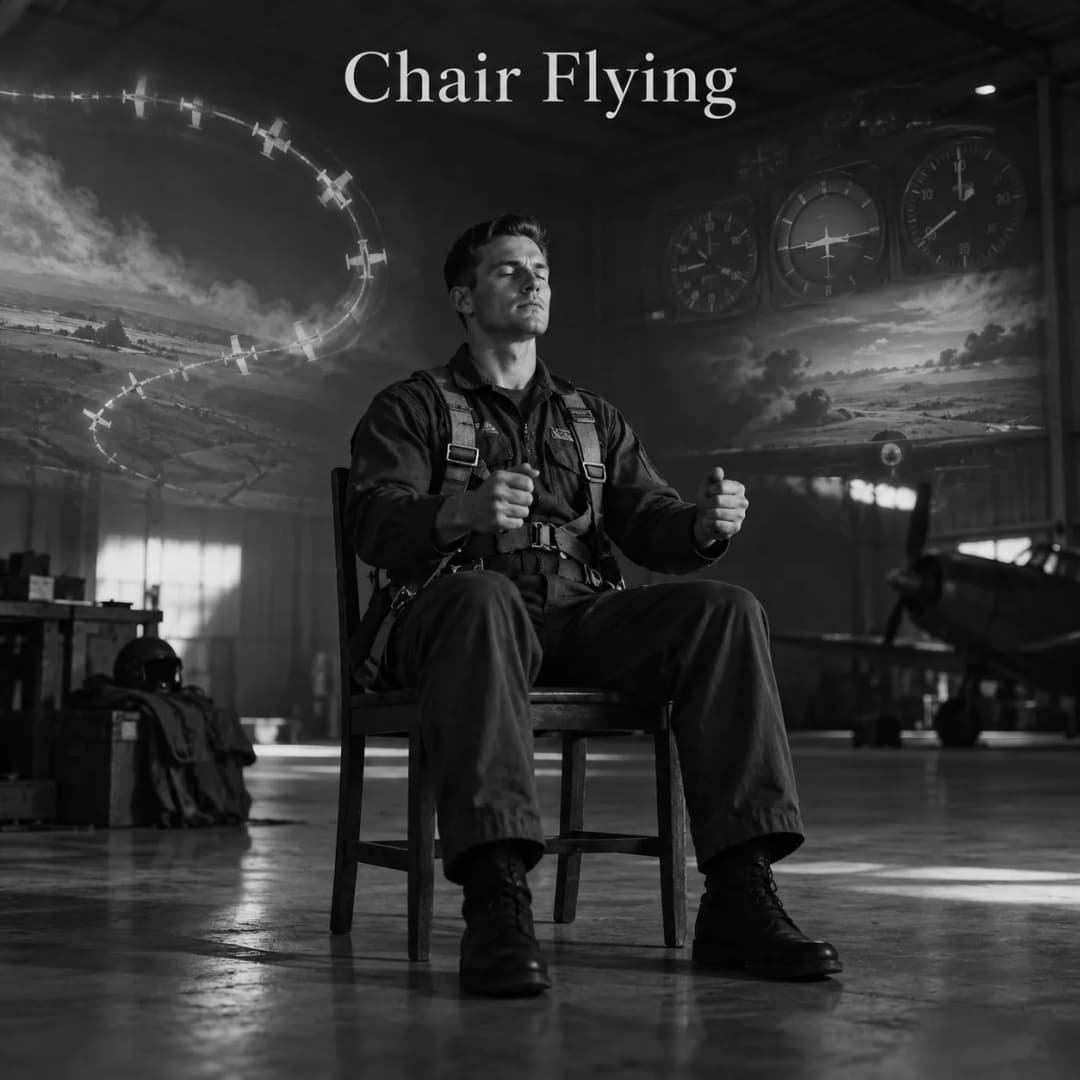
Chair flying is eyes-closed multisensory rehearsal of an entire flight, in which any manoeuvre botched in the mind is repeated until it is completed correctly before the pilot moves on. It is a training practice inherited from working aviators rather than a laboratory technique, and its authority is that it was done by people whose lives depended on the next hour going correctly. It is not a research claim, and it should not be cited as evidence that visualisation improves performance.
What it is
Hasard Lee gives the technique as the fifth of his five pillars of mental toughness and attributes it, at p. 216, to Second World War aviators. That attribution is worth stating plainly, because it is the one borrowed idea in the book that is properly credited. One attribution in 252 pages, and it goes to anonymous dead pilots rather than to any of the living or recently living researchers whose work the book uses without a name.
Say it with respect, because it is the exception that shows the omissions elsewhere are not incapacity. The idea is credited properly here. It happens once, and the fair way to make the wider point about borrowed certainty is to start with that rather than with the omissions.
The rehearsal sits at the top of an escalating ladder described a few pages earlier: simulator repetition, then flying under acceleration and weather and simulated malfunctions, then large force exercises, until the manoeuvre is automatic. Chair flying is what a pilot does when none of that apparatus is available.
In effect
As a practice it has an obvious appeal for anyone whose work has a rehearsable sequence and a costly first attempt. The distinctive part is not the visualisation but the rule attached to it: a botched repetition is not allowed to stand, and the sequence is run again until it is clean.
The technique arrives in the book with one modification, described as slight alterations based on modern neuroscience, and the neuroscience is named nowhere, by field, researcher or paper. So even the book's one credited borrowing has an uncredited one bolted to it.
What it does not say
It does not establish that mental rehearsal works. Mental rehearsal and motor imagery do have a research literature and it is not nothing, but effect sizes are contested and none of that literature is cited in the source this page draws on.
It does not carry the neuroscience the book attaches to it. No field, researcher or paper is named for the modification.
It does not generalise beyond what it is. Cite it as a named, credited piece of aviation practice still in the syllabus eighty years on, and not as data.
Sources
- Lee, H. The Art of Clear Thinking. The technique and the attribution to Second World War aviators at p. 216. The escalating rehearsal ladder at p. 211. The five pillars at pp. 210 to 216.