Citation Asymmetry
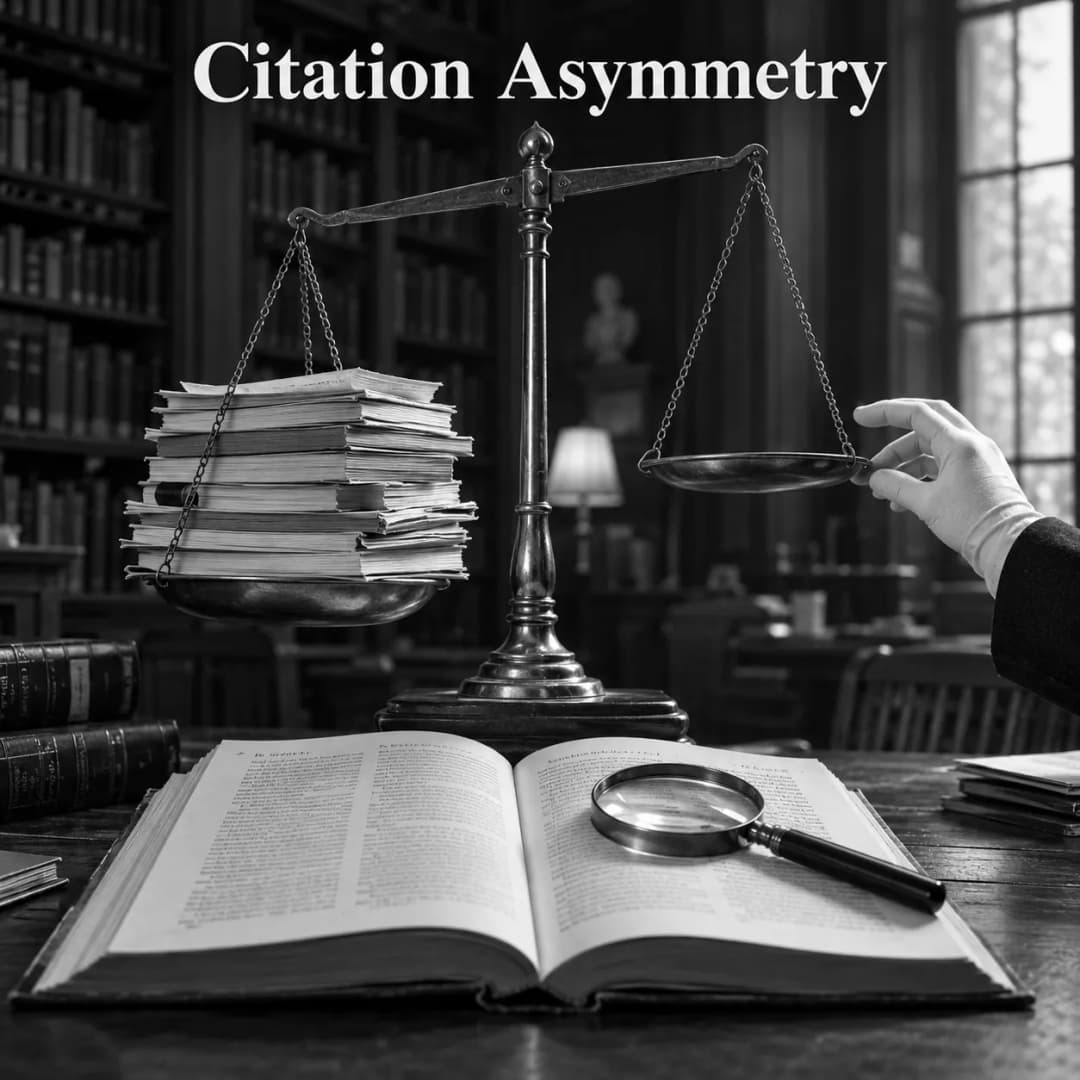
Citation asymmetry is the failure in which a book carries a full and genuine scholarly apparatus, and every source standing behind a contested claim comes from one side of the contest. The citations are real, the journals are real, the primary papers are named underneath the popularisations, and not one source in the apparatus is capable of disagreeing with the author. It is a diagnostic category of this publication's own, and it is the one most likely to fool a careful reader, because the notes look like verification.
What it is
The mechanism is simple and it is worse than an uncited claim. An uncited claim announces itself: a reader meeting the words studies show knows they have been given nothing and can discount accordingly. A reader meeting an endnote goes to the back of the book, finds a real citation in a real journal with volume and page numbers, concludes the sentence was checked and stops there. The apparatus has terminated the enquiry it existed to enable. The better it looks, the more effectively the asymmetry hides.
The category is distinct from its nearest siblings. Source-class inflation is about what class of thing a citation is. Borrowed certainty is about a book with no apparatus to be one-sided with. Asymmetry requires real citations sitting on one side of a live dispute.
The test is one question, asked construct by construct: for each contested claim in the book, could any source cited in support of it possibly disagree with the author. If the answer is no for every contested claim, the apparatus is decorative on exactly the points where it was needed.
In effect
The defining instance is Cal Newport's Deep Work, which carries twenty-three pages of endnotes and roughly 215 entries. Four contested constructs, four one-sided sets of notes. Ego depletion is stated as fact and cited to Roy Baumeister and co-authors and a trade book, with four of the five self-control sources in the first section authored or co-authored by Baumeister, and no replication failure or publication-bias material anywhere in the apparatus. Deliberate practice is cited to Anders Ericsson three times, to Ericsson's own website, to two popularisers and to Ericsson's own rebuttal of his critics, with no meta-analysis and no critic. Unconscious thought is cited to Ap Dijksterhuis and colleagues alone. Media multitasking is cited to a radio interview rather than to the paper underneath it. In every case the contrary literature existed before the book was published and none of it appears.
Zelana Montminy's Finding Focus is the second instance and the more instructive one, because its apparatus is about seventy-one per cent peer-reviewed with full bibliographic detail. The longhand note-taking advantage is cited correctly to the original study and the large preregistered replication that did not reproduce it is absent. The parole judges finding is cited correctly and presented as settled, with the non-random case ordering objection and the implausible effect size objection both missing. The phone and conversation finding is presented as established with a mixed replication record unmentioned. Brain training is credited to a researcher whose commercial interest goes undisclosed and whose contested far-transfer literature goes unmentioned.
One entry in that book shows the asymmetry is a choice rather than an accident. She cites the correction putting working memory nearer four items in the back, and prints seven plus or minus two in the front. The correcting source was in her hands.
The counter-example is The Elephant in the Brain, audited a day after this category was created. Its fourth chapter uses the watching-eyes effect as support for a claim, and the endnote attached to that sentence discloses that two recent meta-analyses cast doubt on all eye-cue effects. The charity chapter warns the reader off a priming study and then explains why the authors still think their contrast holds, with the failure-to-replicate paper sitting in the references alongside the supporting ones. The medicine chapter twice announces its own omissions, concedes that a large insurance experiment was underpowered for mortality, and reports a nearly significant result suggesting free medicine harmed a subgroup, which cuts against the chapter's own framing. About one note in six concedes something, qualifies the text or gives a rival view its due. That settles a question this category left open: the defect is a choice rather than a genre constraint.
Three proxies make the test quick. Count the surnames, because if most sources on one mechanism share an author you have a closed loop rather than a literature. Look for the defendant's reply, since a dispute settled by citing the disputed party's own rebuttal is a nameable special case. And check the dates against the replication record: a 2016 book citing a 2006 finding is not at fault for a 2018 failure, and is at fault for a 2014 one.
What it does not say
It does not rest on research. This is a category this publication defines and applies, not a proposition anyone has tested, and each instance was established by reading the book's own apparatus.
It does not say authors must adjudicate every dispute. No trade writer is obliged to produce a literature review, and a book that stopped to settle every contested construct would be unreadable. The obligation is not to settle the dispute but to say that one exists. A single sentence costs an author nothing and restores the reader's ability to judge.
It does not ignore the dating defence. Nobody can cite what has not appeared. Against that, the corrections on both of Deep Work's load-bearing mechanisms were available while it was being written, and the book has been reprinted continuously since.
It does not follow that provenance discipline and evidential quality are the same virtue. Deep Work passes every first-author check it takes, discloses its discovery chains and credits the right originator where others do not. It is scrupulous about where a claim came from and silent about whether the claim is any good.
It does not apply to every book with a thin apparatus. The Art of Clear Thinking has no citations to be one-sided with, and The Modern Mind's apparatus flags contrary scholarship repeatedly and passes this test on a book of more than eight hundred pages. Those belong to different categories in this vault.
It is not a criticism of authors. Every writer named here cites better than most of this shelf, which is the point.
Sources
- Newport, C. Deep Work (2016). Endnote audit and external verification both 2026-09-13. Roughly 215 entries across pp. 265 to 287, about 8 per cent peer-reviewed, resolving to twelve distinct papers.
- Montminy, Z. Finding Focus (2025). Endnote audit 2026-09-04, re-read 2026-09-13. About 71 per cent peer-reviewed.
- Critical literature absent from Deep Work, verified externally: Hagger, M. S., Chatzisarantis, N. L. D., et al. (2016). Perspectives on Psychological Science, 11(4). Carter, E. C., & McCullough, M. E. (2014). Macnamara, B. N., Hambrick, D. Z., & Oswald, F. L. (2014). Psychological Science, 25(8), 1608-1618. Nieuwenstein, M. R., et al. (2015). Judgment and Decision Making, 10(1), 1-17. Wiradhany, W., & Nieuwenstein, M. R. (2017). Attention, Perception and Psychophysics, 79(8), 2620-2641. Ophir, E., Nass, C., & Wagner, A. D. (2009). PNAS, 106(37), 15583-15587.
- Absent from Finding Focus: Morehead, K., Dunlosky, J., & Rawson, K. A. (2019), the preregistered replication of the longhand advantage; the non-random case ordering and effect size objections to Danziger, S., Levav, J., & Avnaim-Pesso, L. (2011), PNAS, 108. Cowan, N. (1988) is present in the notes and not in the text.
- Simler, K., & Hanson, R. The Elephant in the Brain (2018). Endnote audit and external verification both 2026-09-14. The counter-example. About 480 references, about 44 per cent peer-reviewed, numbered notes keyed to superscripts, about 41 per cent carrying argument rather than a bare citation, about one in six conceding. The chapter four disclosure is Northover, S. B., Pedersen, W. C., Cohen, A. B., & Andrews, P. W. (2017), "Artificial surveillance cues do not increase generosity: two meta-analyses", Evolution and Human Behavior.
- A further instance at p. 53 of The Molecule of More, where a prevalence figure for pathological gaming is quoted in the prose while the same chapter's further reading carries the work that challenges the construct. Gentile, D. A. (2009), Psychological Science, reports about 8.5 per cent from a poll of 1,178 American young people. Przybylski, A. K., Weinstein, N., & Murayama, K. (2017), American Journal of Psychiatry, applying DSM-5 criteria across four samples, report between roughly 0.3 and 1 per cent. Both sides belong wherever the figure is used. Verified 2026-09-19.