Clickbait
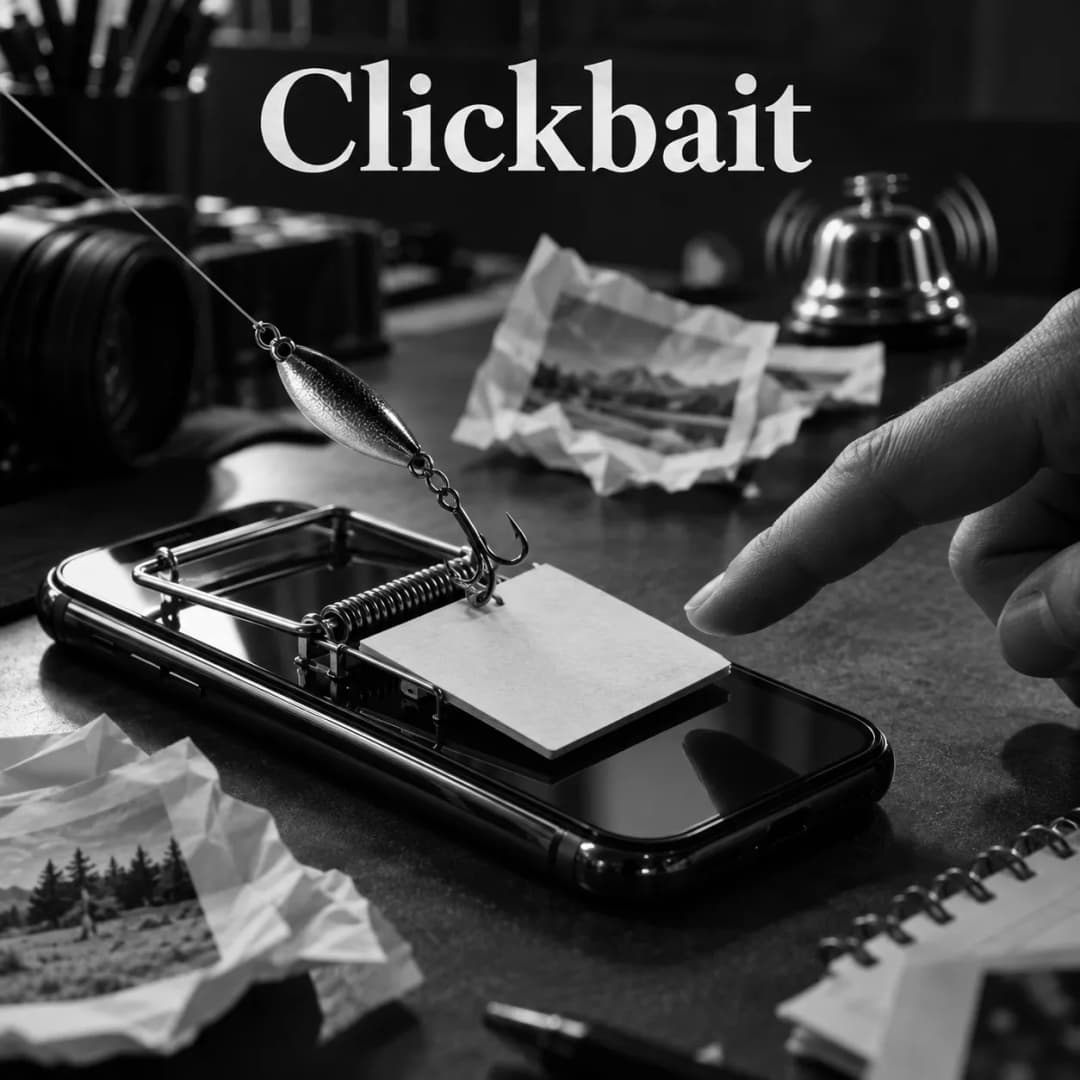
Clickbait is a headline or image engineered to make clicking feel involuntary rather than chosen. The craft is not really about curiosity, it is about arousal. The term is generally traced to a 2006 blog post by Jay Geiger and entered the Oxford English Dictionary in 2016. The one empirical claim embedded in the practice, that high-arousal emotion rather than enjoyment drives sharing, has a primary home and it is not the trade books that popularised it.
What it is
The practice predates the word. Tim Wu's history traces headline escalation through the Huffington Post in the 2000s and then to BuzzFeed, which industrialised the craft by rewriting flat factual headlines into emotionally loaded ones and measuring what happened.
The distinction that makes the practice intelligible was made explicit by BuzzFeed's own data scientist, Ky Harlin: clickability and actual liking are separate variables, and optimising for one does not get you the other. That is the whole craft in a sentence. A headline can be engineered against a metric that has nothing to do with whether the reader is glad they clicked.
The mechanism underneath is high-arousal emotion rather than enjoyment. Awe, outrage and anxiety move content. Contentment does not.
In effect
For anyone producing content today the practice sits in direct tension with the quality signals search engines say they reward. Accuracy and restraint pull one way; arousal pulls the other, and optimising hard for one degrades the other.
Wu's economic footnote is worth keeping alongside the craft. Despite dominating traffic, viral content proved only modestly profitable next to legacy media, which complicates the assumption that the technique was straightforwardly winning.
What it does not say
It does not rest on research. Clickbait is a term of art for a headline practice, not a testable effect.
It does not belong to Wu. He describes the practice and did not coin the word.
It does not licence the numbers that circulate with it. The eighteen million views figure for BuzzFeed's most-cited headline rewrite, and the Harlin quotation, come from Wu's book alone and were not traced to a primary source. They should not be cited as data.
It does not come from BuzzFeed's discovery either. The high-arousal sharing finding is Jonah Berger and Katherine Milkman's, and their study concerns sharing rather than clicking, which is a distinction the popular use of it collapses.
Sources
- Geiger, J. (2006). The blog post generally credited with the term. Added to the Oxford English Dictionary in 2016.
- Berger, J., & Milkman, K. L. (2012). "What makes online content viral?" Journal of Marketing Research, 49(2), 192-205. A single large observational study of New York Times articles plus lab follow-ups, well cited and broadly supported by later work. Consulted through secondary sources.
- Wu, T. (2016). The Attention Merchants. Knopf. Huffington Post headline escalation at pp. 282-283; the BuzzFeed rewrite, its reported view count, Harlin's clickability against liking distinction and the high-arousal finding at pp. 319-320. The view figure and the quotation were not traced to a primary source.