Cognitive Ease
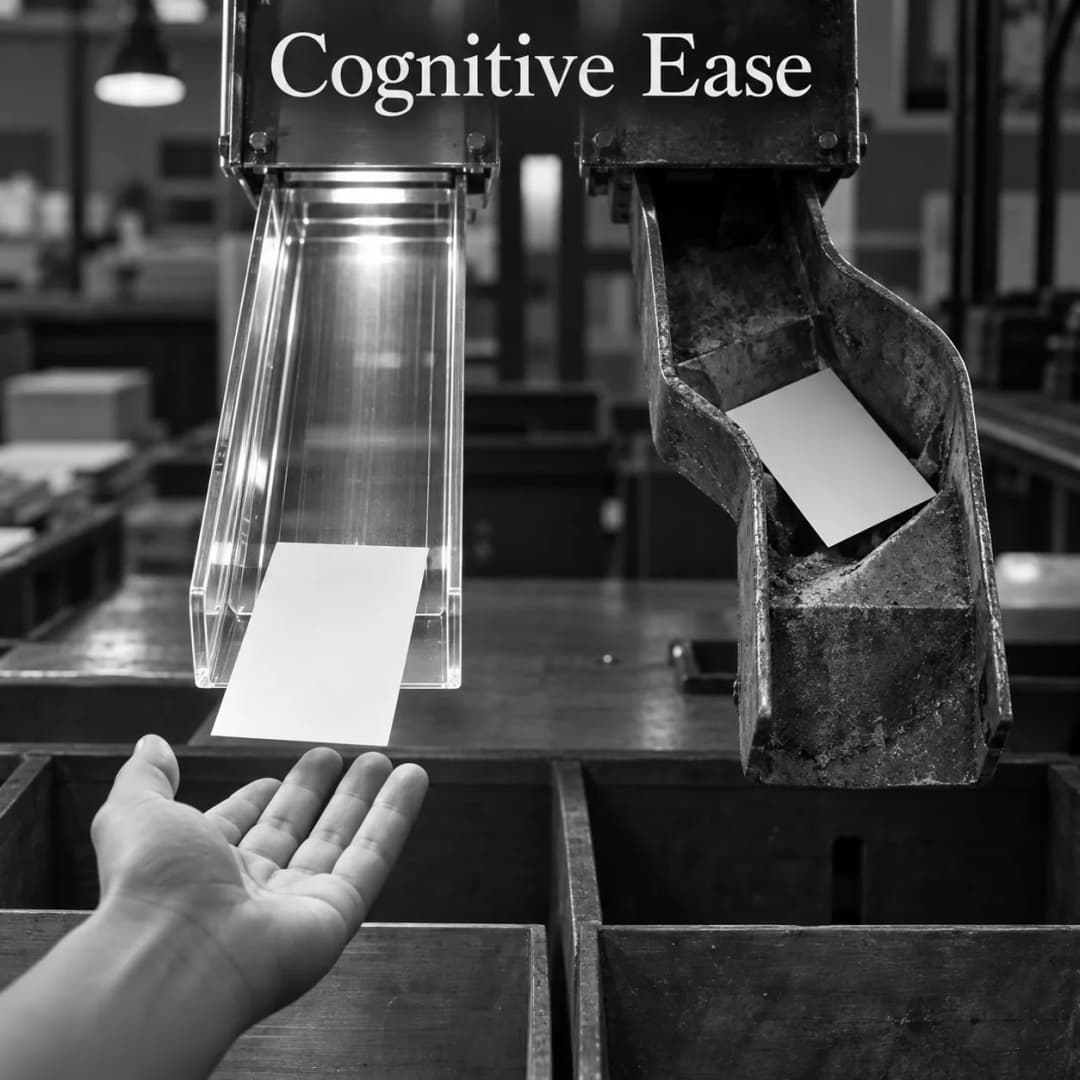
Cognitive ease is the felt fluency of processing, and the mind's habit of reading that feeling as a signal about the world rather than about itself. Something that arrives easily, a clear font, a repeated name, a rhyming line, a familiar face, feels truer and more likeable than identical content arriving with friction. The umbrella term is Daniel Kahneman's, from 2011. The general observation is plausible and supported in places. The specific experimental demonstrations used to sell it are substantially in trouble, which is why this page is marked contested.
What it is
The move being made is a substitution. The hard question is whether a claim is true. The easy question is how smoothly it went down. The second gets answered and the answer is filed under the first.
Kahneman gathers the territory under one name in the fifth chapter of Thinking, Fast and Slow. He does not claim the term as a coinage in the way he does with other constructs in that book, and the components have separate originators, which is why the attribution here is carried at medium confidence.
The component that survives is the oldest one. Robert Zajonc's mere exposure work presented nonsense words, Chinese characters and faces at exposures too brief for conscious recognition and then measured liking. Previously seen items won reliably, and won even when participants could not say which they had seen. Repetition produced ease, and ease produced preference, with recognition playing no part. Its commercial form is advertising frequency: a brand you have simply encountered often enough begins to feel likeable independently of anything it has claimed.
In effect
Before citing anything from this territory, the replication record has to come with it.
The disfluency finding has failed. Adam Alter, Daniel Oppenheimer, Nicholas Epley and Rebecca Eyre reported in 2007 that a harder-to-read font makes people reason more carefully. It did not survive a large replication programme. Kahneman's endnotes cite that paper three times. This vault carries the same finding at its processing fluency page, written from an earlier book, and that page needs the correction propagating into it.
The priming studies in the adjacent chapter have failed and were disowned by Kahneman himself in 2017, when he wrote that he had placed too much faith in underpowered studies. Nothing from that chapter is citable. Proximity is not guilt, but it is a reason to check every item in the neighbouring chapter separately rather than importing it as a unit.
Mere exposure is the exception and it is a strong one. It is among the best-replicated results in the field. It does not need to borrow credibility from the chapter around it, and the chapter must not borrow credibility from it.
The other demonstrations from that chapter are deliberately not reproduced here. Printing the disfluent-font study alongside its correction leaves a reader remembering the study and forgetting the correction.
What it does not say
It does not say that fluency has no effect on judgement. The general observation is plausible and is supported in places, notably by the exposure literature.
It does not say the demonstrations Kahneman uses are sound. Those are two different claims and they must not be cited as one.
It does not mean the construct should be abandoned. Contested, in this publication's scheme, means do not cite as fact while remaining worth writing about.
It is not the same page as processing fluency, and the two should not be merged. Processing fluency is the construct as a research programme, entered through Adam Alter's own work, carrying the pronounceability, stock-ticker and moral-judgement studies. Cognitive ease is Kahneman's umbrella term for the same territory plus the reliability problem attached to how he evidenced it. If either is cited, cite the one whose sourcing is being relied on.
Sources
- Kahneman, D. (2011). Thinking, Fast and Slow, ch. 5. The umbrella term as used here. This publication's audit of the book lists the disfluency failure and the priming retraction.
- Alter, A. L., Oppenheimer, D. M., Epley, N., & Eyre, R. N. (2007). The disfluency and reasoning finding, cited three times in Kahneman's notes, which did not survive a large replication programme.
- Zajonc, R. B. The mere exposure work. Among the best-replicated results in the field, and the durable component of this territory.
- Kahneman's 2017 statement disowning the social priming material in the adjacent chapter.