Cognitive Enhancement
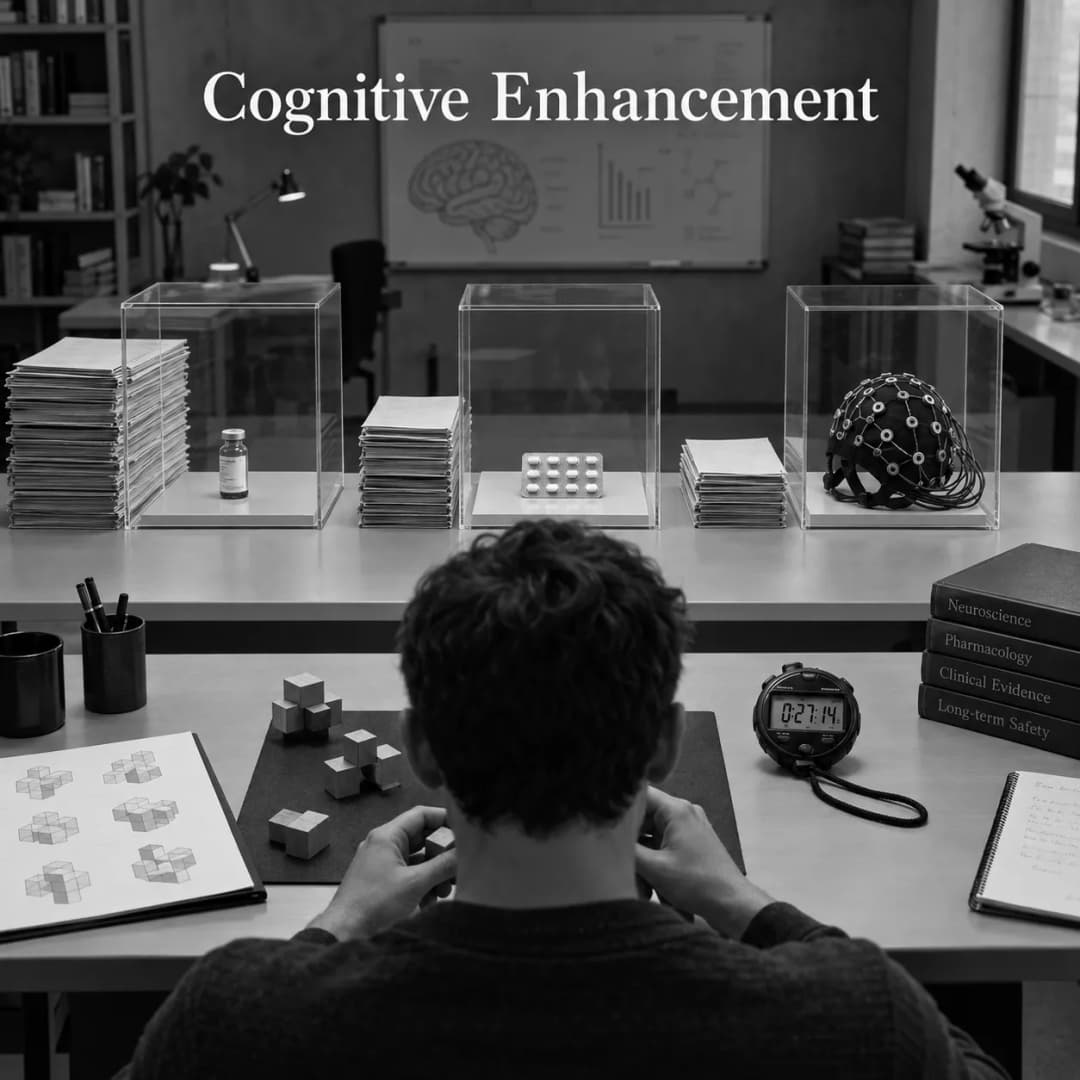
Cognitive enhancement is the umbrella for attempts to raise cognitive performance in people who are not ill, using means developed for people who are: prescription drugs licensed for clinical conditions, electrical and magnetic brain stimulation developed for clinical use, and the commercial products sold on the same promise. The umbrella covers three quite different evidence situations, and the commonest error in writing about the subject is averaging across them. Nothing on this page is advice, and it carries no dose, protocol, device setting or source of supply.
What it is
The organising distinction is between treatment and enhancement, and it collapses under pressure from both ends, which is what makes the area genuinely difficult rather than merely contested. David Adam's term for the field, cosmetic neuroscience, captures the shape of it and is the framing this publication uses.
The three situations are separated below and they stay separated. One licensed wakefulness drug has a small and domain-dependent effect in healthy people with long-term safety unestablished. One class of stimulant supports no enhancement claim in healthy people at all. And brain stimulation is unresolved, with a well-powered null, a substantial rebuttal to it, a reply to the rebuttal, and an underlying literature whose statistical power is too low to settle anything either way.
This page is written under this publication's standing rule for material that could bear on someone's health. It records what the evidence shows and does not show, and anyone reading it for a decision about their own body should be reading a clinician instead.
In effect
On modafinil, the case for an effect is Ruairidh Battleday and Anna-Katharine Brem's 2015 systematic review of use by healthy people who are not sleep-deprived. Its finding is domain-dependent in a way that is the point rather than a hedge. On basic testing paradigms most studies show enhanced executive function, only about half show gains in attention or in learning and memory, and a few report impairment in divergent creative thinking. On longer and more complex assessments the review reports more consistent enhancement. No preponderance of side effects or mood changes appeared across the included studies.
The case against a large effect is Caroline Roberts and colleagues in 2020, whose meta-analysis across fourteen studies found an overall effect that was small, with only one sub-domain reaching significance on its own. Domitille Repantis and colleagues had already reported something more awkward than a small effect, that these drugs can produce overestimation of one's own cognitive performance, which is a distinct thing from improving it and points the wrong way for anyone judging the benefit from the inside.
Long-term safety is the weak point and has not moved. There are no large prospective studies designed to establish the incidence of dependence or harm among long-term healthy users, and the tolerability data come from patients rather than from healthy users. On the licence, the European Medicines Agency concluded in January 2011, after a formal referral, that the benefits outweighed the risks only in narcolepsy. The licensed indication in the United Kingdom has been excessive sleepiness in adults with narcolepsy since then, so use by a healthy person for enhancement falls outside the licence.
On methylphenidate the honest summary is short. Irena Ilieva and colleagues in 2015 pooled stimulants in healthy people and found a small effect on inhibitory control and short-term episodic memory and a medium effect on delayed episodic memory, then qualified the memory results by evidence of publication bias and concluded the effect on healthy cognition is probably modest overall. Roberts and colleagues likewise found any enhancement confined to specific sub-domains. This publication makes no enhancement claim for methylphenidate in healthy people, and records that the book it entered the subject through makes none either, which is the correct position and not the one the genre usually takes.
On brain stimulation the exchange is on the record from both sides and this page keeps it that way. Jared Horvath, Jason Forte and Olivia Carter pooled single-session transcranial direct current stimulation studies in healthy adults across executive function, language, memory and a miscellaneous category in 2015 and found no reliable cognitive effect in any of the four. Andrea Antal and colleagues, and separately Amy Price and Roy Hamilton, published critiques in the same journal that year arguing that the review used inconsistent data-selection criteria, and that its conclusions did not follow from its analysis. Horvath replied in the same journal that reanalysis following the critiques did not change his findings. The exchange was never resolved and all three belong in any citation of it.
Where the field sits now: Lauren Mancuso, Irena Ilieva, Roy Hamilton and Martha Farah ran a deliberately more sensitive meta-analysis of working memory in 2016 and found a small significant effect only for stimulation combined with working memory training, not for stimulation alone. Jared Medina and Sabrina Cason then applied a stringent publication-bias method to the same body of studies in 2017 and concluded there was no evidential value in the samples. Their most useful contribution reframes almost every small study in the area: average statistical power in this literature sits below fifty per cent, with typical power in the low teens for cognitive studies and lower still for working memory studies. A literature powered that low does not produce findings that mean what their significance values say.
What it does not say
It does not say that enhancement works. On the strongest of the three cases the effect is small and domain-dependent, and on the other two the evidence supports no claim at all.
It does not support the superlative that circulates. The phrase describing modafinil as the world's first safe and effective smart drug was not traced to the 2015 review's own published conclusion, which is considerably more measured. It belongs to the press coverage and is never attributed to the review.
It does not say that unsupervised home stimulation is safe. Rachel Wurzman and colleagues, with thirty-nine signatories, published an open letter in Annals of Neurology in 2016 stating that they do not encourage do-it-yourself use, that changes produced may be long-lasting for better or worse, that stimulating one function may come at the cost of another, and that reported effects include anxiety, panic, light sensitivity and emergence of mania requiring psychiatric intervention. That directly contradicts the claim, printed in the book this page was written from, that there is at present no evidence of harmful side effects. This publication does not carry that line.
It does not carry the current-attenuation figure that circulates either. The often-repeated claim that only about a tenth of applied current reaches the brain comes from a 2016 news account of work in progress. The published paper, by Mihaly Voroslakos and colleagues with Gyorgy Buzsaki in 2018, reports roughly seventy-five per cent attenuation by soft tissue and skull. More recent work with intracranial recordings has shown measurable electric fields reaching cortical and some deeper structures during low-intensity stimulation, so almost nothing gets through is too strong. The honest position is that the fields arriving are weak relative to what appears to be needed to drive neuronal spiking directly.
It does not borrow from the clinical literature. Stimulation for depression under clinical supervision has a literature reporting modest short-term benefit against sham, with high heterogeneity and small trials. That is not evidence for enhancement in healthy people and must never be cited as though it were.
It does not carry the book's uncontrolled material. This publication's audit of that book bars fourteen claims outright, including uncontrolled clinician testimony about serious psychiatric outcomes, several small unblinded self-experiments, a problem-solving result that failed a direct replication cleanly, a school result resting on a news item, manufacturer and sports-team performance claims, and the unsourced claim that the weaker the starting performance the more a drug helps. None of that appears here in any form.
The consumer-facing point matters more than any of the above. The gap between what these interventions are sold on and what has been shown is large, it has been large for a decade, and in the one adjacent case where a regulator tested it the outcome was a settlement for deceptive advertising.
Sources
- Battleday, R. M., & Brem, A.-K. (2015). European Neuropsychopharmacology, 25, 1865-1881.
- Roberts, C. A., et al. (2020). European Neuropsychopharmacology. Meta-analyses of acute administration in healthy adults.
- Repantis, D., et al. (2010). On overestimation of one's own performance.
- Ilieva, I. P., et al. (2015). Journal of Cognitive Neuroscience. Stimulants in healthy people, with the publication-bias qualification.
- European Medicines Agency. Article 31 referral concluded January 2011, restricting the modafinil indication to narcolepsy.
- Horvath, J. C., Forte, J. D., & Carter, O. (2015). Brain Stimulation, 8, 535-550. With Antal, A., et al., and Price, A., & Hamilton, R., both Brain Stimulation 2015, and Horvath's reply in the same journal. All three are cited together or none of them is.
- Mancuso, L. E., Ilieva, I. P., Hamilton, R. H., & Farah, M. J. (2016). Journal of Cognitive Neuroscience, 28.
- Medina, J., & Cason, S. (2017). Cortex, 94, 131-141. Evidential value and the statistical power figures.
- Voroslakos, M., et al., with Buzsaki, G. (2018). Nature Communications, 9. The published attenuation figure.
- Wurzman, R., et al. (2016). Annals of Neurology. The thirty-nine-signatory open letter.
- Adam, D. The Genius Within. Picador, 2018. Ingested 2026-09-24. This publication's quarantine table and its forty-seven-claim verdict list are binding on this page: fourteen claims barred outright, three barred in part, twenty-four scoped, six sound.
- Not confirmed and therefore not carried: the exact wording behind the smart-drug superlative; a school mathematics trial for which no primary paper was traced; the detail of the cadaver electrode work; whether a threat-detection result has been independently replicated; a claim about diagnosis rates among professional sportspeople; a claim about how manufacturers avoid regulation; manufacturer and sports-team performance claims; and survey figures for use among undergraduates, surgeons and scientists, which the book itself says are hard to establish.