Confabulation
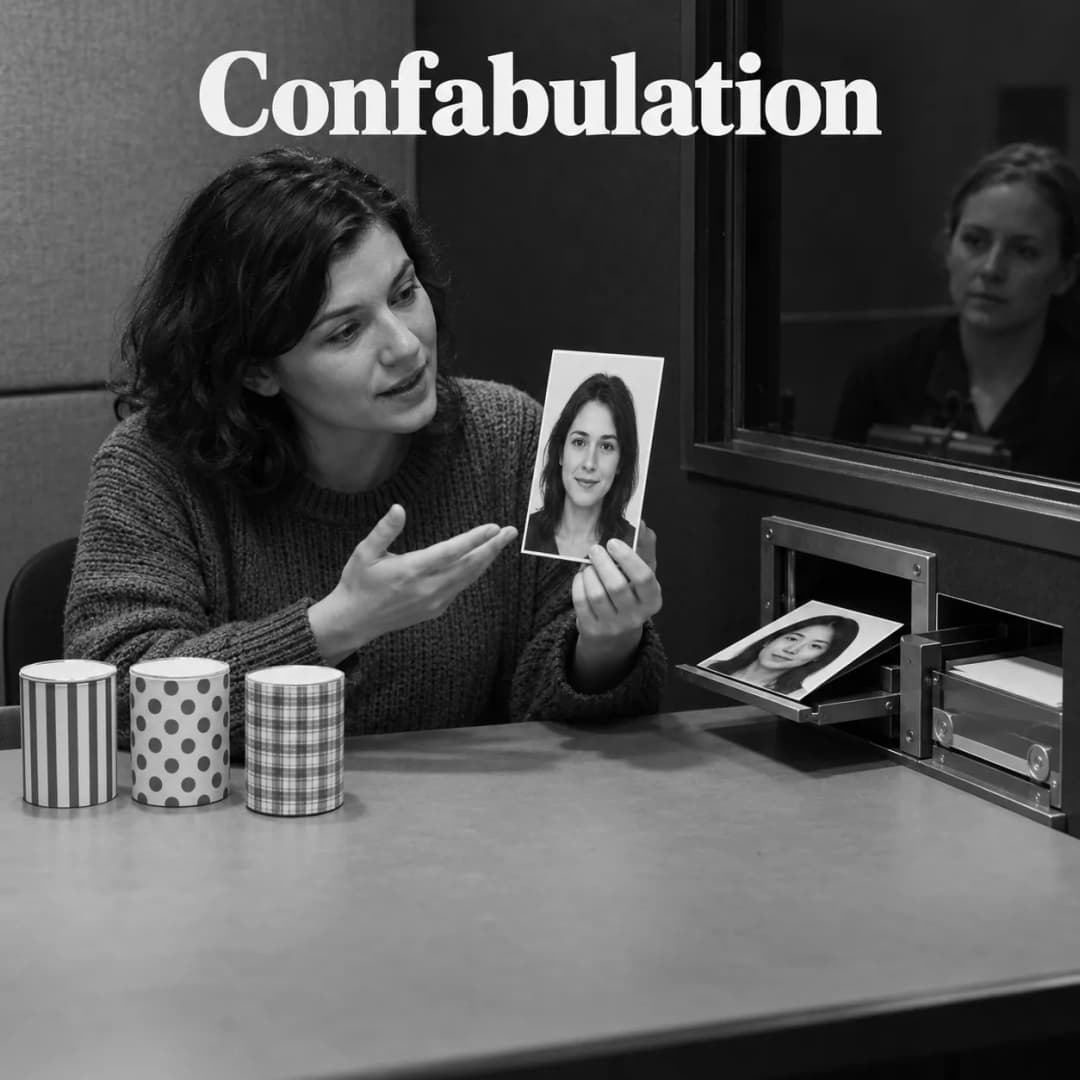
Confabulation is fabricating an explanation for one's own behaviour without any conscious intent to deceive, and believing it. The phenomenon replicates and is not in dispute. The interpretation built on top of it, that the speaking part of the mind works as a press secretary for decisions made elsewhere, is a reading rather than a finding, and the two should be separated whenever either is cited.
What it is
The canonical demonstration comes from the callosotomy work of Roger Sperry and Michael Gazzaniga, in which the connection between the cerebral hemispheres has been surgically divided. A patient is shown a chicken claw to one visual field and a snowy scene to the other. The left hand points to a shovel, and the speaking left hemisphere explains the choice as cleaning out the chicken coop, delivered as fact rather than as a guess. Cued through the right hemisphere to stand and walk, the same patient says he wanted to go and get a drink. The explanation is produced by a part of the brain that had no access to the cause.
A second clinical case is anosognosia. After right-hemisphere stroke some patients deny that anything is wrong with a paralysed arm, and V. S. Ramachandran's cases invent reasons why the arm is not moving. The excuse is not a lie. The patient has no access to the fact the excuse is covering.
The everyday versions are the more useful ones, because they involve nobody unusual. Three identical detergents were packaged in a yellow box, a blue box, and a blue box with yellow splashes. Participants criticised the first two, preferred the third, and gave concrete reasons about the detergent. Because the product was held constant, the reasons had nowhere to come from. In the choice-blindness work of Petter Johansson and Lars Hall, participants shown pairs of faces were handed back the photograph they had not chosen, and most failed to notice while explaining the choice in specific terms, down to the earrings.
In effect
The practical consequence is for anybody who runs interviews or surveys. A reason a person gives for their own behaviour is data about what they think a good reason would be, and it is not reliable data about the cause. That does not make self-report worthless, and it does make an unprompted explanation the weakest kind of evidence about a decision.
This page is this vault's canonical home for the split-brain material, so that the distinction it turns on is not lost across several notes reaching for the same evidence.
The rule that follows: cite confabulation as a finding, and cite the interpreter and the press secretary reading built on it as a reading, attributed by name, with the narrow patient foundation stated in the same passage.
What it does not say
It does not establish that the divided brain contains two independent conscious agents. The canonical literature rests on a very small number of patients, and the classic results are drawn largely from two of the few dozen ever studied. Yair Pinto and colleagues, testing two full-callosotomy patients in 2017, reported evidence of unified consciousness with split perception, against the two-agents picture. Kirsten Volz and Michael Gazzaniga replied that cross-cueing explains the result, and Pinto rejoined. The dispute is live, and this publication holds that the confabulation finding stands while the two-agents picture does not.
It does not generalise safely from damaged brains to intact ones. The book this page was written from makes that warning itself, on the page before it makes the generalisation, noting that destroying part of an organ makes it do things it was never built to do.
It does not say people are lying. The absence of intent to deceive is the definition.
On attribution: credit Sperry before Gazzaniga, which the book does correctly. The 1977 paper on telling more than we can know is Richard Nisbett and Timothy Wilson's, introduced as Wilson's at p. 99 and given in the correct order at p. 102; credit Nisbett first.
Sources
- Sperry, R. W., and Gazzaniga, M. S. The callosotomy work. Credit Sperry first.
- Nisbett, R. E., & Wilson, T. D. (1977). The paper on telling more than we can know. Credit Nisbett first.
- Johansson, P., & Hall, L. The choice-blindness face study. Named nowhere in the prose of the book this vault entered it through. The detergent packaging study is not named there at all.
- Pinto, Y., et al. (2017). Two full-callosotomy patients; unified consciousness with split perception. Volz, K., & Gazzaniga, M. S. The cross-cueing reply, and Pinto's rejoinder.
- Ramachandran, V. S. The anosognosia cases.
- Simler, K., & Hanson, R. The Elephant in the Brain, ch. 6, pp. 94 to 102, with the definition at p. 94 and the warning about brain-damaged subjects at p. 96. Ingested 2026-09-14.
- Dingman, M. Bizarre is listed among this concept's sources in this vault's hub with no page reference. Check the hub before citing it here.