Credence Goods
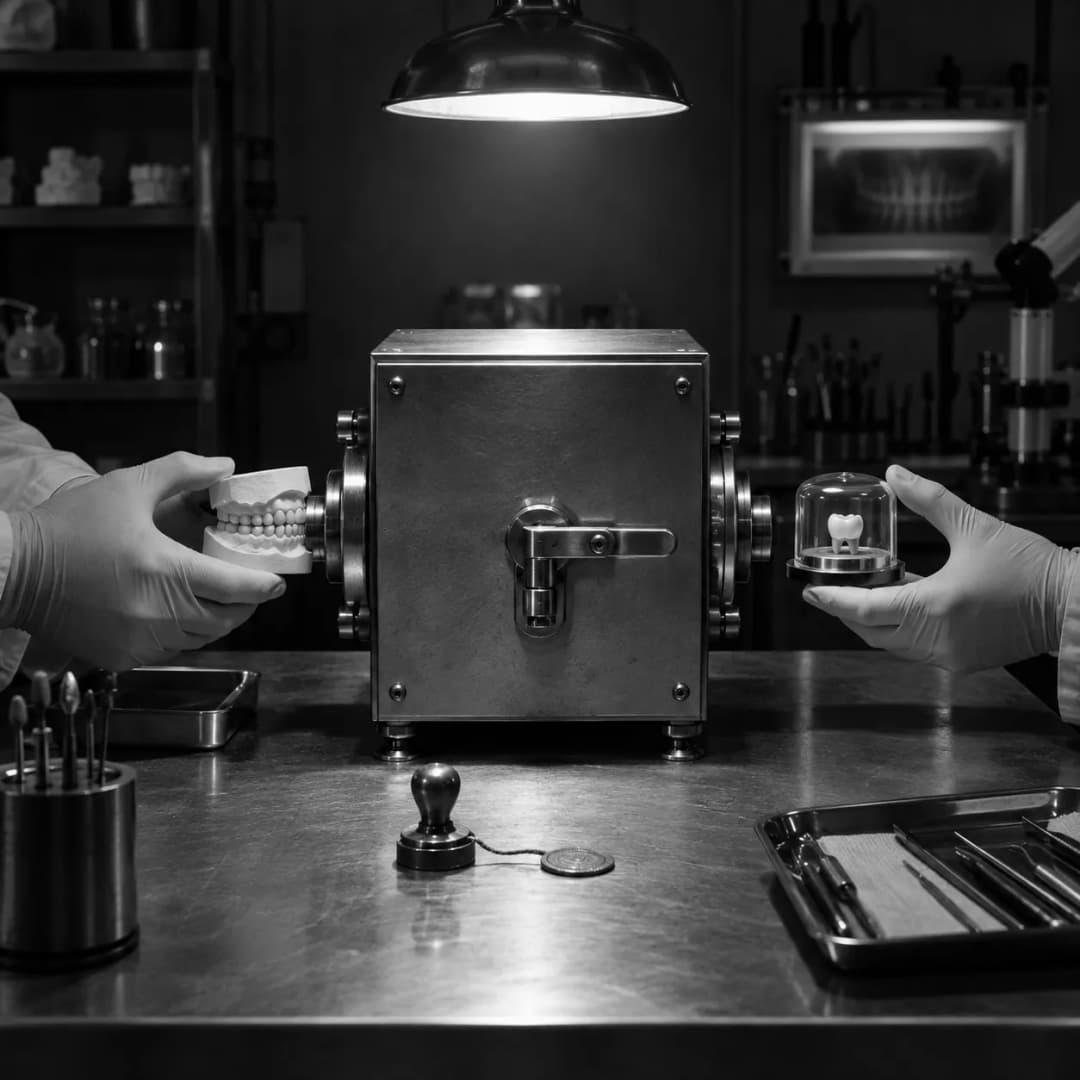
A good whose quality you cannot assess before buying and cannot assess after using. A dental filling, a car repair, a vitamin. The expert diagnoses the problem and then sells you the solution, which is a structural condition rather than an accusation about anybody. An experiment with 936 participants found that only one of the four proposed remedies for it actually works.
What it is
Economists sort goods by when you can judge them. A search good you can judge before buying, such as a shirt's colour. An experience good you can judge after using, such as a restaurant meal. A credence good you cannot judge at either point.
Uwe Dulleck and Rudolf Kerschbamer set out the economics in the Journal of Economic Literature in 2006, under a title that names the territory plainly: doctors, mechanics and computer specialists. The asymmetry is severe enough to produce specific failures, which they name as undertreatment, overtreatment, overcharging and, in the worst case, market breakdown.
The condition was identified long before it was formalised. Stuart Chase and Frederick Schlink argued in Your Money's Worth in 1927 that mass production had severed the buyer from any means of knowing what they were buying, which is the same observation without the vocabulary.
In effect
The useful work is in the 2011 experiment, with Matthias Sutter, in the American Economic Review. 936 participants, and four proposed remedies varied against each other.
Liability, where the seller is answerable if the treatment does not solve the problem, had a crucial effect. Verifiability, where the buyer can confirm afterwards which treatment they received, had at best a minor one. Reputation had little influence, which the theory had predicted. And competition drove prices down and produced maximal trade while not producing higher efficiency, as long as liability was violated.
That reorders consumer advice. Being able to check afterwards matters less than being able to hold somebody answerable, so a guarantee that the problem is fixed or you do not pay is worth more than an itemised invoice. And shopping around gives you price information about a diagnosis you still cannot evaluate.
What it does not say
It does not say any trade behaves badly. This is a designed experiment with participants in a modelled market, not an audit of dentists or garages.
It does not estimate how often the failures occur. The theory says the incentive exists; nothing here says how often it is acted on, and anybody quoting a proportion is working from something other than these papers.
And the reputation result should not be stretched into a verdict on reviews. It is a finding about a defined game with a defined number of rounds, and real reputation systems are larger and messier than that.
Sources
- Dulleck, U., & Kerschbamer, R. (2006). "On doctors, mechanics, and computer specialists: the economics of credence goods." Journal of Economic Literature. doi:10.1257/002205106776162717. Verified at the published record, 5 October 2026.
- Dulleck, U., Kerschbamer, R., & Sutter, M. (2011). "The economics of credence goods: an experiment on the role of liability, verifiability, reputation, and competition." American Economic Review, 101(2), 526-555. doi:10.1257/aer.101.2.526. Verified at the published record, 5 October 2026.
- Chase, S., & Schlink, F. J. (1927). Your Money's Worth. Read in full in this vault, 20 September 2026.