Crowd Psychology
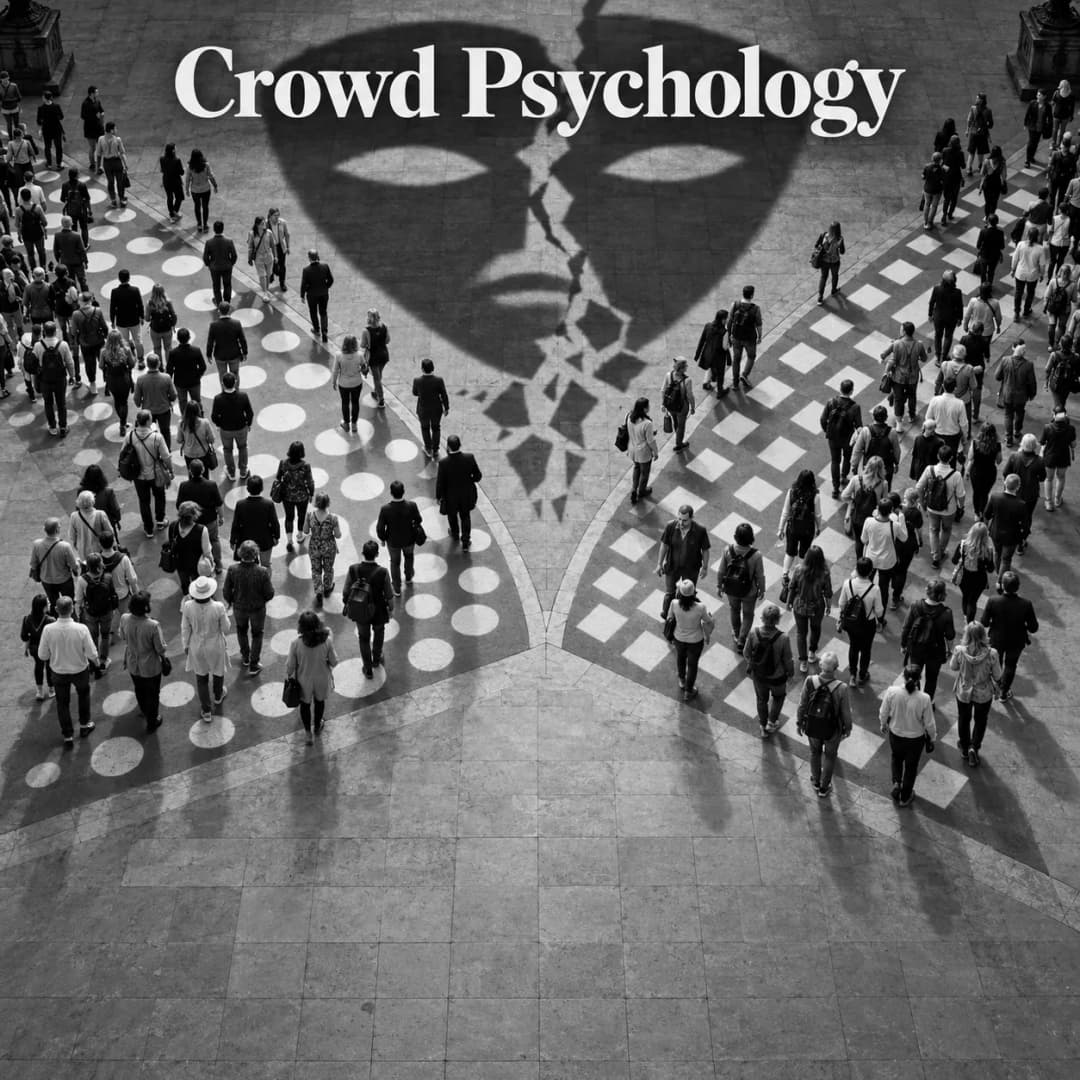
Crowd psychology is the nineteenth-century claim that a person inside an excited crowd loses critical distance, sheds personal responsibility into the group and becomes more suggestible than they would be alone. It is associated with Gustave Le Bon, though Scipio Sighele published first, and it was enormously influential on twentieth-century propagandists. The modern evidence does not support it. A meta-analysis of the deindividuation literature found little sign either of antinormative behaviour or of the dissolved self the theory requires, and what it did find looks more like people conforming harder to the norms of the particular situation. The history of how the theory was used is real. The theory itself is contested and should be attributed rather than asserted.
What it is
The founding texts are Italian and French and they arrive close together. Scipio Sighele's La folla delinquente appeared in 1891 and is usually treated as the first book on the subject, with Gabriel Tarde working the same ground. Gustave Le Bon's Psychologie des foules followed in 1895 and is the version that travelled, to the point that Sighele complained publicly that Le Bon had drawn on his work without credit. Sigmund Freud took the account up later and gave it a psychoanalytic frame.
The mechanism, as Le Bon set it out, is a group mind. Individual judgement is submerged, responsibility diffuses so that no one feels themselves the author of what the crowd does, and suggestion passes through the assembly with nothing to stop it. Tim Wu's addition is a media argument rather than a psychological one: radio and staged mass rallies let a state produce that crowd state at national scale, without needing everyone in the same hall.
Walter Lippmann is often described as extending Le Bon, and he is not. In Public Opinion he mentions Le Bon once, as the prophet of an opposing school, sets him alongside talk of a collective soul or a national mind, and rejects the whole family: the facts, he writes, can be explained more convincingly without the help of the oversoul in any of its disguises. His replacement has nothing mysterious in it. Where Le Bon has a crowd mind, Lippmann has a machine made of nameable people, and where Le Bon has suggestibility, Lippmann has an ordinary limit on what a mass can do, which is to say yes or no to something put in front of it. Two rival accounts, not one updating the other.
In effect
The historical record of the theory's use is the part that holds. Hitler's early beer-hall speeches tested the technique at small scale. Albert Speer's staging at Nuremberg, with its searchlights, formations and choreography, scaled it into what Speer himself called total theatre. Alfons Heck's account of attending one rally and being converted on the spot is Wu's evidence that something happened to individuals and not only to crowds in the abstract. The method was deliberately narrow: a handful of points, repeated without variation, pitched at emotion and explicitly refusing argument as a mode.
Wu's non-authoritarian comparator is William Jennings Bryan's Cross of Gold speech at the 1896 Democratic convention, the same crowd mechanics turned to persuasion inside a democracy rather than against one.
All of this is history of what propagandists believed and did. It is not evidence that their theory of mind was correct, and it should be written that way. What the controlled literature does support is narrower and better behaved: social facilitation, the change in individual performance produced by the mere presence of others, and diffusion of responsibility, the fall in the likelihood that any one bystander acts as the number of bystanders rises. Both are robust and both belong to Le Bon's side of the question rather than Lippmann's, but neither requires a group mind.
What it does not say
It does not say that people in crowds lose their selves. Tom Postmes and Russell Spears pooled sixty independent studies of deindividuation and reported little support either for antinormative behaviour or for the deindividuated state itself. What the data fit better is a social identity account, in which group members conform more closely to the norms that are salient in that specific situation. That is a different claim, and a less alarming one.
It does not say that Le Bon was first. Sighele's book precedes his by four years and Tarde was working alongside. Le Bon popularised the idea; he did not originate it.
It does not license restating the classical mechanism in this publication's own voice. Suggestibility, submerged judgement and the crowd soul are claims from a particular nineteenth-century literature and should be attributed to it every time they appear.
And it does not tell you that the staged rally worked because the theory was true. It tells you that the people staging rallies had read the theory, which is a fact about them.
Sources
- Sighele, S. (1891). La folla delinquente. Usually treated as the first book of crowd psychology.
- Le Bon, G. (1895). Psychologie des foules. The popularising text. The 1896 date that circulates is the English translation.
- Wu, T. (2016). The Attention Merchants. Knopf. Le Bon and Freud applied to radio-age Germany, the beer-hall speeches, Speer's Nuremberg staging, the Alfons Heck conversion account and the Bryan comparison, at pp. 111-115.
- Lippmann, W. (1922). Public Opinion. Read in full. Le Bon at Part V, Chapter XIII, section 1; the rejection of the oversoul and the machine that replaces it at Chapter XIV, section 4; the yes-or-no limit at Chapter XIV, section 5; the loose-talk passage at Part III, Chapter VI, section 5. No page numbers exist in this edition, so cite by part, chapter and section.
- Postmes, T. & Spears, R. (1998). "Deindividuation and antinormative behavior: A meta-analysis." Psychological Bulletin, 123(3), 238-259. 60 independent studies. Read from the abstract.