Dark Patterns
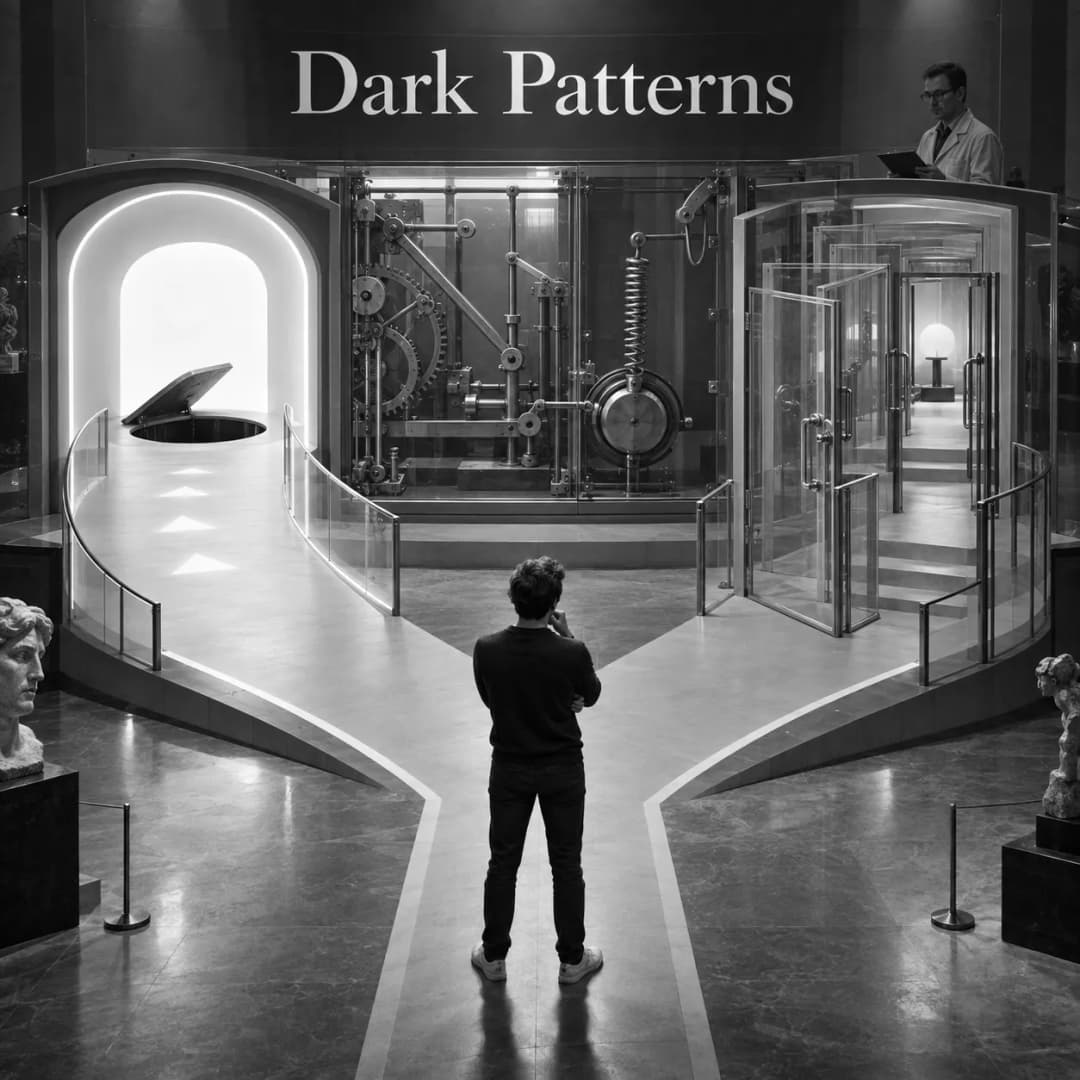
Dark patterns are interface designs that steer a user into a choice they would not make if the options were laid out plainly. The point is not that design influences behaviour, since all design does, but that these designs work against the user's own stated goal and depend on the user not noticing. The term is Harry Brignull's, from 2010. Both halves of the claim are well evidenced: large crawls show the designs are common, and randomised online experiments show they shift what people sign up to. What is still open is where persuasion ends and deception begins, and that is a legal and ethical line rather than an empirical one.
What it is
Harry Brignull, a user experience practitioner, coined the phrase in 2010 and began cataloguing instances publicly. The taxonomy that grew out of that work is descriptive rather than theoretical: it names the shapes that recur.
A subscription that takes one tap to start and a telephone call to cancel. A pre-ticked box adding travel insurance to a flight. A refusal button worded so that declining feels foolish, along the lines of no thanks, I prefer to pay full price. A countdown timer on a hotel room that resets when the page is reloaded.
What unites them is not that they persuade. It is that they rely on asymmetry. The designer knows the pattern is there and the user does not, and the design would stop working the moment the user did. James Williams treats them as the visible surface of a deeper problem, which is an industry optimising for what a person can be made to want rather than serving what they already want.
In effect
Two lines of evidence carry this concept, and they answer different questions.
Prevalence. Arunesh Mathur and colleagues crawled roughly eleven thousand shopping sites and catalogued deceptive patterns on a meaningful minority of them, with an accompanying map of which third-party services supply them ready-made. The designs are not rare and they are not artisanal.
Effect. Jamie Luguri and Lior Strahilevitz ran large online experiments in which participants were offered an unwanted subscription service through interfaces varying in how hard they pushed. Mild dark patterns substantially raised the proportion who signed up. Aggressive ones raised it too but also provoked measurable backlash, which is a useful finding for anyone assuming that more manipulation is always better business. They also reported that less educated participants were more affected, which is the distributional point regulators care about.
For a reader the practical reading is narrow and reliable. When cancelling is harder than subscribing, when a default has been set for you, when a timer is counting down, the asymmetry is the signal. Reloading the page is a free test of the timer.
What it does not say
It does not say that all persuasive design is a dark pattern. Defaults, framing and friction are the ordinary materials of interface work, and choice architecture is unavoidable, since some arrangement has to be chosen. The distinguishing feature is working against the user's own stated goal while depending on concealment.
It does not settle where the line sits. The empirical work establishes prevalence and effect. Whether a given pattern is unlawful, or merely sharp practice, is a question for law and ethics, and jurisdictions are answering it differently.
It does not say that noticing protects you completely. The experiments varied the interface and measured behaviour in aggregate, and the backlash finding suggests recognition does something, but no study here licenses the claim that an informed user is immune.
And it does not require bad faith at every step. A pattern can be inherited from a template, or copied because a competitor's conversion rate is higher, without anyone in the building having decided to deceive. The effect on the user is the same.
Sources
- Brignull, H. (2010). darkpatterns.org. Coinage of the term.
- Mathur, A., Acar, G., Friedman, M. J., Lucherini, E., Mayer, J., Chetty, M. & Narayanan, A. (2019). "Dark patterns at scale: Findings from a crawl of 11K shopping websites." Proceedings of the ACM on Human-Computer Interaction, 3(CSCW).
- Luguri, J. & Strahilevitz, L. J. (2021). "Shining a light on dark patterns." Journal of Legal Analysis, 13(1), 43-109.
- Williams, J. (2018). Stand Out of Our Light. Cambridge University Press. Used here as the frame in which these designs act against a user's reflective goals, not as the source of the term.