Delusional Misidentification
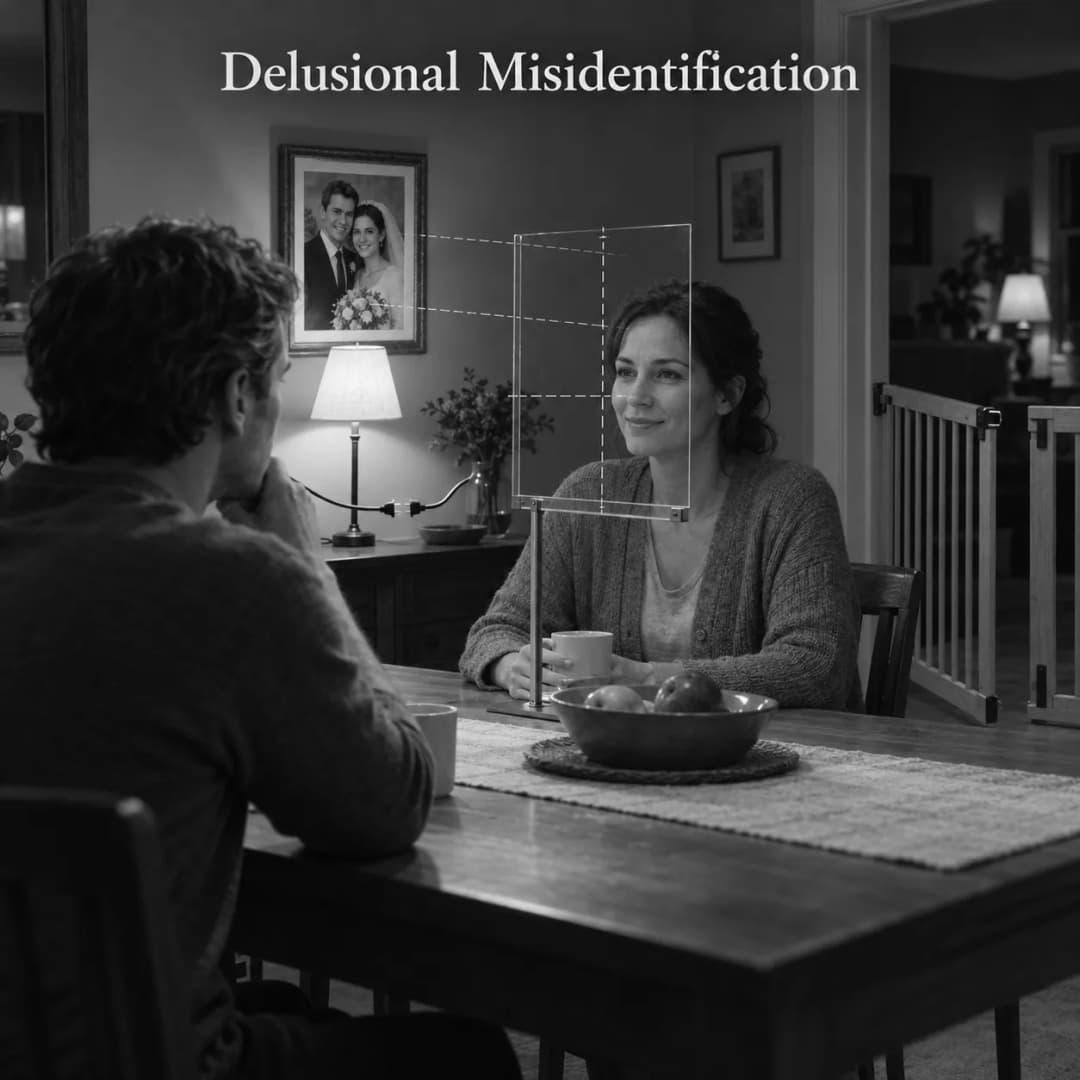
Delusional misidentification is a family of delusions in which a person, a place or the self is recognised and its identity is felt to be wrong. A spouse is agreed to look exactly like the spouse and is insisted to be an impostor. The family is instructive because it shows that recognition and the feeling of familiarity are separable, and that the delusion appears when the two disagree. The phenomena are robustly documented clinically. The explanatory model is well supported and built largely on single cases, which is a real limit and not a reason to doubt that the syndromes exist.
What it is
Joseph Capgras and Jean Reboul-Lachaux described the first case in 1923: a patient who maintained that her spouse had been replaced by an identical double. Courbon and Fail described the mirror-image syndrome in 1927, in which many strangers are felt to be one familiar person in disguise. George Christodoulou's edited volume in 1986 consolidated the scattered syndromes into the family they are now treated as.
The leading explanation has two parts and both are needed. The first is a recognition and affect mismatch, proposed by Ellis and Young in 1990: the face is processed and identified normally, but the usual autonomic surge of familiarity that accompanies a loved face does not arrive, so the person is recognised without feeling recognised. That alone would produce a strange feeling rather than a fixed belief. The second part is a failure of belief evaluation, the two-factor theory of Davies, Coltheart, Langdon and Breen, published in 2001, which supplies the reason the odd feeling is not rejected as implausible but is instead accepted and defended.
Everyday déjà vu and jamais vu are faint and harmless cousins of the same mismatch, which is a useful way in for a reader who has never met the clinical form.
In effect
The practical value of the family is diagnostic and conceptual rather than therapeutic. Clinically, the presentations are distinctive enough to be recognised, and they appear in the context of neurological damage as well as of psychiatric illness, which is part of why the two-factor account has held.
Conceptually, the family is one of the cleanest demonstrations available that familiarity is not a by-product of recognition but a separate signal that can fail on its own. That has consequences well outside psychiatry, because a great deal of ordinary judgement runs on how familiar something feels rather than on whether it has been identified.
Popular neuroscience writing tends to use the two-factor mechanism without naming the people who proposed it, describing the plausibility-checking failure as though it were simply how the brain is known to work. The mechanism is a specific published theory with named authors and it should be credited as one.
What it does not say
It does not say the patient cannot see. Visual recognition is typically intact, which is what makes the delusion so striking: the person agrees about every feature of the face and rejects the identity anyway.
It does not say the belief is a reasoning error alone. The one-factor version, in which the odd experience is simply reasoned about badly, does not account for why people with comparable autonomic disruption and intact belief evaluation do not develop the delusion. Both factors are needed.
It does not rest on the kind of evidence the word robust usually implies in this publication. The clinical documentation is mostly case reports and small series, because the presentations are rare. The verdict here is that the phenomena are securely described, not that large controlled samples exist.
And it does not transfer to everyday misrecognition. Mistaking a stranger for a friend in the street is a perceptual error that corrects itself on a second look. These delusions survive correction, which is the whole point of the second factor.
Sources
- Capgras, J. & Reboul-Lachaux, J. (1923). The first described case, of the illusion of doubles.
- Courbon, P. & Fail, G. (1927). The first description of the syndrome of the multiple double in disguise.
- Christodoulou, G. N. (ed.) (1986). The Delusional Misidentification Syndromes. Karger. The volume that consolidated the grouping.
- Ellis, H. D. & Young, A. W. (1990). "Accounting for delusional misidentifications." British Journal of Psychiatry, 157, 239-248.
- Davies, M., Coltheart, M., Langdon, R. & Breen, N. (2001). "Monothematic delusions: Towards a two-factor account." Philosophy, Psychiatry, & Psychology, 8(2-3), 133-158.
- Dingman, M. (2023). Bizarre. Nicholas Brealey. The misidentification chapter. The plausibility-checking mechanism it uses is Davies and colleagues' and is credited nowhere in the text.