Denominator Neglect
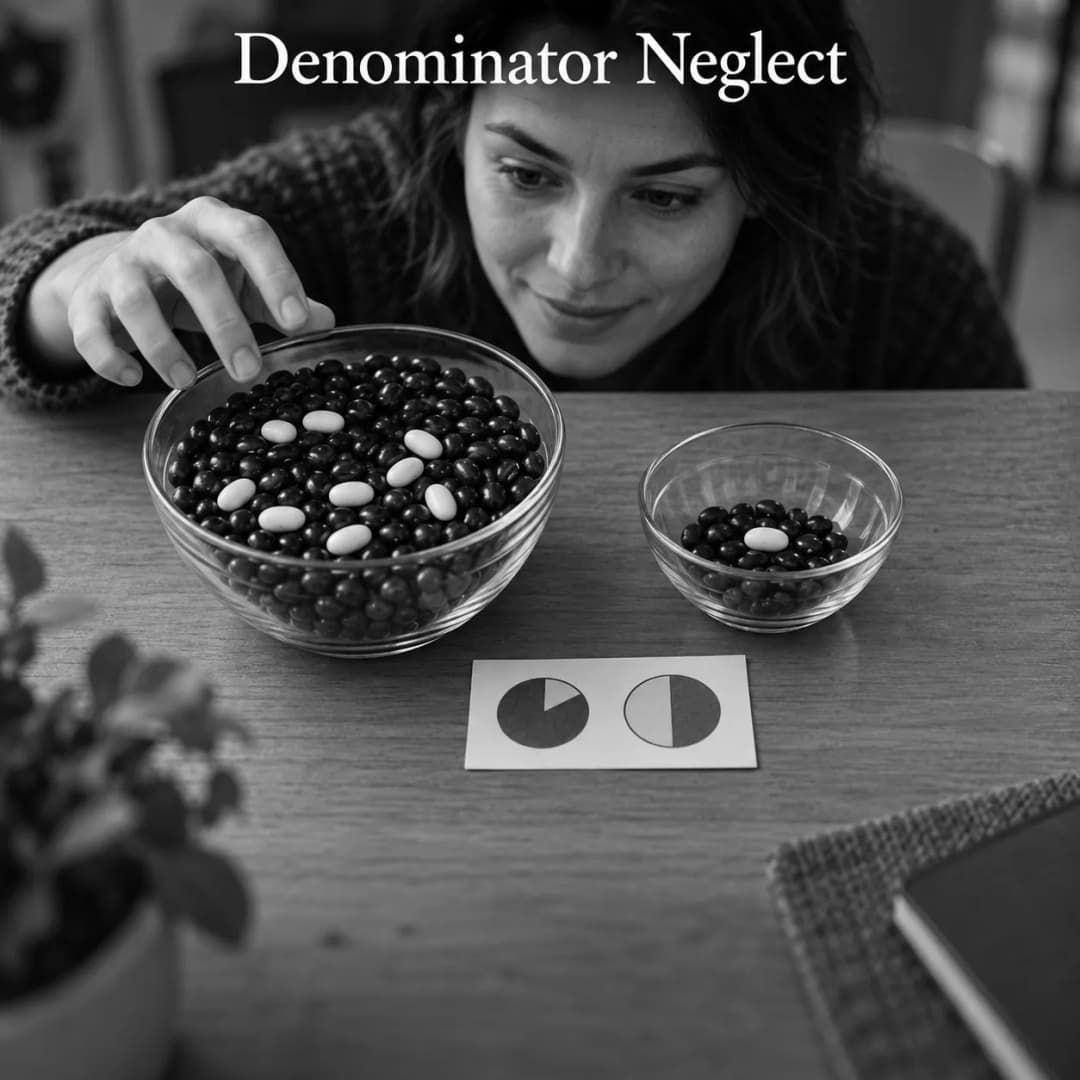
Denominator neglect is attending to the number of cases and ignoring the base they sit on. One in a hundred thousand produces a mental image of a person, while the hundred thousand who are fine produce no image at all, so the risk feels larger than the identical figure stated as a percentage. It is also called the ratio bias, and frequency-format effects of this kind are among the steadier findings in judgement research. What is weak is not the phenomenon but the sourcing in the popular accounts, which print the most consequential figures with no researcher attached. The primary papers exist and are named below.
What it is
The laboratory demonstration comes from Seymour Epstein's laboratory. Kirkpatrick and Epstein in 1992, and Denes-Raj and Epstein in 1994, put people in front of two bowls of beans or marbles. One holds ten, of which one is a winner. The other holds a hundred, of which eight or nine are winners. Draw blind. The small bowl is the better bet, and a substantial minority take the large one anyway, some of them while saying out loud that they know it is the worse choice, because a handful of winning beans is a more vivid quantity than one winning bean and the denominators never enter the picture.
Epstein's reading of that result is that an experiential system runs alongside a rule-based one and does not defer to it, which is why the conflict can be felt rather than merely inferred.
The label denominator neglect is often attributed to Paul Slovic in secondary coverage. Who first used it has not been established here, and this publication does not credit anyone with coining it. The finding belongs to Epstein's laboratory.
In effect
The consequential study is a forensic one, and popular accounts print it with nobody's name on it. Slovic, Monahan and MacGregor asked mental health professionals to judge whether a patient was safe to discharge. Told that ten of every hundred patients like this one are estimated to commit an act of violence, they refused discharge in forty-one per cent of cases. Told there was a ten per cent probability of the same, they refused in twenty-one per cent. The same statistic, and twice the caution, from people whose profession is exactly this judgement.
That makes this concept a lever rather than merely a demonstration of error, and it points both ways. Frequency formats make risk feel bigger. This is why one in a hundred thousand appears in campaigning material and a hundredth of a per cent appears in defensive material, and why both are honest arithmetic. Anyone writing about health, safety or money is choosing a denominator whether they notice it or not, and the professional standard is to give both, which removes the choice rather than hiding it.
It also cuts against the flattering reading of the wider heuristics programme. The same frequency framing that inflates perceived risk here reduces error in the conjunction fallacy, where presenting the problem in frequencies cut mistakes sharply. Format is not a bias to be argued away. It is a variable, and it does not always push in the direction that makes people look better.
What it does not say
It does not say that people cannot do the arithmetic. Participants in the bowl experiments often state the correct odds and choose against them, which is why an account in terms of two systems in conflict was proposed rather than an account in terms of innumeracy.
It does not say that frequency formats are wrong and percentages right. Neither is wrong. They are the same number, and the choice between them is a rhetorical decision that a writer is making on the reader's behalf.
It does not say that frequency framing always worsens judgement. In the conjunction work it improves it, substantially.
And it does not license the figures that circulate without their sources. The urn result and the forensic discharge figures both have papers behind them, named below, and for years those numbers travelled through popular accounts with no researcher attached. Anyone quoting the forty-one against twenty-one comparison should be quoting Slovic, Monahan and MacGregor.
Sources
- Kirkpatrick, L. A. & Epstein, S. (1992). "Cognitive-experiential self-theory and subjective probability." Journal of Personality and Social Psychology, 63(4), 534-544.
- Denes-Raj, V. & Epstein, S. (1994). "Conflict between intuitive and rational processing: When people behave against their better judgment." Journal of Personality and Social Psychology, 66(5), 819-829.
- Slovic, P., Monahan, J. & MacGregor, D. G. (2000). "Violence risk assessment and risk communication." Law and Human Behavior, 24(3), 271-296. The source of the 41 per cent and 21 per cent discharge-refusal figures.
- Kahneman, D. (2011). Thinking, Fast and Slow. Farrar, Straus and Giroux. The urns, the forensic study and the attribution to Slovic and Epstein. The book names no researcher for the forensic study. This publication's reliability audit of the book applies with full force to this chapter.
- Verified in the vault on 2026-09-25 from secondary sources. Who first used the label denominator neglect is not established, and Slovic is not credited with coining it here.