Deskilling
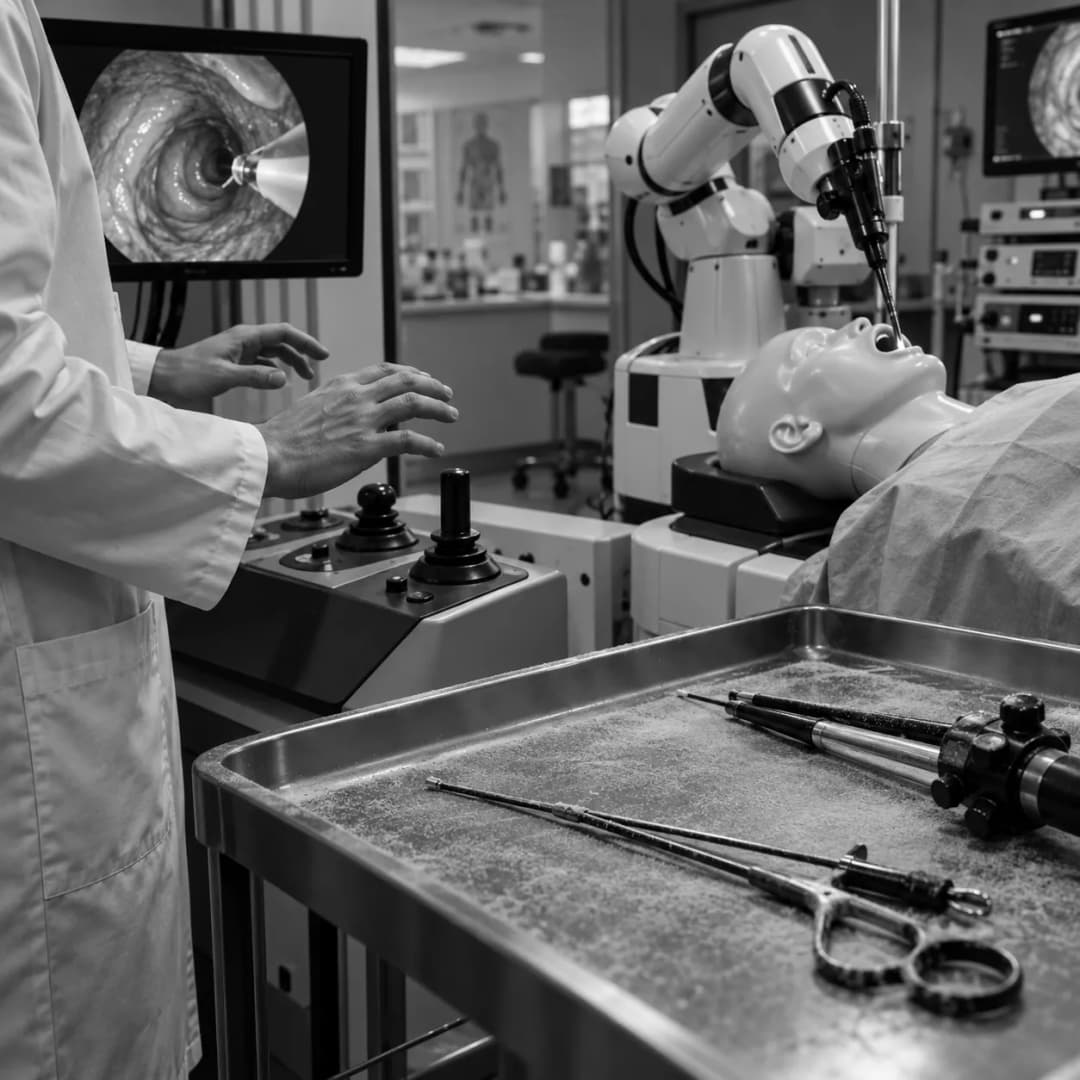
Deskilling is the loss of a skill through reliance on a tool that does part of the work. In medicine the concern is that clinicians who routinely use AI may perform worse when the AI is not available. The first clinical measurement of it came from colonoscopy in 2025.
What it is
Krzysztof Budzyń and colleagues studied four endoscopy centres in Poland that introduced AI tools for polyp detection at the end of 2021, as part of the ACCEPT trial. After the tools arrived, colonoscopies were assigned to be done with or without AI depending on the date. The researchers compared standard colonoscopies, done without AI, in the three months before and the three months after the AI was introduced. Across 1,443 patients, the adenoma detection rate in non-AI colonoscopies fell from 28.4 per cent to 22.4 per cent. Exposure to AI was independently linked to the lower rate, along with the patient's sex and age. The study was published in The Lancet Gastroenterology & Hepatology in 2025 and was widely reported.
In effect
Deskilling matters for any service that relies on AI but cannot guarantee it will always be running, and for any plan that relies on clinicians to check an AI's work. A clinician whose own detection has slipped is less able to catch the machine's misses. It sits alongside automation bias, measured by Thomas Dratsch and colleagues in 2023, in which radiologists followed wrong AI suggestions on mammograms.
What it does not say
The colonoscopy study was observational. It compared two periods rather than randomly assigning doctors to use AI or not, so other changes over the same months could account for part of the fall. It does not show that AI-assisted colonoscopy is worse overall: randomised trials find that detection rises when the AI is in use. The question it raises is about performance without the tool, and how quickly skills return or decline, which needs further study.
Sources
- Budzyń, K., Romańczyk, M., Kitala, D., Kołodziej, P., Bugajski, M., Adami, H. O., Blom, J., Buszkiewicz, M., Halvorsen, N., Hassan, C., et al., & Mori, Y. (2025). Endoscopist deskilling risk after exposure to artificial intelligence in colonoscopy: a multicentre, observational study. The Lancet Gastroenterology & Hepatology, 10(10), 896-903. doi:10.1016/S2468-1253(25)00133-5
- Dratsch, T., Chen, X., Rezazade Mehrizi, M., et al. (2023). Automation bias in mammography: the impact of artificial intelligence BI-RADS suggestions on reader performance. Radiology, 307(4), e222176. doi:10.1148/radiol.222176
- Soleymanjahi, S., Huebner, J., Elmansy, L., et al. (2024). Artificial intelligence-assisted colonoscopy for polyp detection: a systematic review and meta-analysis. Annals of Internal Medicine, 177(12), 1652-1663. doi:10.7326/ANNALS-24-00981