Dialoguing With Images
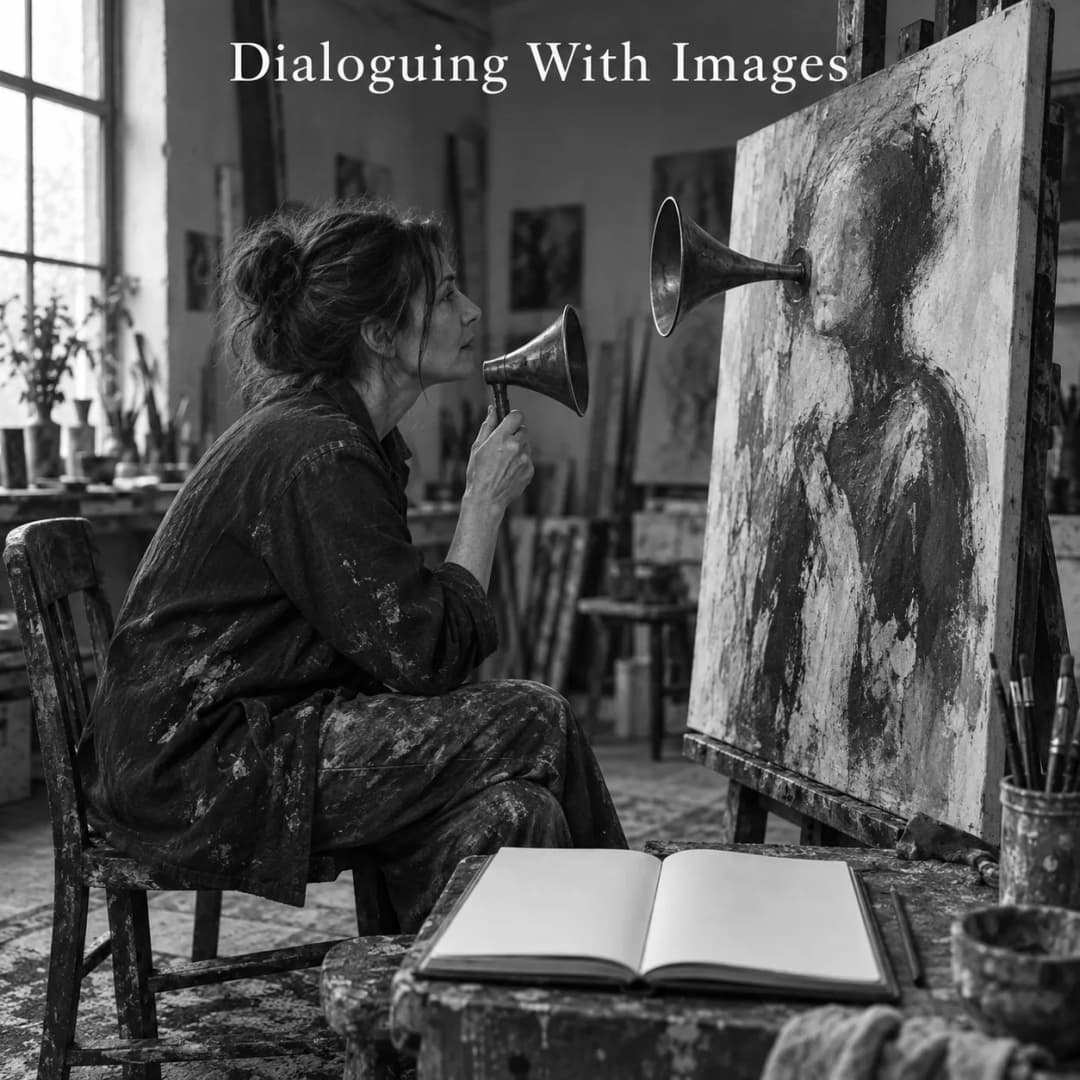
Dialoguing with images is Shaun McNiff's method of treating a painting as a presence that can be addressed: you speak to the image, then speak or write as it, instead of decoding it into a diagnosis. It is a technique and an ethical stance at once, because it refuses to reduce the image, or the person who made it, to a label. It has never been tested as a technique and this page records it as a method and a position rather than as a finding.
What it is
McNiff set the method out in 1992 as the centre of his approach to art therapy. It develops James Hillman's move of personifying, in which the figures of the psyche are addressed as beings rather than translated into concepts, and it has an older relative in Carl Jung's active imagination, the practice of entering into dialogue with inner figures.
What the method replaces is interpretation. In the interpretive mode a therapist looks at a dark red shape and asks what it means, with the answer drawn from a framework the client did not choose. In McNiff's mode the client is invited to ask the shape what it wants, and to answer in its voice. The shape says it is tired of being hidden. The meaning is made in the exchange rather than assigned from a manual.
The ethical half of the claim is that interpretation borrows an authority it has not earned, and that the borrowing is done at the expense of the person in the room.
In effect
In practice the method belongs to the studio rather than the clinic. It is used where the work of therapy is understood as a relationship with what has been made, and its value as reported by McNiff is clinical observation over a long practice.
It has a tested cousin worth knowing about, though the evidence does not carry across. Self-distancing, the practice of addressing your own situation from outside yourself, has its own experimental literature on how it changes the felt intensity of a problem. The Gestalt empty chair is a nearer relative in form. Neither of those evidence bases transfers to this method, and borrowing them for it would be exactly the kind of move this publication declines to make.
What it does not say
It does not claim a measured benefit. No controlled study of the method exists, and any claim of benefit is McNiff's clinical observation.
It does not inherit the evidence of the techniques it resembles. Empty chair work and self-distancing have been tested. This has not, and proximity is not evidence.
It does not say that interpretation is always wrong. It says that interpretation is a move with a cost, and it proposes an alternative that declines to pay it.
And it does not belong in a piece of writing as a therapeutic recommendation. It belongs there as a practice with a lineage, described as such.
Sources
- McNiff, S. (1992). Art as Medicine. Shambhala. The method as set out by its originator.
- McNiff, S. Art Heals. Chapter 9, "Treating Images as Persons", which sets out the method as the book's centre of gravity. Read in the vault on 2026-09-27.
- Hillman, J. Personifying, the move the method applies.
- Jung, C. G. Active imagination, the earlier practice of dialogue with inner figures.
- No controlled study of the method has been located.