Dopamine vs Here and Now
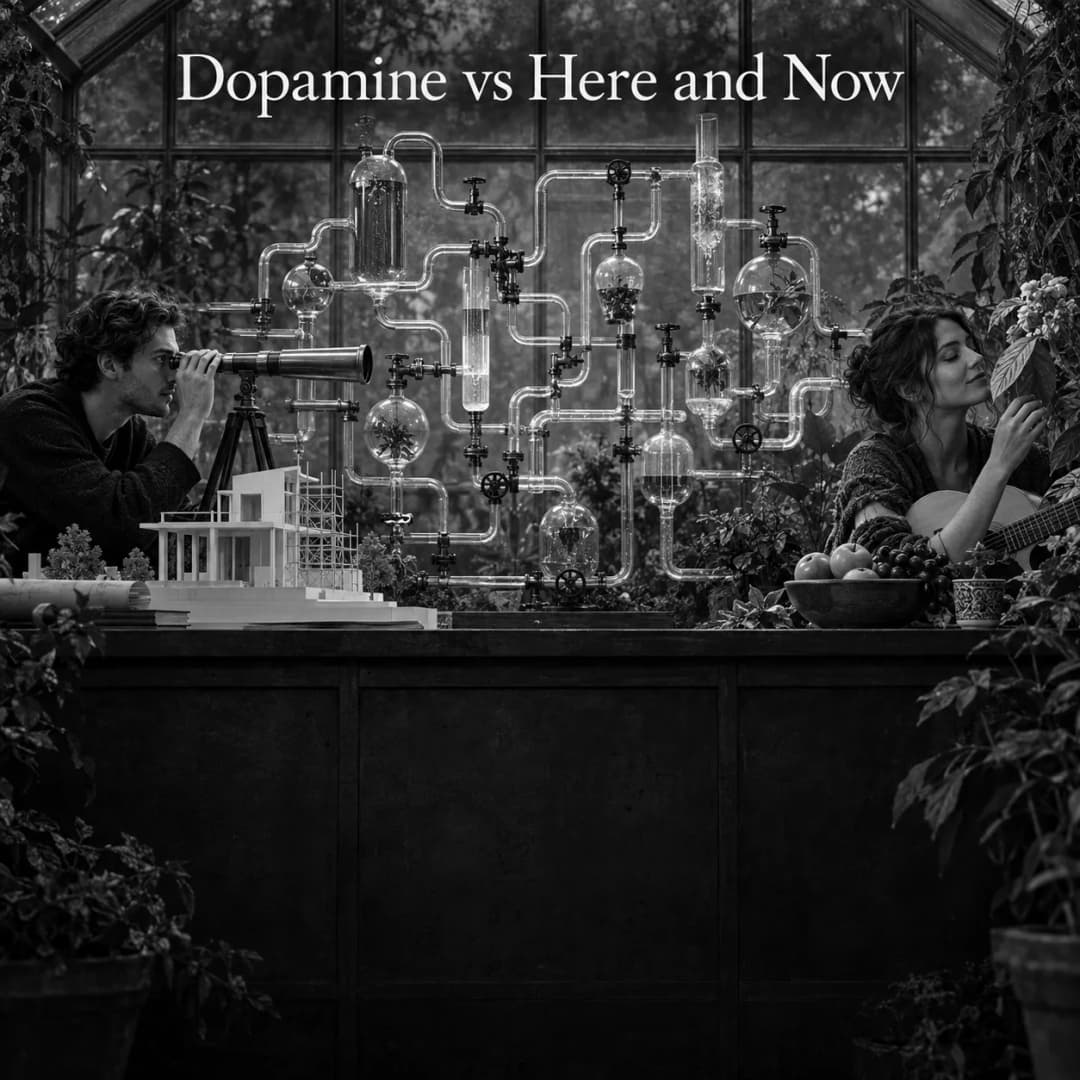
Dopamine versus the here and now is the organising dichotomy of The Molecule of More, and it is a borrowed one. Dopamine is cast as the chemistry of the future, of distance, abstraction, pursuit and dissatisfaction, and set against a group the authors call the here and now neurotransmitters, cast as the chemistry of the present, of sensation and contentment. The two are said to suppress each other. Parts of that picture are real: reciprocal mechanisms between the dopamine and serotonin systems exist, and anticipation and consummation genuinely are different. The strict see-saw is not established, oxytocin and endorphins have no established opponency with dopamine at all, and what a general reader takes to be settled neuroscience is in substance one contested monograph. This is the authors' framework and this publication never records it as a construct.
What it is
The provenance is volunteered and worth crediting. The book's acknowledgements credit Fred Previc and his 2009 book The Dopaminergic Mind in Human Evolution and History with the fundamental distinction between dopamine's future focus and the present focus of a group of other neurotransmitters. That is the most useful sentence in the front matter, and the framework is Previc's rather than the authors' own.
What the dichotomy does in the book is enormous. Love, addiction, creativity, politics and the course of civilisation are all mapped onto the single axis, with dopamine running when a thing is wanted and the other chemicals running when it is had.
What dopamine actually does, on the current evidence, is narrower and stranger than either the popular pleasure story or this dichotomy. It is centrally involved in reward prediction and in the motivational pull towards something anticipated, rather than in the enjoyment of it. That distinction is real and it is the reason the anticipation half of this framework lands. The mistake is in the second move, which takes a group of unrelated chemical families and assembles them into an opposing team.
In effect
The book is at its best when the device is doing metaphorical work. Dopamine, it says, cannot provide satisfaction any more than a hammer can turn a screw, and mastery is the point at which dopamine gives way and allows contentment. Those sentences reach something close to the right conclusion by a route that is not evidence.
It is at its worst when the device is asked to explain a result it did not measure. An Israeli experiment found that winners of a first dice game misreported a second, and the researchers explained the result by a sense of entitlement. The book reports that, then offers dopamine and domination as a better explanation. Nothing in that study measured dopamine, and the substitution is narrative rather than empirical.
The evidence, split honestly, runs like this. In favour: reciprocal inhibitory mechanisms between the dopamine and serotonin systems are real, serotonergic projections reach the ventral tegmental area and the nucleus accumbens, serotonin activity at one receptor class can inhibit dopamine release, and one influential model does cast dopamine as reward seeking and serotonin as behavioural inhibition under anticipated threat. Against: current reviews describe the relationship as multifaceted and mutual rather than oppositional, with the two acting as opposing forces or as collaborative partners depending on region and receptor subtype, and strict opponency fails in particular to account for serotonin's role in avoidance.
The right comparison is with the dissociation this framework resembles and does not reproduce. Kent Berridge's wanting and liking are separable systems with distinct neural substrates, established by manipulating one and observing the other. This is a see-saw with one chemical class placed on each end.
What it does not say
It does not say that dopamine is the pleasure chemical, and to the authors' credit the book is pushing against that error rather than repeating it. Dopamine is better described as doing the work of anticipation and pursuit.
It does not establish that the here and now chemicals form a system. Oxytocin, endorphins and serotonin are grouped for narrative convenience, and there is no established see-saw between that group and dopamine.
It does not rest on a reviewed literature. The framework comes from a single 2009 monograph whose reception is mixed, with critics faulting its theoretical foundations and its reliance on non-scientific sources, and no review of it in a major neuroscience journal was located.
And it cannot be checked by a reader. The book has no endnotes, no superscripts and no bibliography, only per-chapter further reading lists that map to no sentence in the text, so it is never the authority for a neuroscience claim. In fairness the authors pre-declare their own speculation gradient in a boxed note in the front matter, stating that the later chapters are speculative and that studies were selected rather than reviewed. That disclosure is real and unusual, and it is the yardstick this page holds the framework to.
Sources
- Previc, F. H. (2009). The Dopaminergic Mind in Human Evolution and History. Cambridge University Press. The originating framework, credited in The Molecule of More at p. xi.
- Lieberman, D. Z. & Long, M. E. (2018). The Molecule of More. BenBella. The popularisation. The reciprocal-suppression model is asserted across pp. 16-17 on the strength of a single correlational serotonin-receptor result. The dice study is at p. 85, the hammer and screw line at p. 213 and the mastery passage at p. 214. The speculation disclosure is at pp. xvii-xviii.
- The vault's external verification pass of 2026-09-19 established that reciprocal dopamine and serotonin mechanisms are real, that current reviews describe the relationship as complementary rather than antagonistic, including a 2025 primate study in Translational Psychiatry, and that oxytocin and endorphins have no established opponency with dopamine.
- Recorded as a criticism of a framework, not of its authors.