Eat-Your-Own Mentality
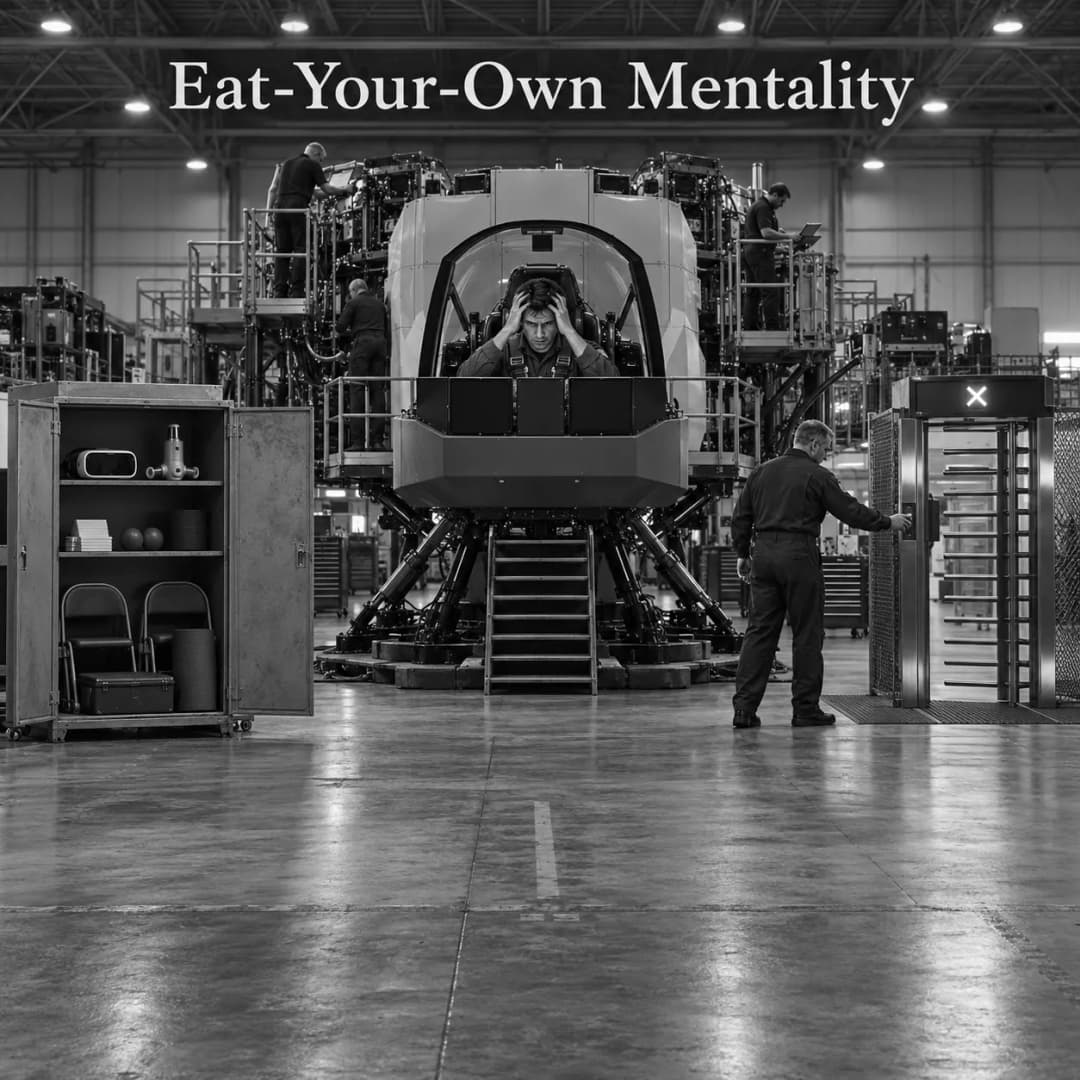
The eat-your-own mentality is the United States Air Force's former default on the mental side of flying: the belief that composure under pressure was innate, and that a student who unravelled should simply be washed out. It is institutional history, told candidly by an insider, and it is recorded here as history rather than as a finding. Its value is as a documented case of an organisation treating a trainable capacity as a fixed trait, at enormous cost, for decades.
What it is
The name is Hasard Lee's, a former fighter pilot writing about how the service changed its approach. No date is attached to the mentality's origin, because it was a default rather than a policy.
The arithmetic is the part that makes it vivid. Tens of millions of dollars are spent training each pilot, and until recently almost nothing was spent on optimising the pilot's mind. That is a resource allocation nobody would defend if the assumption behind it were stated out loud, and it persisted precisely because it never was.
The case Lee gives as the one that motivated change is a pair of students. A reasonably performing candidate imploded inside a week, failing three consecutive rides. A commercial pilot with prior hours graduated mid-pack, not because his flying was weak but because his resilience was. Two anecdotes carrying a general claim, and recorded here as anecdotes.
In effect
What replaced the mentality was a structured programme in mental skills, run first as a live experiment at a single base before being adopted more widely.
The more useful application of the concept is as a frame for reading the same service's celebrated debrief culture, in which rank is set aside and errors are examined without blame. An organisation looking enviously at the fighter squadron tends to treat that debrief as evidence of something innate to the institution. The eat-your-own mentality shows it is not. The same organisation that runs the blameless debrief also ran this, for decades, which means the debrief culture is something the Air Force built rather than something it had. That is the encouraging finding, and it is the one a company can act on.
The reclassification at the heart of the change, from composure as an innate trait to composure as a learnable skill, is mindset territory. Lee never names Carol Dweck, so this is convergence rather than borrowing, and the disputed effect sizes in the mindset literature are held elsewhere and not re-argued here.
What it does not say
It does not say the Air Force was uniquely bad. The assumption it describes is the ordinary one in any field that selects hard and trains expensively, which is part of why it is worth having a name for.
It does not establish that mental skills training works. The replacement programme is described from inside the institution by someone who took part in it, and no controlled evaluation is offered.
It does not rest on data. The two students are anecdotes and the spending comparison is an author's framing of public figures.
And it does not license reading across from a military training pipeline to an ordinary workplace without saying so. The selection pressure, the stakes and the population are all different.
Sources
- Lee, H. (2023). The Art of Clear Thinking. St Martin's Press. p. 198 for the culture and the spending comparison, pp. 196-197 for the selection rate and the two students, pp. 208-217 for the replacement programme. The reclassification of composure and confidence as learnable appears at pp. 198, 210 and 215.
- Carol Dweck is named nowhere in the book. The overlap with the mindset literature is recorded here as convergence, not as borrowing.