Emotional Labour
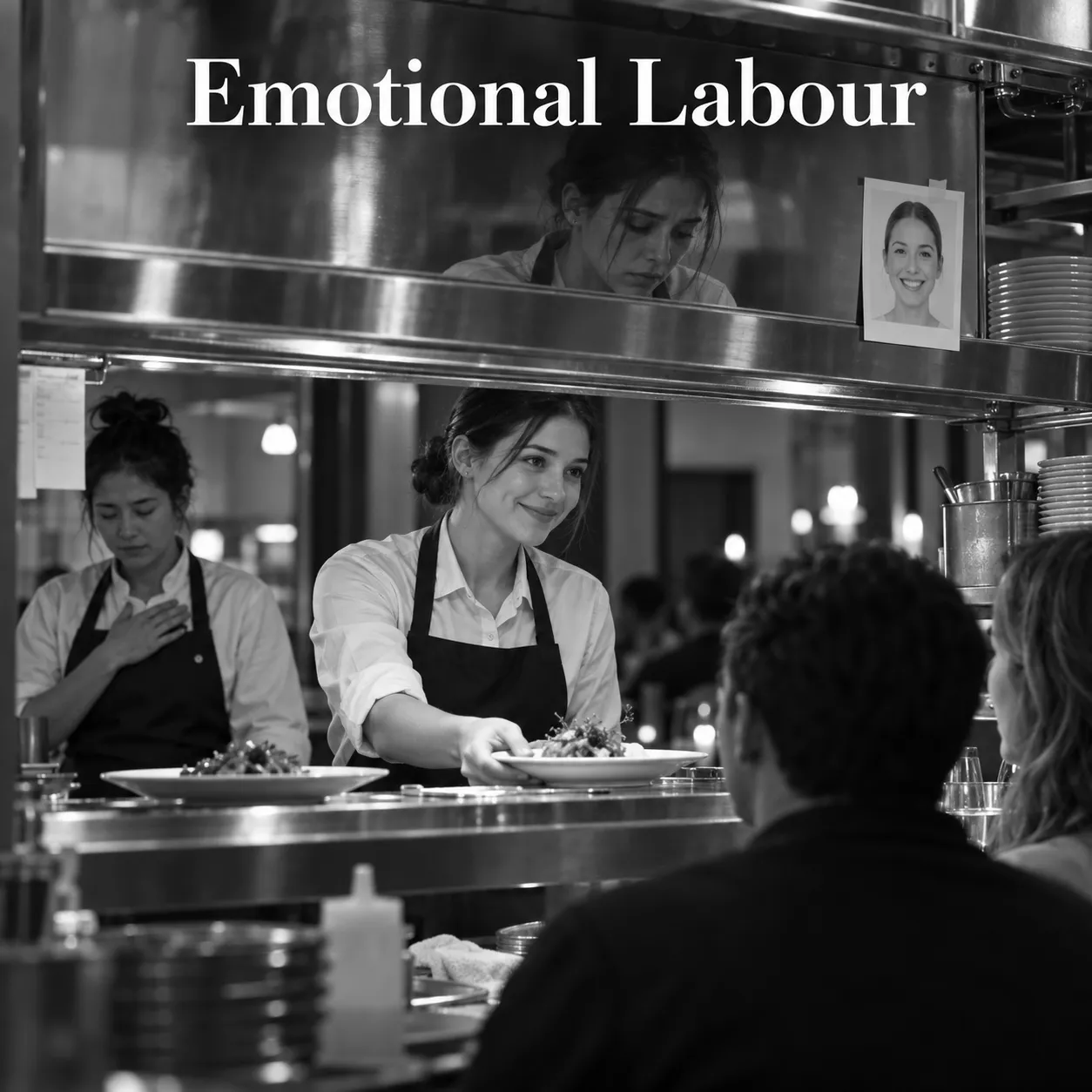
Emotional labour is the work of hiding or suppressing what you actually feel while displaying the emotion the job requires, which is sometimes the opposite of it. Arlie Hochschild named it in 1983, and her insight was that this is labour: it is effortful, it is bought and sold, and employers specify it as precisely as they specify anything else a worker does with their body. The concept itself is secure. The outcome literature is more uneven than popular use suggests, with a consistent link between one of the two strategies and exhaustion, weak and inconsistent findings for the other, and small effects on the customer outcomes it is usually invoked to explain.
What it is
Hochschild studied flight attendants and debt collectors, two jobs whose emotional requirements point in opposite directions, and found the same thing in both: the feeling displayed was a specified part of the job, trained for and supervised.
She distinguished two ways of meeting that specification, and both appear in The Managed Heart. Surface acting changes the display without changing the feeling, so the smile goes on over whatever is underneath and the gap stays open. Deep acting works on the feeling itself until the required display becomes genuine, closing the gap by changing the worker rather than the performance.
Alicia Grandey recast the pair in 2000 as emotion-regulation strategies, and most of the measurement work in the field descends from that paper rather than from Hochschild directly. This publication previously carried a flag suggesting the two terms were later additions to Hochschild's framework. That flag has been withdrawn: both terms are hers.
In effect
The concept travels far beyond psychology because most of the economy now runs on it. Every service interaction a reader has, the barista, the call centre, the cabin crew, the nurse, the checkout, is someone doing this on the clock. The more interesting half is that the reader is the audience the display is aimed at. The warmth is a product feature, priced in, and produced by a person under instruction.
On outcomes, the meta-analytic record is the thing to work from. Hülsheger and Schewe pooled the literature in 2011 and found a consistent association between surface acting and exhaustion and strain. Deep acting shows weak and inconsistent links, and its effects on customer satisfaction and performance are small. Most of the underlying studies are cross-sectional and rely on self-report, so causal language should stay modest.
Two framings sit in that same evidence and pull against each other. Hochschild's own treats emotional labour as an alienating cost imposed on the worker. The management literature treats it as a trainable job skill. This publication agrees with Hochschild on the cost and with the management reading on the trainability, and does not think those are in conflict, because something can be teachable and still be extracted.
The argument that some jobs therefore require inauthenticity, and that emotional labour is about concealing rather than revealing, is an opinion advanced by particular authors rather than a finding, and should be attributed to them rather than to a literature.
What it does not say
It does not establish that emotional display drives sales. The link to customer satisfaction is frequently described as presumed even by authors sympathetic to it, and the meta-analytic effects on customer outcomes are small.
It does not say both strategies cost the same. The consistent damage in the record attaches to surface acting. Deep acting's picture is weak and inconsistent, which is not the same as showing it to be harmless.
It does not support causal language. The bulk of the evidence is cross-sectional self-report, which cannot separate the worker who is exhausted because they surface act from the worker who surface acts because they are exhausted.
And it does not mean that any managed feeling at work is emotional labour in Hochschild's sense. Her term is about a display specified and supervised as a condition of employment, not about ordinary politeness.
Sources
- Hochschild, A. R. (1983). The Managed Heart: Commercialization of Human Feeling. University of California Press. Both surface acting and deep acting appear here.
- Grandey, A. A. (2000). "Emotion regulation in the workplace: A new way to conceptualize emotional labor." Journal of Occupational Health Psychology, 5(1), 95-110. The recasting as emotion-regulation strategies, from which most measurement work follows.
- Hülsheger, U. R. & Schewe, A. F. (2011). "On the costs and benefits of emotional labor: A meta-analysis of three decades of research." Journal of Occupational Health Psychology, 16(3), 361-389.
- Furnham, A. The New Psychology, ch. 3. Hochschild credited in prose and in the reference list, which puts this among the better-sourced passages in that book. The customer-satisfaction link is marked there as presumed, with no study, figures or samples given.
- Verified in the vault on 2026-09-25 from secondary sources. The vault's earlier attribution flag on surface and deep acting has been withdrawn.