Environment Design
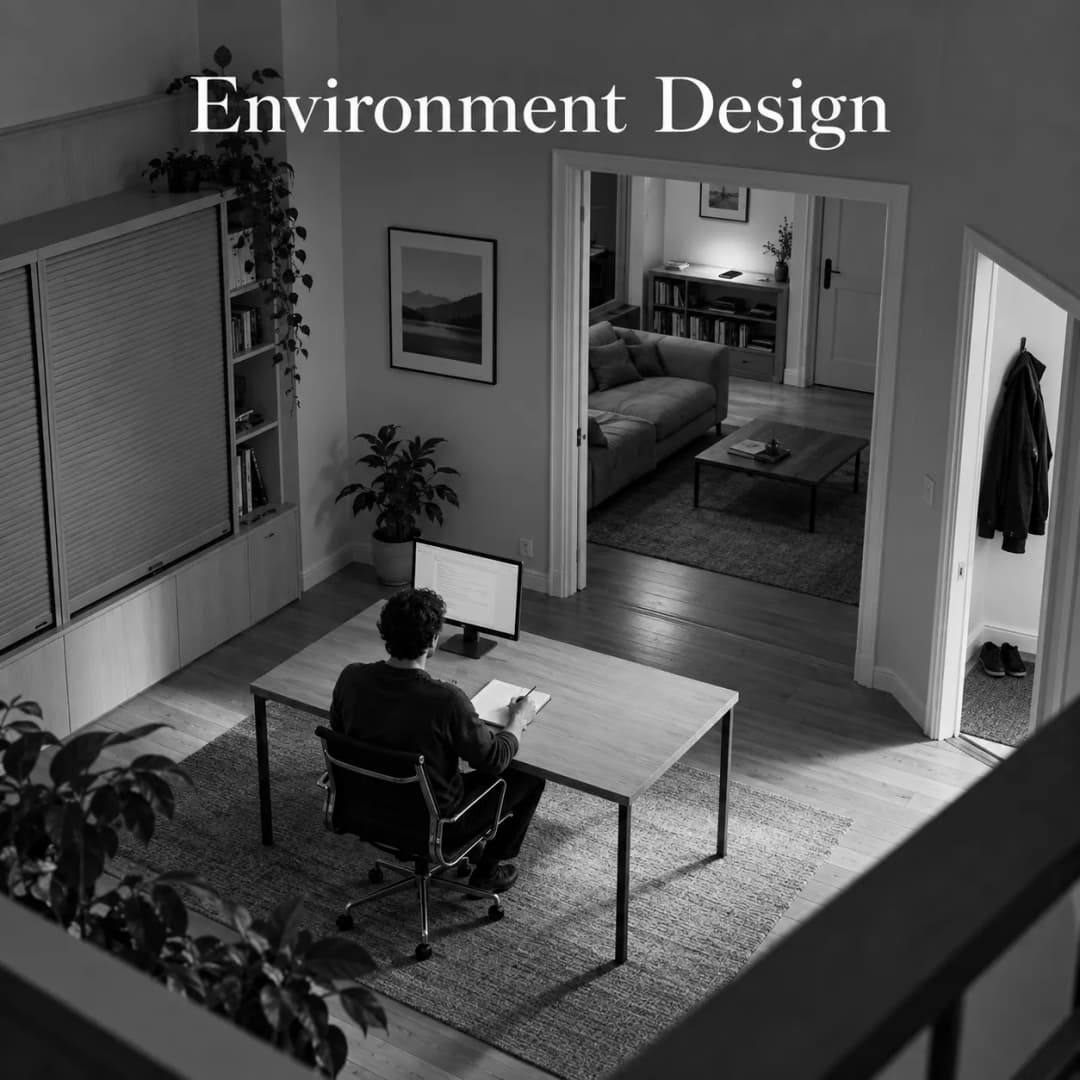
Environment design is the deliberate arrangement of the situations you spend your time in, the rooms, the inputs, the people and the constraints, on the view that these do more to determine how you behave than anything you would call your character. The general claim is well supported: situations shape behaviour far more than lay intuition allows, and choosing your situations is a real lever. The stronger prescription that circulates with it, that redesigning your surroundings will change your personality, is asserted rather than tested. Keep the lever and drop the guarantee.
What it is
The defensible core is the person-situation literature. Lee Ross's formulation is the one to hold: people look predictable largely because we observe them in situations that constrain them, so what reads as character is often the stability of the setting. Christopher Soto's point that responses to personality measures shift across different interviewers is a real methodological complaint about the measurement rather than a claim about the underlying trait.
The best idea in the popular version follows from that, and it is not original to the authors who use it: personalities look stable because people stop entering new contexts, not because personality hardens with age.
The licence taken from this is where the trouble starts. The argument is usually run on two bodies of evidence that do not support it. Aggregate Big Five ageing data describes population mean-level drift with nobody deciding anything. Peer-influence research is correlational and about groups. Neither tests the prescription, which is that a particular individual can select a personality by rearranging their surroundings. That is the population-to-individual slide, and it is often made on pages carrying no citation at all.
In effect
The sharpest and best-supported version of the idea comes from attention research rather than personality writing, and the narrowing is what makes it usable. Adam Gazzaley and Larry Rosen run their practical chapter on a single variable borrowed from foraging theory: how easily the next patch can be reached.
The ordering that falls out is unusually precise for the genre. The phone in another room beats the phone face-down on the desk, which beats the phone in your pocket. A single screen beats two. A closed application beats a minimised one, because minimised icons beckon. One browser tab beats several. None of that asks anyone to resist anything. It raises the cost of travel to the next patch, which is the term that decides when a forager leaves.
There is a supporting finding worth keeping. Bill Thornton and colleagues at the University of Southern Maine found that a phone belonging to somebody else, silenced and untouched, degraded performance on demanding tasks. If a phone you neither own nor use can do that, leaving your own one on the desk and ignoring it is not a plan.
The honest limit is that the same book's signature prescriptions, the ninety-minutes-then-a-break rule, the coloured signs on the door, the fixed check-in intervals, carry no citation at all. The cited studies cluster around the diagnosis and not the remedy. That is the same gap between study and advice that the personality version has, appearing in a much better-sourced book.
What it does not say
It does not say that character is an illusion. It says behaviour is more context-dependent than people assume, which leaves the question of what persists across contexts open.
It does not show that changing your environment changes your personality. The evidence marshalled for that claim is population ageing data and correlational peer-influence work, and neither tests an individual making a choice. The literature that does test individual change keeps the effects small.
It does not inherit anything from cell biology. The analogy sometimes drawn, from a cell's fate being determined by its medium to a person's personality being determined by their surroundings, is doing rhetorical work rather than evidential work, and the underlying trade-book thesis about belief reprogramming gene expression goes well beyond what the epigenetics literature supports.
And the practical protocols are not the evidence. Accessibility as a lever is supported. The specific intervals, rules and signage attached to it in popular accounts are not.
Sources
- Hardy, B. (2020). Personality Isn't Permanent. Portfolio. Chapter 6, pp. 197-220, for the environment-design thesis, with the author's own countervailing caveat at p. 184 that the science describes general trends in populations and each person's situation is unique.
- Gazzaley, A. & Rosen, L. D. (2016). The Distracted Mind. MIT Press. Chapter 11 for accessibility as the operative variable and the ordering of interventions. The chapter's specific prescriptions carry no citation.
- Thornton, B., et al. University of Southern Maine. The finding that another person's silenced, untouched phone degraded performance on demanding tasks.
- Ross, L. Quoted on the power of the situation. Soto, C. Quoted on the instability of personality-test responses across interviewers.