Focus-Based Training
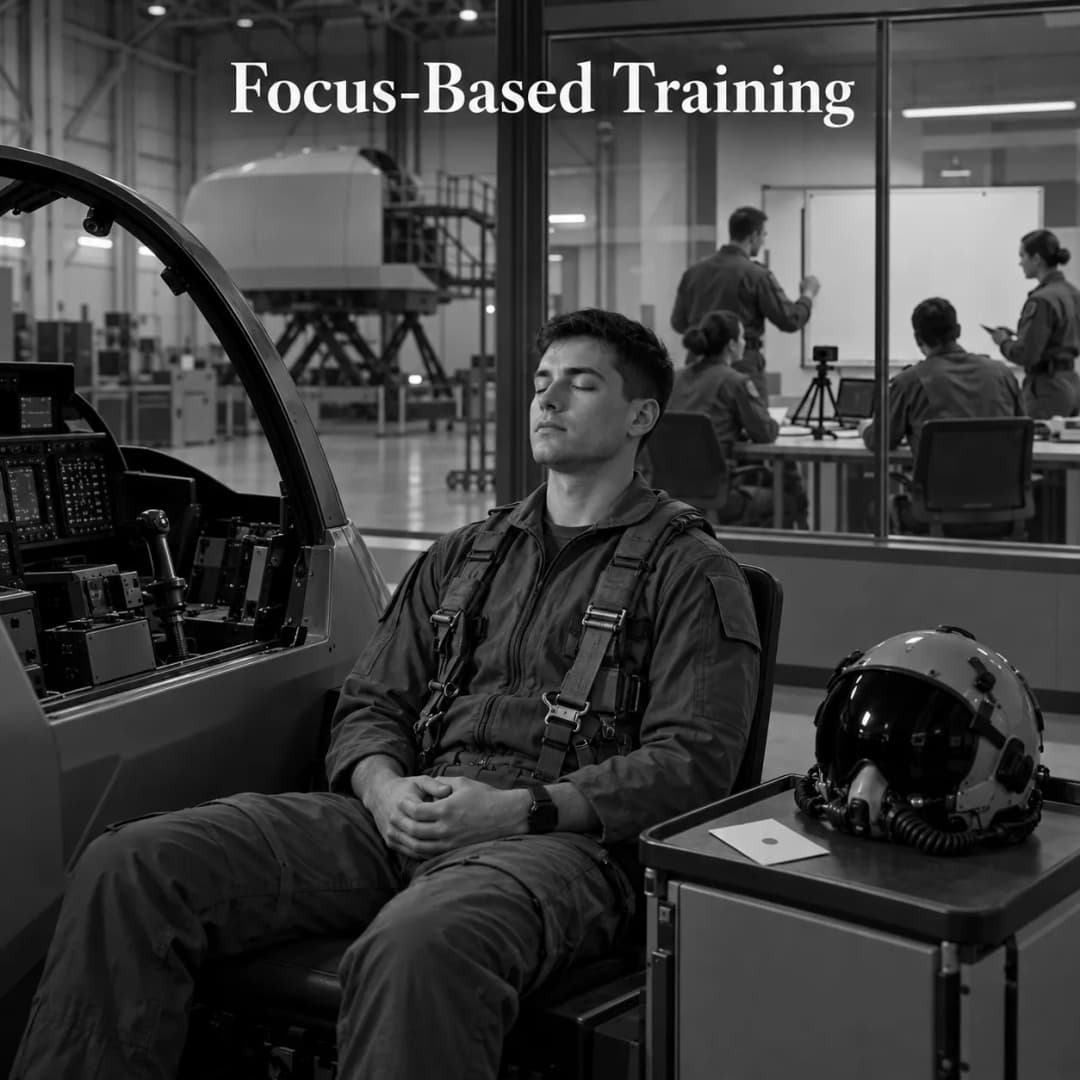
Focus-based training is the name the United States Air Force gives to the second of its five pillars of mental toughness: eyes closed, watch the stream of thought without judgement, and return attention when it wanders. The practice is ordinary mindfulness meditation under a new name, mixing two standard forms, open monitoring and focused attention, and neither is an Air Force invention. The mindfulness literature it belongs to supports small improvements in anxiety, depression and pain, with weaker evidence for attention outcomes. The specific protocol attached to it is untraced, and the advice that travels with it about pushing thoughts away does not generalise beyond the cockpit.
What it is
The practice is introduced in Hasard Lee's account as a type of meditation called focus-based training, which reads as though the service devised it. It did not. Watching the stream of thought is open monitoring and returning attention when it wanders is focused attention, and both have been taught for a very long time, reaching clinical settings largely through Jon Kabat-Zinn's programmes.
The institutional practice underneath the meditation is the stronger idea and is easy to miss. The doctrine is that mistakes are analysed in the debrief and not during execution. Rumination in the cockpit steals attention from the only thing a pilot can still affect, so the organisation assigns it a time and a place and forbids it everywhere else.
That is an organisational technique rather than a mental one, and it works because the debrief actually exists. Telling someone to stop ruminating without giving them somewhere to put it is a different instruction, and the difference is exactly what the popular treatment never marks.
In effect
The demonstrations offered are first-person. After a close air support drop with a real risk of having hit friendly forces, Lee describes deliberately letting go of intrusive thoughts about a court martial and refocusing on the next decision. Elsewhere he describes doing the same mechanically, on techniques learned a decade earlier, after hearing that a soldier had been hit. Both are the chapter's proof of concept and both are anecdotes.
The wider evidence is the mindfulness-training literature. Madhav Goyal and colleagues' 2014 systematic review found moderate evidence for small improvements in anxiety, depression and pain, and low or insufficient evidence for attention and other outcomes. In a military sample closer to this use, Amishi Jha and colleagues linked more mindfulness practice to protected working memory under pre-deployment stress, in a small study.
The thirty-minute session length presented as an optimum the programme found has no data behind it and is not traced beyond the book. The framing of mental bandwidth as a finite resource is adjacent to ego depletion, which is one of the clearest failed-replication cases in this field and is handled separately.
What it does not say
It does not describe a new technique. The name is new and the practice is not, and the book says so nowhere.
It does not establish thirty minutes as an optimum, or any other figure. That number is presented as a programme finding with nothing behind it.
It does not generalise as advice for anxiety, and this is the part that can cause harm. Pushing intrusive thoughts away and refocusing is sound in a cockpit for the duration of a sortie. As a general strategy for anxious rumination, thought suppression tends to rebound, which Daniel Wegner's original experiments showed and a later meta-analysis by Jonathan Abramowitz and colleagues confirmed at a small effect size. The popular account makes no distinction at all, and the distinction is the whole safety question.
And it does not license the finite-bandwidth framing. That framing has a research literature behind it which has largely failed to replicate.
Sources
- Lee, H. (2023). The Art of Clear Thinking. St Martin's Press. p. 212 for the practice, the renaming, the thirty-minute claim and the debrief-only rule; pp. 211-212 for the bandwidth framing; pp. 199 and 206 for the author's own use.
- Goyal, M., et al. (2014). "Meditation programs for psychological stress and well-being: A systematic review and meta-analysis." JAMA Internal Medicine, 174(3), 357-368. Read from secondary sources.
- Jha, A. P., et al. (2010). "Examining the protective effects of mindfulness training on working memory capacity and affective experience." Emotion, 10(1), 54-64. A small military sample.
- Wegner, D. M., et al. (1987). "Paradoxical effects of thought suppression." Journal of Personality and Social Psychology, 53(1), 5-13.
- Abramowitz, J. S., Tolin, D. F. & Street, G. P. (2001). "Paradoxical effects of thought suppression: A meta-analysis of controlled studies." Clinical Psychology Review, 21(5), 683-703. A small rebound effect.
- The name focus-based training and the thirty-minute session were not traced beyond Lee's book. This page touches on mental health and is handled under the house standard for such material.