Geodemographic Clustering
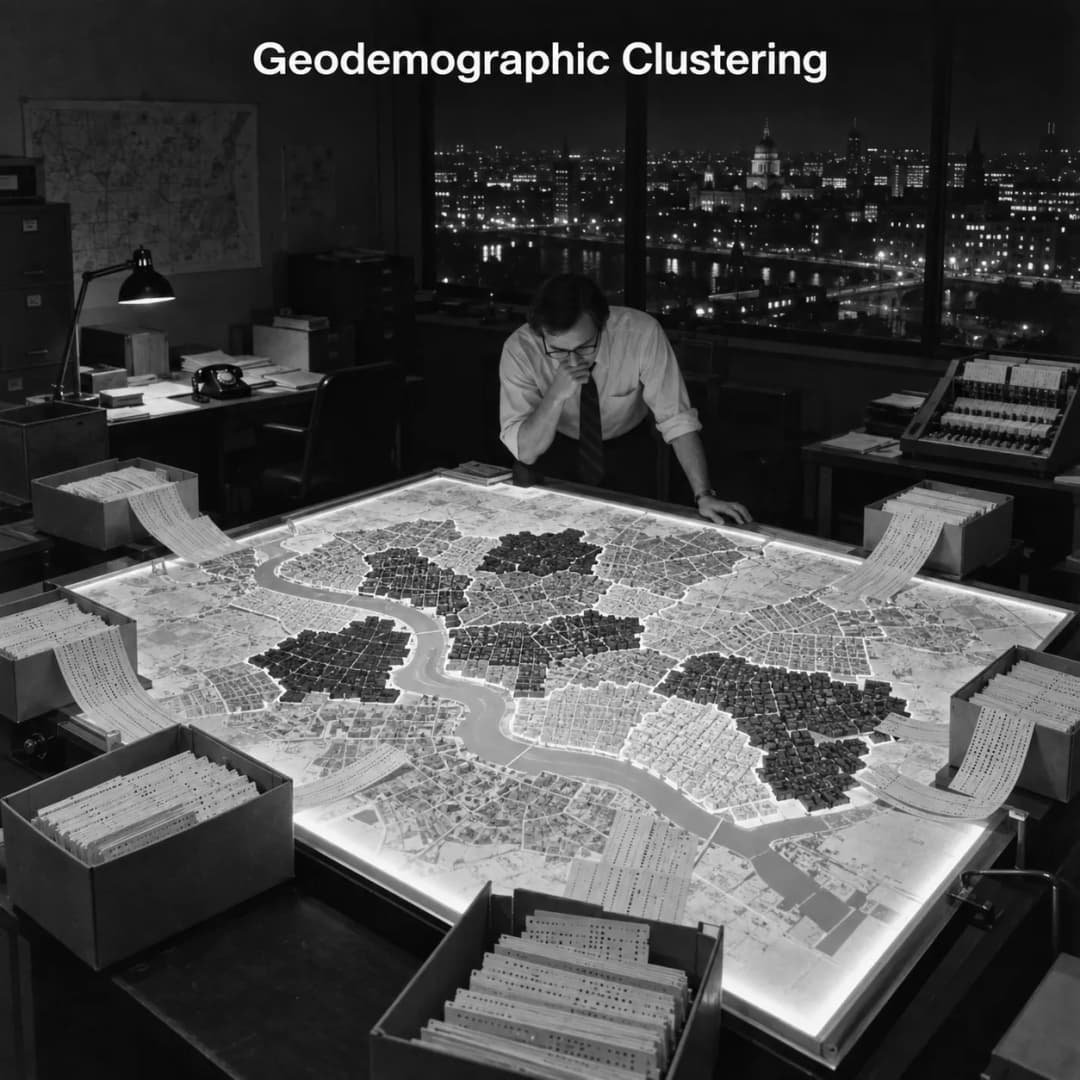
Geodemographic clustering is sorting an entire population into lifestyle types using census and postcode data instead of treating consumers as one undifferentiated mass. Jonathan Robbin built the technique into PRIZM, Potential Ratings in Zip Markets, at the company he founded in 1971, with the system usually dated to 1974. It is a market-segmentation technique and a piece of industry history rather than a testable effect, so replication does not apply to it. It is the moment American mass marketing became targeted marketing, decades before anyone had a device that could track an individual.
What it is
The mechanism is unglamorous and enormously consequential. Census data is collected at fine geographical grain. People who live near one another resemble one another on income, household composition, education and consumption. Cluster the geography and you have clustered the population, without ever knowing anything about a particular person.
The cluster names tell you what was actually being sold: Money and Brains, Young Influentials, Shotguns and Pickups, Bohemian Mix, Sharecroppers. These are identity categories with a price attached, and the industry's own summary of the claim, from Michael Weiss in 1988, was that the characteristic separating Americans more than any other is the cluster.
A parallel British tradition developed at about the same time, with Richard Webber's ACORN in the late 1970s, so the framing of a single American moment is a national one rather than a global one.
In effect
The commercial demonstration usually given is the launch of Diet Coke in 1982, which was targeted at six specific clusters so that it would not cannibalise sales of the company's existing diet product. That account reaches this publication through Tim Wu, following Weiss, and was not traced to a company primary source, so it should be cited as reported rather than as documented.
What the technique established is the logic that everything since has refined. Sorting a population into types, then addressing each type differently, is now the default assumption of consumer marketing, and the modern versions differ from PRIZM in grain rather than in kind. Where PRIZM sorted postcodes into tribes, individual-level targeting sorts people, and the step from one to the other required new data rather than a new idea.
For a reader the useful point is that the categories are not descriptions discovered in the population. They are constructions built to be sold to advertisers, and they become self-confirming to the extent that the advertising addressed to each cluster shapes what the people in it see.
What it does not say
It is not a research finding. It is a commercial technique, and nothing about it was tested in the sense this publication usually means.
It does not say that people in a postcode are alike. It says they are alike enough, on the variables an advertiser cares about, for the sorting to pay. Those are different claims and only the second was ever asserted.
It does not establish that clusters define identity. That formulation comes from a trade book about the system and is a salesman's claim about its own product.
And the Diet Coke case is not documented from the company side. It is an account in a work of media history, following an earlier trade book.
Sources
- Robbin, J. PRIZM, Potential Ratings in Zip Markets. Claritas, founded 1971; the system is usually dated to 1974 and was rebuilt on the 1980 census. Read from secondary sources.
- Weiss, M. J. (1988). The Clustering of America. Harper & Row. The source of the quoted claim about clusters defining Americans.
- Wu, T. (2016). The Attention Merchants. Knopf. pp. 171-173 for the PRIZM taxonomy and the Diet Coke launch targeted at six clusters. The launch account follows Weiss and was not traced to a company primary source.
- Webber, R. ACORN, the parallel United Kingdom tradition, late 1970s.