Groupthink
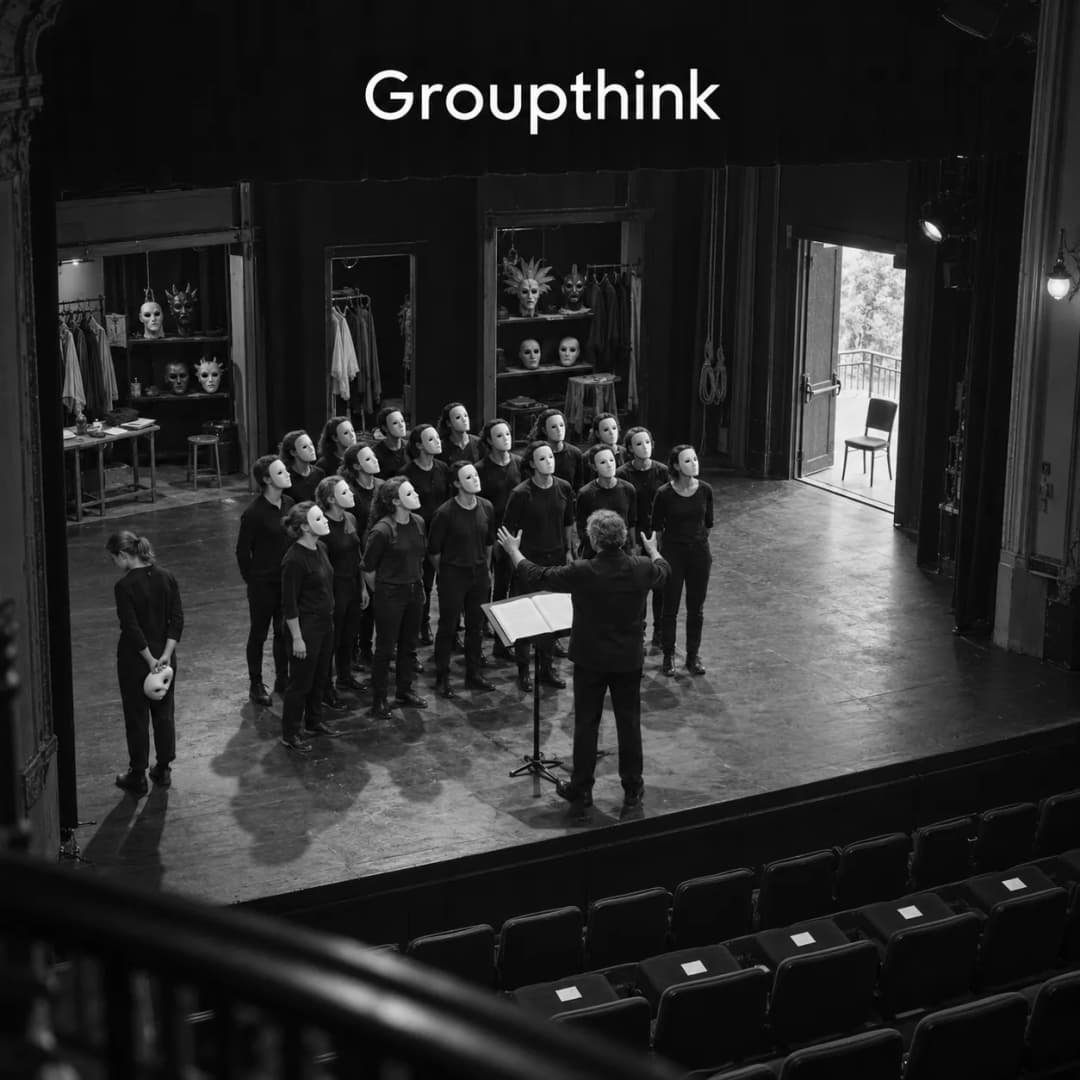
Groupthink is Irving Janis's term for a mode of group decision-making in which the drive for unanimity overrides realistic appraisal of alternatives. He set it out in Victims of Groupthink in 1972, revised and expanded as Groupthink in 1982, and he took the coinage from Orwell, which is worth keeping because it tells you the idea arrived as a polemic before it arrived as a construct. The symptom vocabulary is genuinely useful and widely taught. The causal account is not demonstrated, and the two facts belong in the same sentence every time.
What it is
Janis's symptoms include an illusion of invulnerability, direct pressure on dissenters, self-censorship by those who have doubts, and an illusion of unanimity produced by that self-censorship. Antecedent conditions include a cohesive group, an insulated decision process and a directive leader.
What is agreed on all sides is that Janis originated the construct, that he is correctly credited for it almost everywhere, and that the symptom list is a useful descriptive vocabulary for something people recognise from meetings they have sat in.
What is in dispute is whether the case studies support the causal account, whether the antecedent conditions predict the symptoms, and whether the laboratory literature has ever reproduced the full syndrome. Janis offered no experimental support, building instead on retrospective analysis of decisions already known to have gone wrong, which is a selection problem: a theory built from fiascos has not been tested against the occasions when a cohesive, insulated, directively led group got it right.
Two named assessments give the current standing. James Esser reviewed the laboratory literature in 1998 and found the tests too few and too partial to evaluate even the antecedent conditions, let alone the whole theory, concluding that it was too early to judge. Robert Baron in 2005 concluded that the evidence had largely failed to support the formulation's more ambitious and controversial predictions, and proposed a ubiquity model in its place, in which the underlying processes are common to most groups rather than confined to a special pathological state.
In effect
The most common way the concept is misused is the tidy version: a list of famous disasters explained by one mechanism. The loss of the Challenger, the Ford Pinto and the launch of New Coke are all routinely attributed to groupthink, and all three attributions are disputed in the scholarly literature. Trade books present them as settled, and this publication does not repeat them from such sources.
What is worth carrying is the remedy, and the important property of it is that it is structural rather than heroic. Devil's advocacy is a weak instrument, because advocacy assigned as a role is still advocacy and everyone in the room knows it. What works better is outside perspective, psychological safety, deliberate boundary-spanning and brokerage, newcomers, the systematic aggregation of judgements collected independently before discussion, and dissent that is protected rather than invited.
Those remedies have their own evidence, in Charlan Nemeth's work on dissent and in the psychological safety literature, and it is worth noticing that they do not depend on Janis's causal account being correct. A room designed so that independent judgements are collected before a discussion begins is more robust whatever the mechanism turns out to be.
What it does not say
It does not explain the famous disasters. Those attributions are contested, and a book that lists them without saying so is giving a reader a false impression of how settled the matter is.
It does not have laboratory support for the full syndrome. The tests that exist are too few and too partial to evaluate the theory, which is Esser's conclusion rather than this publication's.
It does not describe a rare pathology, on the strongest current alternative. Baron's ubiquity model holds that the underlying processes run in most groups most of the time, which would make the symptom list a description of ordinary group behaviour rather than of a special failure state.
And it does not licence calling any bad group decision groupthink. The term has a specific antecedent structure, and using it as a synonym for consensus is what made it a polemic again.
Sources
- Janis, I. L. (1972). Victims of Groupthink: A Psychological Study of Foreign-Policy Decisions and Fiascoes. Houghton Mifflin. Revised and expanded as Groupthink, 1982. Not read here, which is why the originator confidence in the vault is medium: the year comes from the standard record rather than from a copy in hand.
- Esser, J. K. (1998). Organizational Behavior and Human Decision Processes. The review finding the laboratory tests too few and too partial to evaluate the theory.
- Baron, R. S. (2005). The ubiquity model, concluding that the evidence had largely failed to support the formulation's more ambitious predictions.
- Fisher, C. M. The Collective Edge. Janis credited at p. 98 with the Orwell provenance and no year; the Challenger, Ford Pinto and New Coke attributions at p. 100, presented without a note that all three are disputed.