Heart Rate Variability
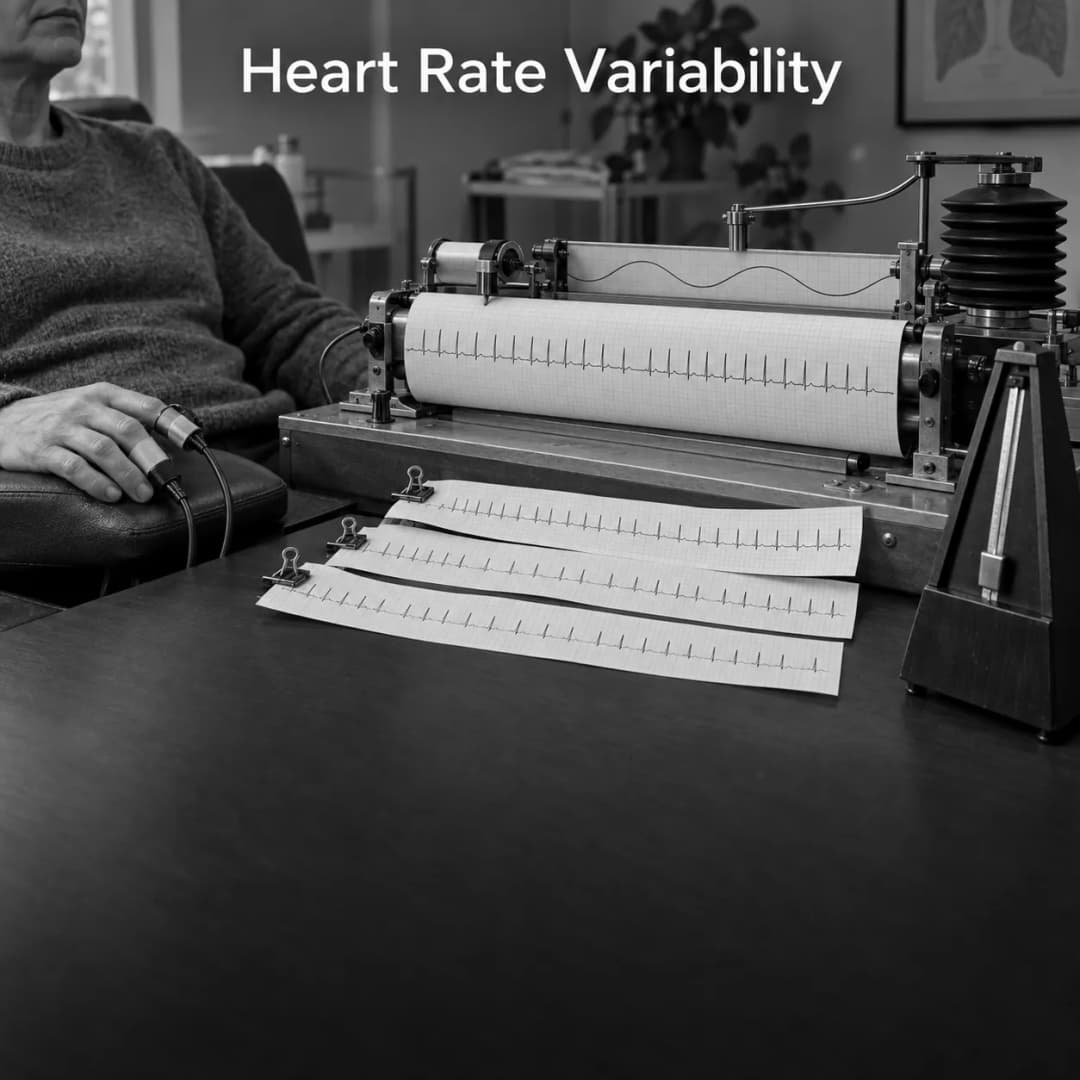
Heart rate variability is the beat-to-beat variation in the time between heartbeats. A healthy heart is not a metronome, and higher variability at rest generally reflects a flexible autonomic system in which parasympathetic influence can adjust heart rate quickly. It is a well-standardised physiological measure with established clinical meaning, and the training built on it, heart rate variability biofeedback, has meta-analytic support for modest benefits across several outcomes. It is also easy to over-read, because one number gets asked to stand for stress, resilience, emotion regulation and more besides. This page concerns health, and nothing on it is medical advice.
What it is
The measure came into clinical use through fetal monitoring, where Hon and Lee reported in 1963 that changes in beat-to-beat variation preceded distress. The measurement standards that make readings comparable between studies were set by a joint task force of the European Society of Cardiology and the North American Society of Pacing and Electrophysiology in 1996, and that document is still the reference point for which metrics mean what.
The physiology is the part to hold on to. The interval between beats is continuously adjusted by the autonomic nervous system, and at rest the parasympathetic branch, acting largely through the vagus nerve, is the faster of the two influences. More variability at rest is generally taken to indicate that this branch is responsive.
The reading of the measure as a pure index of vagal activity is itself disputed, which matters because a great deal of the psychological interpretation built on it assumes exactly that.
In effect
What the measure is genuinely useful for is tracking within a person over time. A wearable showing lower overnight variability after a hard training week and a late flight, and suggesting an easy day, is using it reasonably. Between people the comparison is much weaker, because the normal range is wide and depends on age, fitness, posture, breathing and the recording method.
The intervention with the best support is heart rate variability biofeedback, in which a person breathes at a rate that maximises the oscillation between heart rate and breathing while watching a real-time display. Paul Lehrer and colleagues pooled fifty-eight studies in 2020 and reported modest benefits across a range of outcomes, and that is the citation to use for the practice.
Two cautions belong beside it. First, the psychological constructs that get attached to the number go well beyond what the physiology establishes. Claims linking resting variability to compassion rest in part on a 2017 review by James Kirby, James Doty, Nicola Petrocchi and Paul Gilbert, and where that material is repeated in a trade book by one of its authors the self-citation is not disclosed in the body text, which a reader should know. Second, proprietary coherence constructs marketed by commercial biofeedback programmes, of which HeartMath's is the best known, are a company's own scoring of its own signal and are not the same thing as the standardised physiological measure. They do not inherit its evidence and should be described separately.
What it does not say
It does not measure stress. Variability responds to stress among many other things, including breathing rate, posture, sleep, alcohol, illness and time of day, and a single reading cannot separate them.
It does not compare well between people. The useful signal is the change in one person against their own baseline.
It does not establish a compassion score, or any of the other psychological quantities wearables report from it. Those are interpretations layered on the number, some of them resting on a small review whose authorship overlaps with the book promoting them.
It is not the same as a proprietary coherence measure. A commercial programme's own index, however it is branded, is a separate construct from standardised heart rate variability and carries whatever evidence its own developers have produced for it, which is not the mainstream literature described here.
And nothing here is advice. Anyone with a cardiac symptom or an unexpected reading should take that to a clinician rather than to an application.
Sources
- Hon, E. H. & Lee, S. T. (1963). First clinical use of beat-to-beat variation, in fetal monitoring. This publication's own identification of the originator.
- Task Force of the European Society of Cardiology and the North American Society of Pacing and Electrophysiology (1996). "Heart rate variability: Standards of measurement, physiological interpretation, and clinical use." Circulation, 93(5), 1043-1065.
- Lehrer, P., et al. (2020). Applied Psychophysiology and Biofeedback. A systematic review and meta-analysis of heart rate variability biofeedback covering 58 studies, reporting modest benefits across outcomes.
- Kirby, J. N., Doty, J. R., Petrocchi, N. & Gilbert, P. (2017). "The current and future role of heart rate variability for assessing and training compassion." Frontiers in Public Health, 5, 40. Confirmed on PubMed, including the authorship.
- Mind Magic, read in the vault on 2026-09-27, cites Lehrer and colleagues correctly and cites Kirby and colleagues twice, at pp. 43 and 112, without disclosing in the body text that the author is a co-author of that review.