Hedonic Hunger
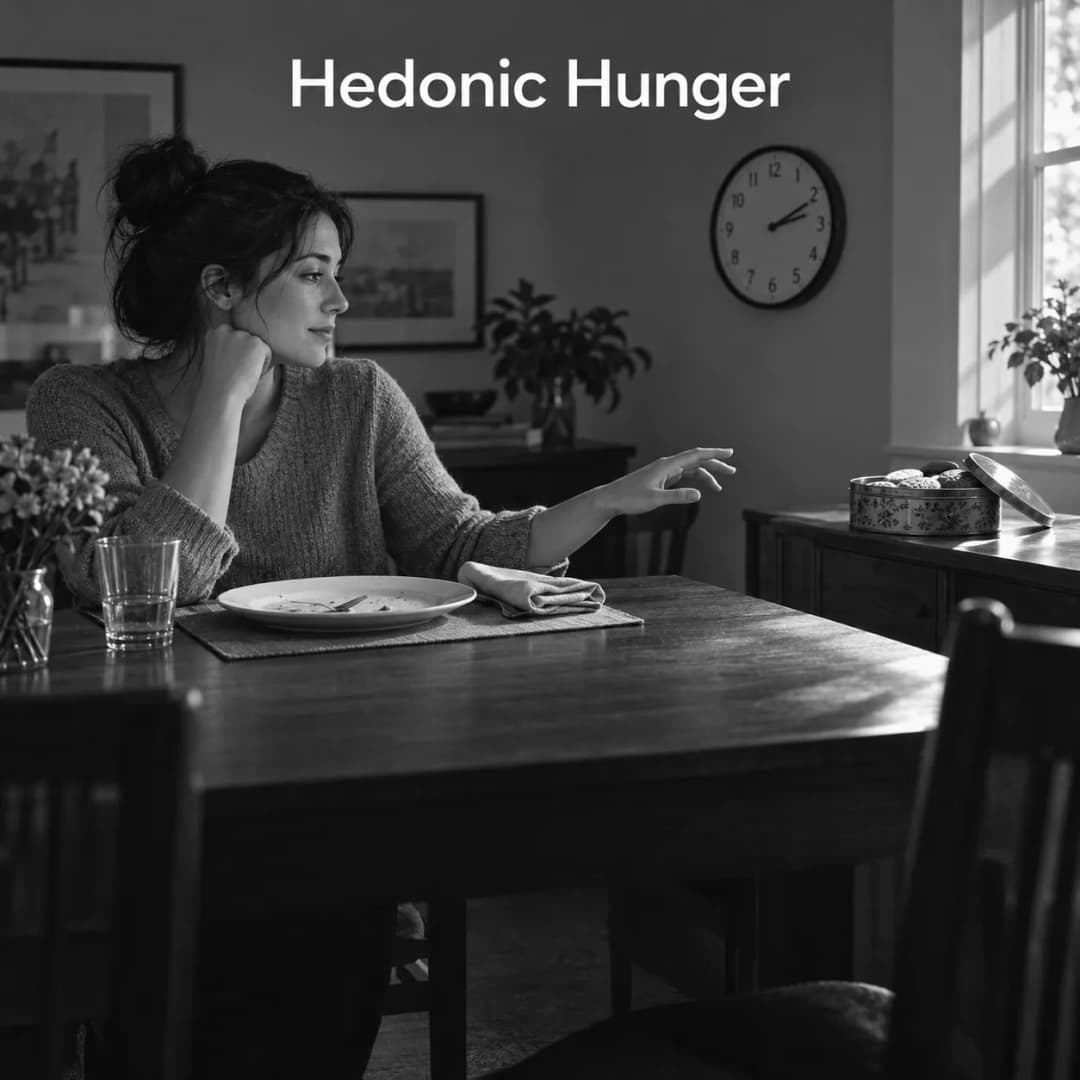
Hedonic hunger is the pull towards food for its pleasure rather than for energy, the appetite that turns up in a person who has just eaten enough. The term is Michael Lowe and Meghan Butryn's, from 2007, and the vault has confirmed that attribution. What it has not confirmed is that the construct measures what its name suggests: the scale built for it is internally consistent, but its links to body weight and to what people actually eat are inconsistent across studies. It is useful vocabulary rather than a settled finding.
What it is
The distinction is between two kinds of appetite. Homeostatic hunger tracks need, the body signalling that energy is low. Hedonic hunger is the other one, the appetite that arrives when nothing about the body's state has changed much and what has changed is the availability of something pleasant. The biscuit tin at four o'clock, an hour after a lunch that was plenty, is the ordinary case.
Lowe and Butryn proposed the term in Physiology and Behavior in 2007, framing it as a dimension of appetite that existing models of eating had no room for. The construct is usually measured with the Power of Food Scale, published by Lowe and colleagues in Appetite in 2009, which asks about responsiveness to the food environment rather than about eating itself.
The pairing is cleaner as vocabulary than it is as physiology. The boundary between the two kinds of hunger is blurred in the body, and the note holds that blurring rather than tidying it away.
In effect
The most useful thing this concept does is give a name to an experience people otherwise moralise about, the appetite that turns up without a deficit behind it. It is also the point at which a more exact mechanism should take over.
That mechanism is wanting against liking. Kent Berridge and Terry Robinson's dissociation, which the vault holds separately and at a higher evidence grade, separates the pull towards something from the pleasure of it, and they are not the same system. The afternoon pull towards the biscuit tin is better described as wanting than as liking, and anything that needs a mechanism should be citing that literature rather than this one.
What remains for hedonic hunger itself is the territory of memory, cue and expectation: what a person remembers eating, what the environment has just offered, and what they expect a food to do. That is where the concept earns its keep.
What it does not say
It does not say that eating for pleasure is a disorder or a failure. The note is descriptive and carries no moral framing of the thing it names.
It does not say the two hungers are separable in the body. They are separable as descriptions. The physiological boundary is not clean, and treating the pair as two switches misrepresents what is known.
It does not say that a high score on the Power of Food Scale predicts weight or intake. That is the specific thing the literature has failed to establish consistently, and it is why the construct sits at mixed rather than robust.
And it does not say anything a reader should act on. This is eating and appetite, which the vault treats as a high-stakes subject, and the concept carries no protocol, no threshold and no advice.
Sources
- Lowe, M. R., & Butryn, M. L. (2007). "Hedonic hunger: A new dimension of appetite?" Physiology & Behavior, 91(4), 432-439.
- Lowe, M. R., et al. (2009). The Power of Food Scale. Appetite. The measure most commonly used for the construct.
- Attribution confirmed in the vault's evidence review of 2026-09-25, from secondary sources. Links between hedonic hunger and body weight or actual intake are inconsistent across studies, which is why the construct is graded mixed rather than robust.
- For the mechanism, see the wanting and liking literature rather than this note.