Hick's Law
Hick's Law is the finding that the time it takes to choose rises roughly with the logarithm of the number of equally likely options. William Edmund Hick published it in 1952 and Ray Hyman confirmed and extended it in 1953, though Julius Merkel had reported the underlying pattern as early as 1885. It is robust as stated, inside the laboratory task it was built on. Almost everything design writing attaches to it, including the jam experiment, belongs to a different and much weaker literature.
What it is
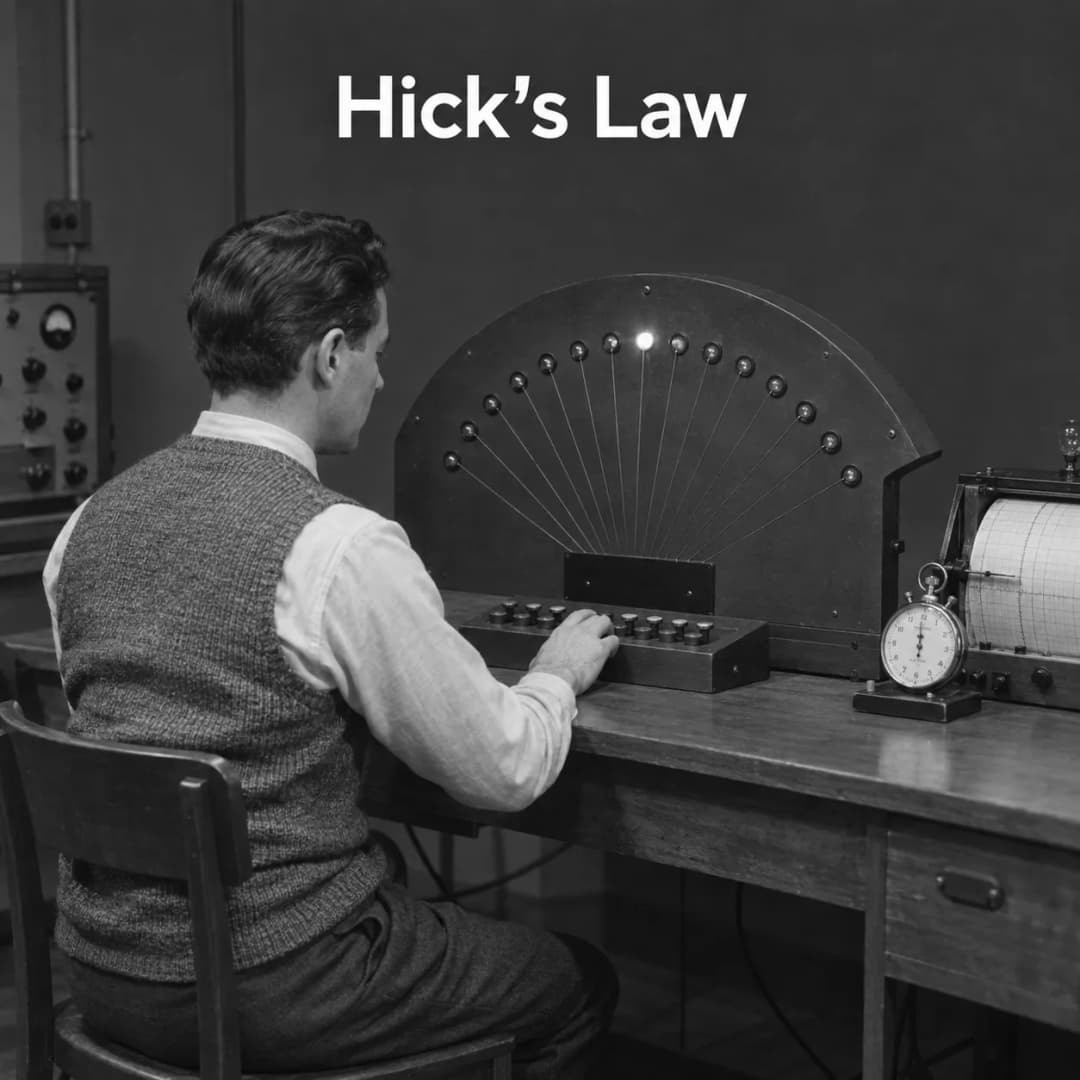
Hick sat participants in front of a set of lights and had them respond to whichever one came on. As the number of possible lights went up, response time went up too, and not in proportion: it went up with the logarithm of the number of alternatives, so each doubling of the choice set added a roughly constant amount of time. Hick published the result in the Quarterly Journal of Experimental Psychology in 1952 under the title "On the rate of gain of information". Hyman reproduced it the following year in the Journal of Experimental Psychology, varying how the alternatives were presented, and the relationship held.
The framing was information-theoretic. What the law describes is the rate at which a person can extract information from a display, which is why the measure that fits is bits rather than options.
Two boundary conditions came with it from the start. The effect weakens with practice, and it weakens when the mapping between stimulus and response is natural rather than arbitrary. A well learned, well laid out set of choices costs less per option than a strange one.
In effect
In design the law is invoked whenever someone argues for fewer options: shorter menus, fewer navigation items, a product line small enough to hold in the head. That argument is sound in the narrow sense the law supports. A longer list of equally weighted, equally unfamiliar options does take longer to work through, and interfaces that ignore this are slower to use.
The common misapplication is worth stating plainly, because it is everywhere. Hick's Law is a law about reaction time. It says nothing about people declining to choose at all. The claim that past some threshold a person makes no decision is not part of the law and should not be attributed to it.
That claim belongs instead to the choice overload literature, and its most famous result is Sheena Iyengar and Mark Lepper's jam study, published in 2000: a tasting table with six jams and one with twenty-four, and a much higher purchase rate at the smaller table. The result is real and the ratio usually quoted for it is accurate for that study. The literature it launched is not. Benjamin Scheibehenne, Rainer Greifeneder and Peter Todd pooled the experiments in 2010 and found a mean effect near zero with very large variance, which is to say that reducing choice sometimes helps, sometimes does not, and the conditions are not well understood.
So the honest version of the design advice is two sentences rather than one. Fewer options make a given choice faster to execute, which is Hick. Whether fewer options make people more likely to buy is unsettled, which is not.
What it does not say
It does not say that more choices cause paralysis. That is choice overload, a separate and much weaker claim, and folding it into Hick's Law borrows an authority the overload literature has not earned.
It does not say the cost of an option is fixed. The relationship is logarithmic, so the tenth option costs far less than the second, and an argument that treats every added item as equally expensive has the shape of the law wrong.
It does not survive practice unchanged. The effect shrinks as people learn a display, so the law describes a first encounter far better than it describes a tool someone uses daily.
And it does not generalise from lights on a panel to the whole of decision making. It was measured in simple choice reaction tasks with equally likely alternatives, and the further a real decision sits from that description, the less the law is saying about it.
Sources
- Hick, W. E. (1952). "On the rate of gain of information." Quarterly Journal of Experimental Psychology, 4(1), 11-26.
- Hyman, R. (1953). Journal of Experimental Psychology, 45(3), 188-196.
- Merkel, J. (1885). Reported the underlying pattern earlier than either.
- Iyengar, S. S., & Lepper, M. R. (2000). Journal of Personality and Social Psychology, 79(6), 995-1006. 30 per cent of shoppers at the six-jam table bought, against 3 per cent at the twenty-four-jam table.
- Scheibehenne, B., Greifeneder, R., & Todd, P. M. (2010). Journal of Consumer Research, 37(3), 409-425. Mean choice-overload effect near zero across 50 experiments, with large variance.
- The vault's evidence review of 2026-09-25 grades the law robust as originally stated and records the jam study as a misattribution to be moved to choice overload.