Hindsight Bias
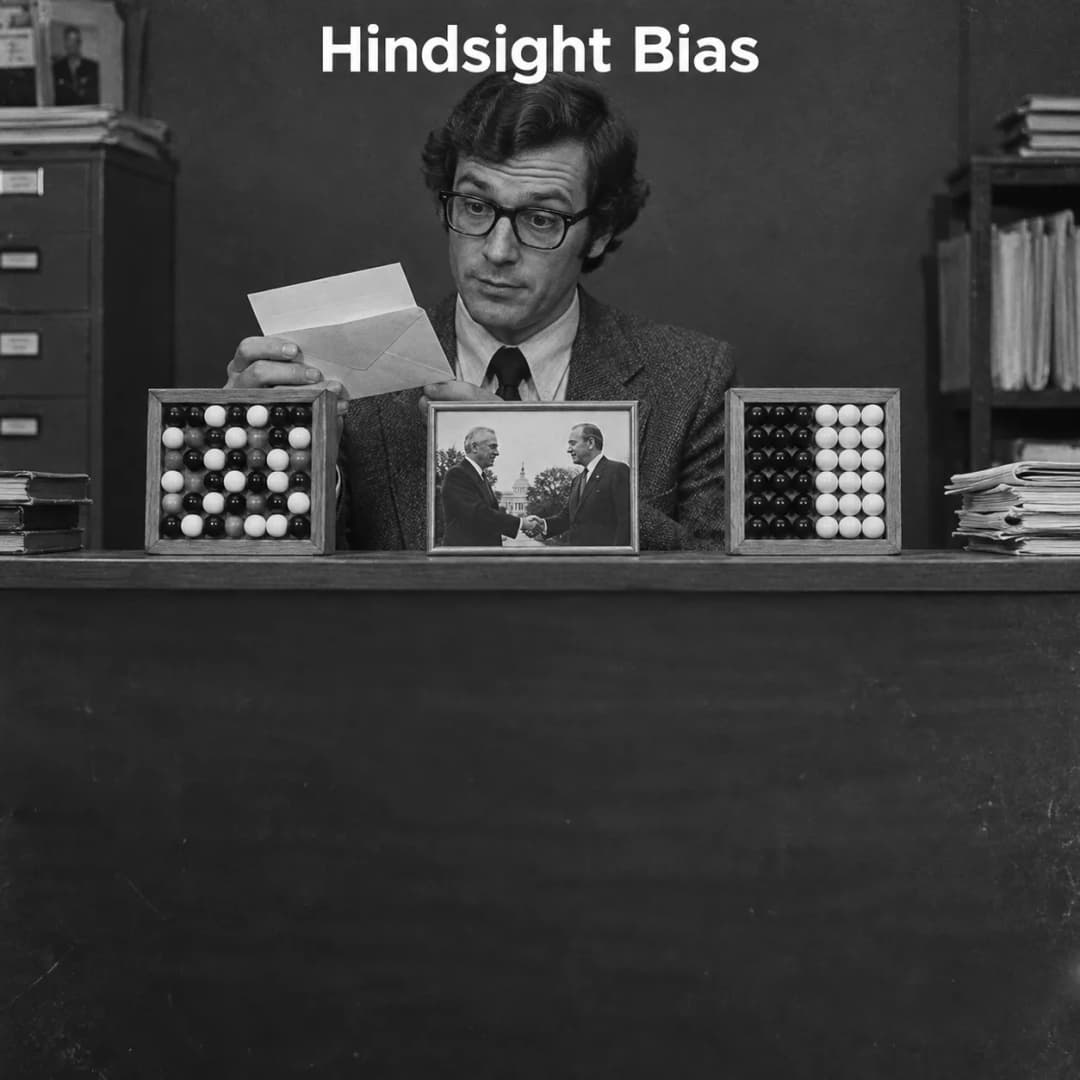
Once you know how something turned out, you lose the ability to reconstruct what you believed before you knew. The old belief is not retrieved, it is rebuilt out of the new one. The founding study is Baruch Fischhoff and Ruth Beyth's, run while they were Daniel Kahneman's students, which is worth saying because the finding usually travels under his name rather than theirs. The effect is among the material in the judgement literature that has held up.
What it is
Before Richard Nixon's visits to China and Russia in 1972, Fischhoff and Beyth asked people to assign probabilities to fifteen possible outcomes of the trips. After the visits, they asked the same people to recall the probabilities they had given. Outcomes that had happened were recalled as having been rated more likely than they were. Outcomes that had not happened were recalled as having been thought unlikely.
Nobody had changed their mind. They had lost the record of the mind they used to have.
Two errors follow, and they are the same error pointing in opposite directions. You underestimate how surprised you were, and you overestimate how predictable the event was. The mechanism is reconstructive memory: the belief is not stored and retrieved intact, it is rebuilt at the moment of asking out of whatever the person now knows, and what they now know includes the answer.
The practical consequence is that the past always looks more orderly from here than it did from there, and that your own memory is not admissible evidence of what you once thought.
In effect
This is the machinery underneath a great deal of confident retrospection. It is what makes a market crash, a failed product or a lost election feel as though the signs were obvious, and it is what makes outcome bias feel like fair judgement rather than unfairness: once the result is known, the decision that produced it is reassessed against a past that has been quietly rewritten.
It is also why institutional post-mortems are harder than they look. Everyone in the room already knows the ending, so the question "what did we believe at the time" cannot be answered by asking people to remember. The only defence with any real purchase is procedural, which is to get doubt onto the record before the outcome exists. The premortem exists for exactly this reason: it moves the prediction to a point where hindsight cannot reach it.
The same reconstructive process shows up elsewhere in memory research, on events rather than beliefs in the misinformation effect, and on rumour in the levelling and sharpening work, where a remembered account tidies itself towards coherence with each retelling.
What it does not say
It does not say the event was unpredictable. Some things genuinely are foreseeable. The bias concerns the reliability of your recollection of what you foresaw, not the objective difficulty of the forecast.
It does not say people are lying when they claim they knew. The finding is that they sincerely believe it. That is what makes it a memory phenomenon rather than a social one.
It does not say that awareness fixes it. Nothing in the founding design suggests that knowing about the bias restores access to the earlier belief, and the remedies that work are ones that create a record instead of relying on memory.
And the vault does not have the study's scale. The account it holds names the researchers, the fifteen outcomes and the design, and gives no sample size, no year and no journal. Treat the design as citable and the size of it as untraced.
Sources
- Fischhoff, B., & Beyth, R. The Nixon 1972 study, in which respondents rated fifteen possible outcomes before the visits and were asked to recall their own ratings afterwards. Described in Kahneman, D. (2011), Thinking, Fast and Slow, ch. 19, which names the researchers and the design but gives no sample size, publication year or journal. The primary paper has not been read here.
- Attribution rule applied: credited to Fischhoff and Beyth, who did the work, rather than to Kahneman, who supervised it and is the reason most readers meet it.
- The reliability audit on Thinking, Fast and Slow places hindsight bias among the material in that book which has held up, alongside anchoring, framing and regression to the mean, and separates it from the priming and depletion chapters that have not. The audit also records that two pages of chapter 19 are missing from the vault, though nothing above depends on them.