Hospitality Psychology
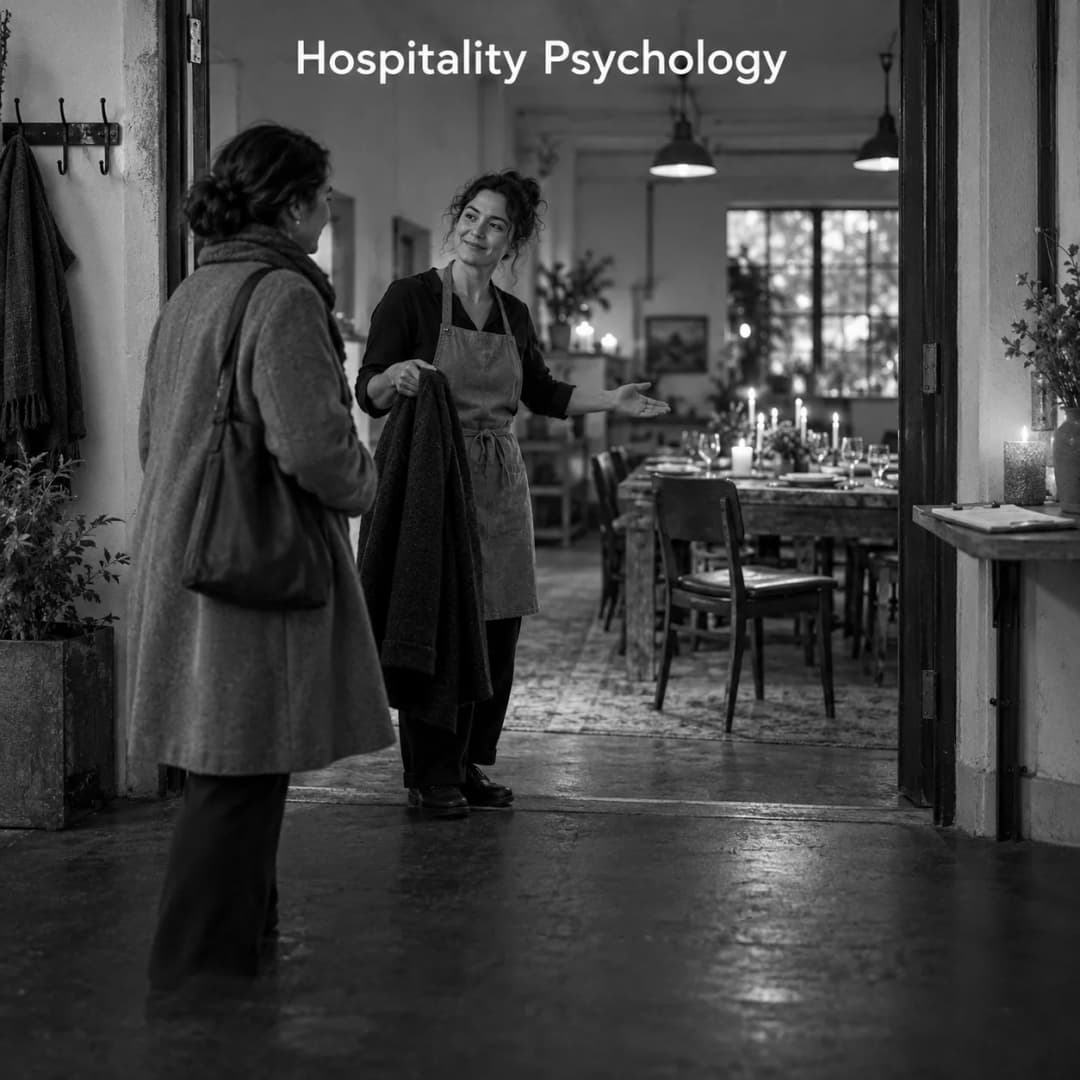
Hospitality psychology is this publication's umbrella term for what makes a guest feel welcome, assembled from practitioner books rather than from a research literature. It has no founding study and no single originator, and the vault grades it as not a research claim. It is a useful way of organising a set of observations about hosting, and the evidence, where an article needs evidence, sits in the neighbouring research concepts rather than here.
What it is
The claim being organised is that welcome is a perceptible, almost physical state rather than a metaphor, and that it has ingredients which can be named. The ones this vault holds are noticedness, meaning you were seen on arrival; agency, meaning you know what is expected of you and what is not; the host's own affect, calm and present and warm; and small rituals that signal the room was prepared for you. The failure modes are the mirror image: the guest is processed rather than greeted, the rules are unclear, the host is visibly stressed, and the room reads as built for somebody else.
The sources are practitioners writing about their own work. Danny Meyer's Setting the Table, published in 2006, sets out what he calls enlightened hospitality and is the origin of most of the restaurant material. Will Guidara's Unreasonable Hospitality, from 2022, makes the thesis explicit: hospitality is an emotional memory the guest takes home, and people return for that memory long after they have forgotten the food. Priya Parker's The Art of Gathering, from 2018, extends the same idea beyond commerce to any hosted room.
None of these is research, and none of them claims to be.
In effect
The practical reading is about the first moments of an event rather than its budget. The difference between the best private dinner you have been to and the worst networking event is rarely money. It is whether the host was looking at you or at a clipboard.
Two lines that circulate with this material read like findings and are not. The first is the claim that the host's affect in the opening ninety seconds sets the room. That is this publication's own observation, with no source behind the number. The second is the claim that one restaurant group built a very large business on this single variable. That is untraced and it overstates a single cause. Both are illustrations, and neither should be cited as evidence.
Where an article needs a research claim about welcome, the claim is available elsewhere and should be taken from there directly. Emotional contagion carries the mechanism by which a host's state propagates through a room. Belonging carries what being welcomed is the entry cost of. The peak-end rule carries why the door and the goodbye weigh more in memory than the middle.
What it does not say
It does not say that hospitality has been studied under this name. The name is the vault's, not a field's, and nobody should be credited with proposing it.
It does not say that the practitioner claims are wrong. Meyer, Guidara and Parker are describing careers of close observation, and that is worth something. It is not the same as a tested finding, and the page keeps the two apart.
It does not supply a number for anything. The ninety seconds is not a measurement, and no figure on this page should be repeated as one.
And it does not substitute for the research notes it points to. An argument that needs evidence should cite the emotional contagion, belonging or peak-end literatures, not this.
Sources
- Meyer, D. (2006). Setting the Table. The source of "enlightened hospitality".
- Guidara, W. (2022). Unreasonable Hospitality.
- Parker, P. (2018). The Art of Gathering.
- The vault's evidence review of 2026-09-25 grades this not a research claim: an umbrella term assembling practitioner ideas, with no founding study and no establishable originator. Two lines in the earlier material, the ninety-second window and the single-variable business claim, are recorded there as untraced and not citable.