Hypervigilance
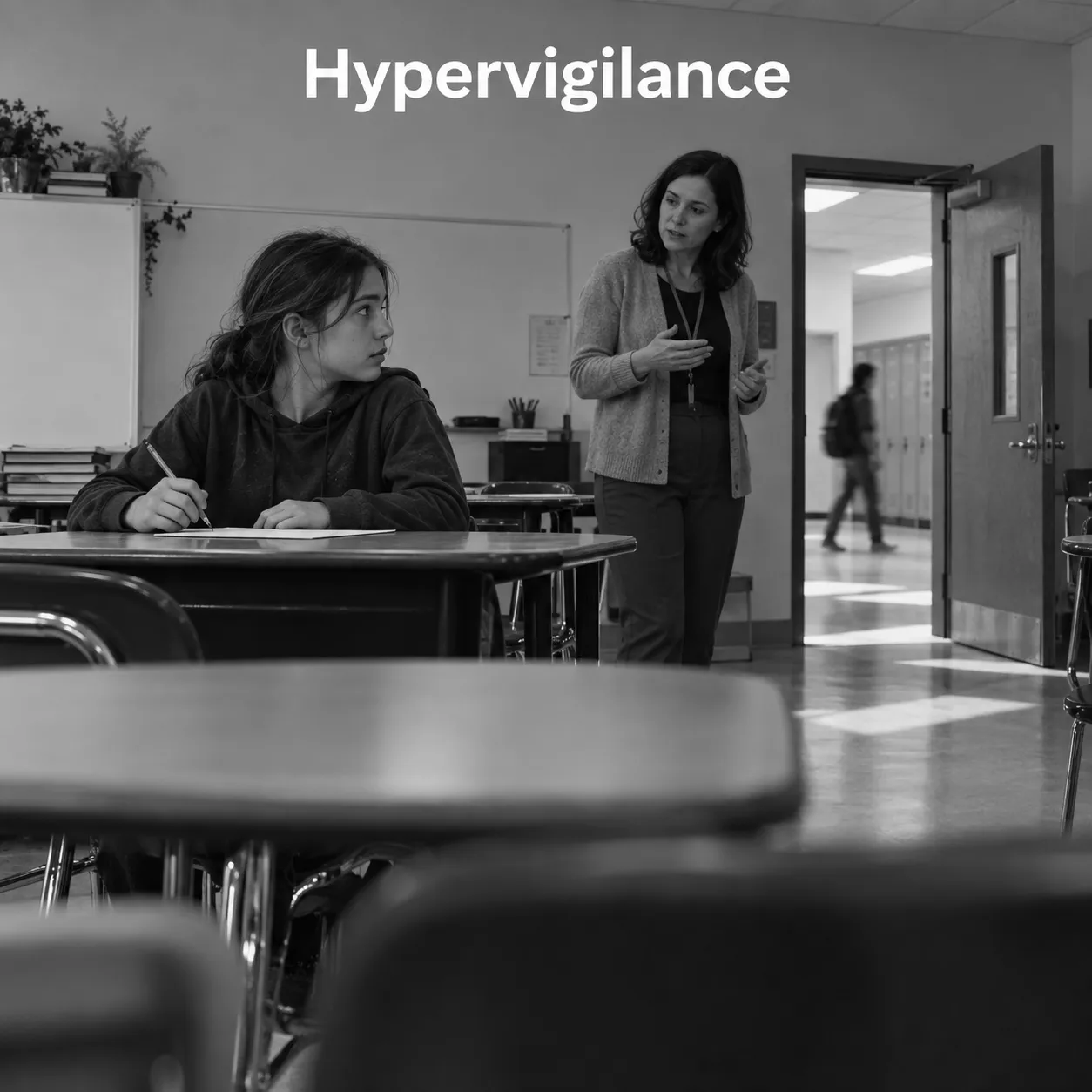
Hypervigilance is attention spread across a whole environment, scanning for threat, rather than settled on a single task. The distinction that makes it worth holding is that it is not absent attention, it is attention pointed elsewhere. The term is ordinary clinical vocabulary and this publication's source does not establish who originated it. The conceptual reframe is useful and can be written about. The clinical material attached to it is contested and cannot carry reader-facing conclusions.
What it is
A child who cannot stay on a worksheet may be attending very hard indeed, to the door, to the corridor, and to the tone of the adult's voice. From the outside that is indistinguishable from not attending. From the inside it is the opposite.
The account this vault holds comes from Johann Hari's Stolen Focus, where the concept is explained to him by two clinicians in interview. Nadine Burke Harris, a paediatrician who later became Surgeon General of California, supplies the framing. Jon Jureidini, a child psychiatrist in Adelaide, supplies the sharper point: evenly spread vigilance is the correct strategy in a genuinely dangerous environment, so narrowing a child's focus collides with the fact that the situation producing the vigilance is still happening.
Both reach the reader as interviewees talking, not as published findings of their own, and the distinction matters for what the concept can be used to argue.
In effect
The supporting research Hari prints, kept separate from the interview material, is as follows. Burke Harris's clinic assessed more than a thousand children, and those with four or more types of trauma were reported to be far more likely to carry an attention or behaviour diagnosis. Nicole Brown is cited as finding that childhood trauma tripled attention-deficit symptoms. A British Office for National Statistics study is cited for raised odds of a diagnosis following a family financial crisis, a serious family illness, or a parental court appearance.
Hari prints his own hedge alongside these, stating in the body text that the evidence base here is small but growing, and he deserves credit for putting it there rather than in the endnotes.
The caveat that must travel with the clinic figure is stronger than the hedge. It comes from one clinic's own patient population, it is cross-sectional, and it is keyed to diagnoses already recorded at that clinic. It is not a population estimate, it establishes no direction of causation, and it cannot support a sentence of the form that trauma makes a child some multiple more likely to have an attention disorder. The use of adverse childhood experience scores as an individual screening instrument has drawn substantial criticism since publication, and the initiative Burke Harris led in California is a live scientific dispute rather than settled practice. Hari's chapter presents the framework as settled. It is not.
None of the three studies is traced in this vault to a journal, a year or a sample size beyond what the book prints.
What it does not say
It does not say that an attention diagnosis in a child is really untreated trauma. That is the inference a reader draws unprompted from this material, and it is a clinical judgement about an individual child. Nothing here can carry it.
It does not say anything about medication for any particular person. Jureidini's point is about the logic of narrowing focus while a dangerous situation continues. It is an argument, offered in conversation, and it is not a treatment recommendation and must not be read as one.
It does not establish causation in either direction. Cross-sectional data from a single clinic is compatible with several orderings of events, and the literature has not settled which.
It does not come with an originator. The source does not attempt to trace the term, and this page does not invent one.
What does survive, and what the concept is genuinely useful for, is the observation itself: failing to attend and attending to something else look identical from the outside. That holds well beyond the clinical case, and it is the part of this note that can be written about freely.
Sources
- Hari, J. (2022). Stolen Focus: Why You Can't Pay Attention. Bloomsbury. Burke Harris and Jureidini are interview material. The clinic figure of 32.6 times, the Brown finding and the Office for National Statistics odds of 50 per cent, 75 per cent and nearly 200 per cent are as printed in the book, which supplies no journal, year or sample size for them.
- Evidence status set in the vault on 2026-09-03: mixed. Real studies exist behind these numbers and real problems sit in the same literature. The clinic figure cannot be cited without its cross-sectional single-population caveat stated in the same breath, and the load-bearing conceptual claim is two interviews rather than either clinician's published work.
- This is childhood trauma and paediatric diagnosis. Nothing here is usable in reader-facing advice without a credentialed reviewer signing it off.