Incremental Progress
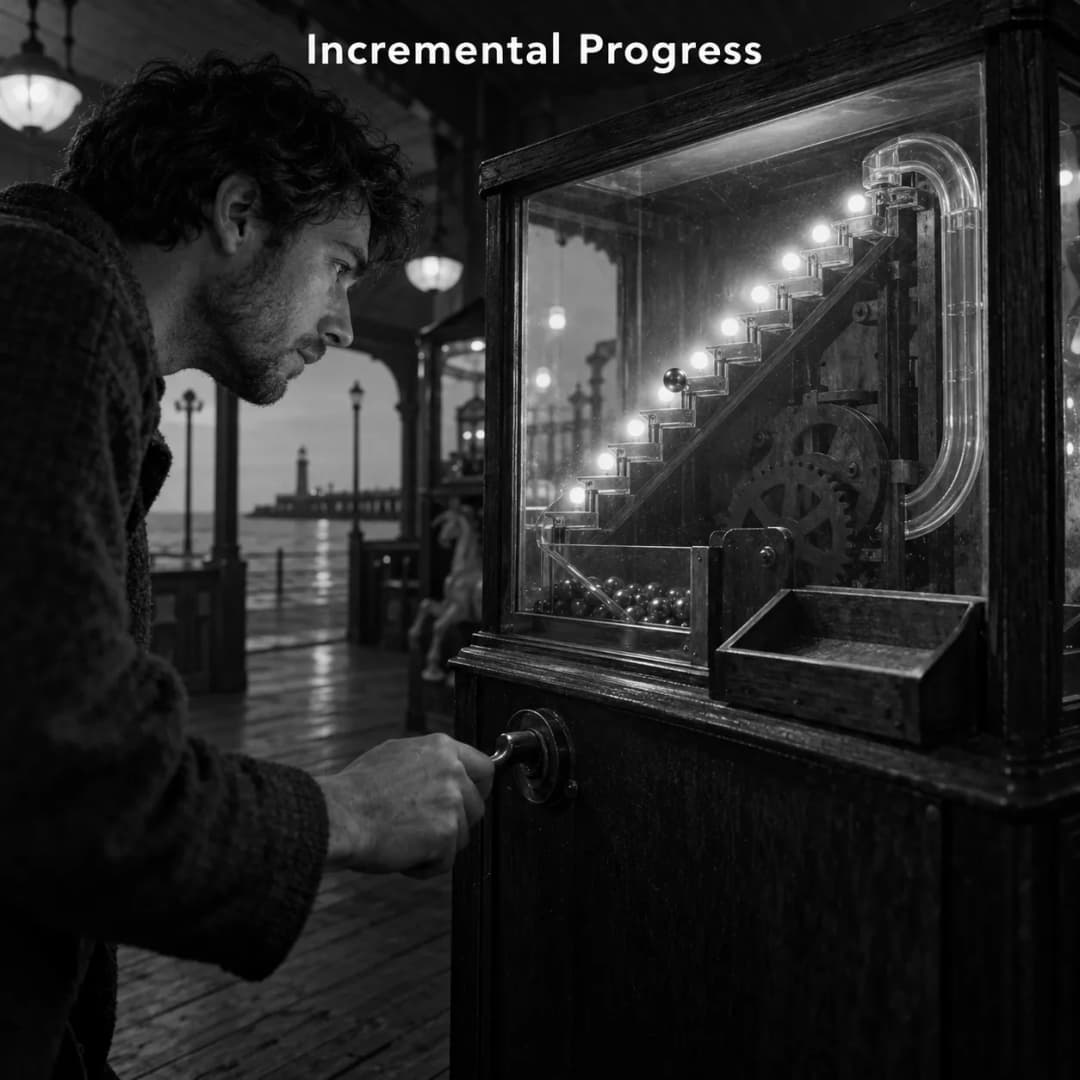
Incremental progress is Adam Alter's name, from Irresistible in 2017, for the felt sensation of getting better, manufactured through graded difficulty rather than earned through any real gain. It is the third of six ingredients in his account of behavioural engagement. This is a framework rather than a tested construct, and the evidence for the parts of it that have been tested lives in neighbouring concepts rather than in this one.
What it is
The observation is that progress does not have to lead anywhere in particular. It only has to register as motion. A product whose destination is nowhere specific can still feel like it is building towards something, provided the steps are small enough, frequent enough and visibly cumulative.
Alter's design example is Shigeru Miyamoto's level construction for Mario, where hidden shortcuts reward players who already know the game without punishing the ones who do not, so everyone feels they are improving and only the rate differs. This is an account of a designer's craft, not a study, and should be read as anecdote.
The framework sits inside a set of six. Compelling goals supply the target that this ingredient breaks into graded steps. Progressive difficulty supplies the escalation that keeps the progress feeling earned rather than given. Variable rewards, unresolved tension and social hooks are the remaining siblings.
In effect
The commercial versions run from gentle to predatory. FarmVille was the gentle end at scale, a very large number of people returning daily on a schedule to water crops, with nothing at the end of the watering except more watering.
The predatory end is Martin Shubik's dollar auction, published in the Journal of Conflict Resolution in 1971, in which a dollar bill is auctioned under a rule that both the highest and the second-highest bidder pay. Bidders can end up paying many times the value of the prize, each increment justified by the amount already committed. Alter has run the game in his own classes to demonstrate it.
That example is worth being careful with, because it is really illustrating something else. The dollar auction is a demonstration of escalation of commitment, where money already spent justifies spending more, and the connection to incremental progress is Alter's link rather than Shubik's finding. The endowed progress effect is the closer relative on the evidence side: it shows that a head start manufactures in a single move the sensation this ingredient builds step by step, and it has actual experimental support behind it.
For anyone auditing a product, the useful question is whether the progress bar corresponds to anything outside itself. If the only thing advancing is the bar, the design is manufacturing the sensation rather than reporting it.
What it does not say
It does not say this is a research finding. It is one ingredient in a book-level synthesis, and it has no founding experiment of its own.
It does not say the dollar auction is evidence for it. Shubik's game is real and traceable, and what it demonstrates is escalation of commitment.
It does not come with citable numbers. The classroom takings Alter reports and the daily-user figure for FarmVille have not been traced to primary sources here, and neither should be quoted as data.
And it does not say that graded progress is inherently manipulative. Deliberate pacing is what makes a hard skill learnable. The objection is narrower: it is to progress that reports nothing, offered by a product whose interest is in the return visit.
Sources
- Alter, A. (2017). Irresistible. Named as ingredient three of six in the opening chapter; developed in ch. 6, "Progress", p. 147.
- Shubik, M. (1971). "The dollar auction game: A paradox in noncooperative behavior and escalation." Journal of Conflict Resolution, 15(1), 109-111.
- The vault's evidence review of 2026-09-25 grades this not a research claim. Alter's classroom figure of $660 raised from a single dollar and the FarmVille figure of roughly 10 million daily users were not traced to primary sources and should not be cited as data. The Miyamoto design account is anecdote.