Life Domains
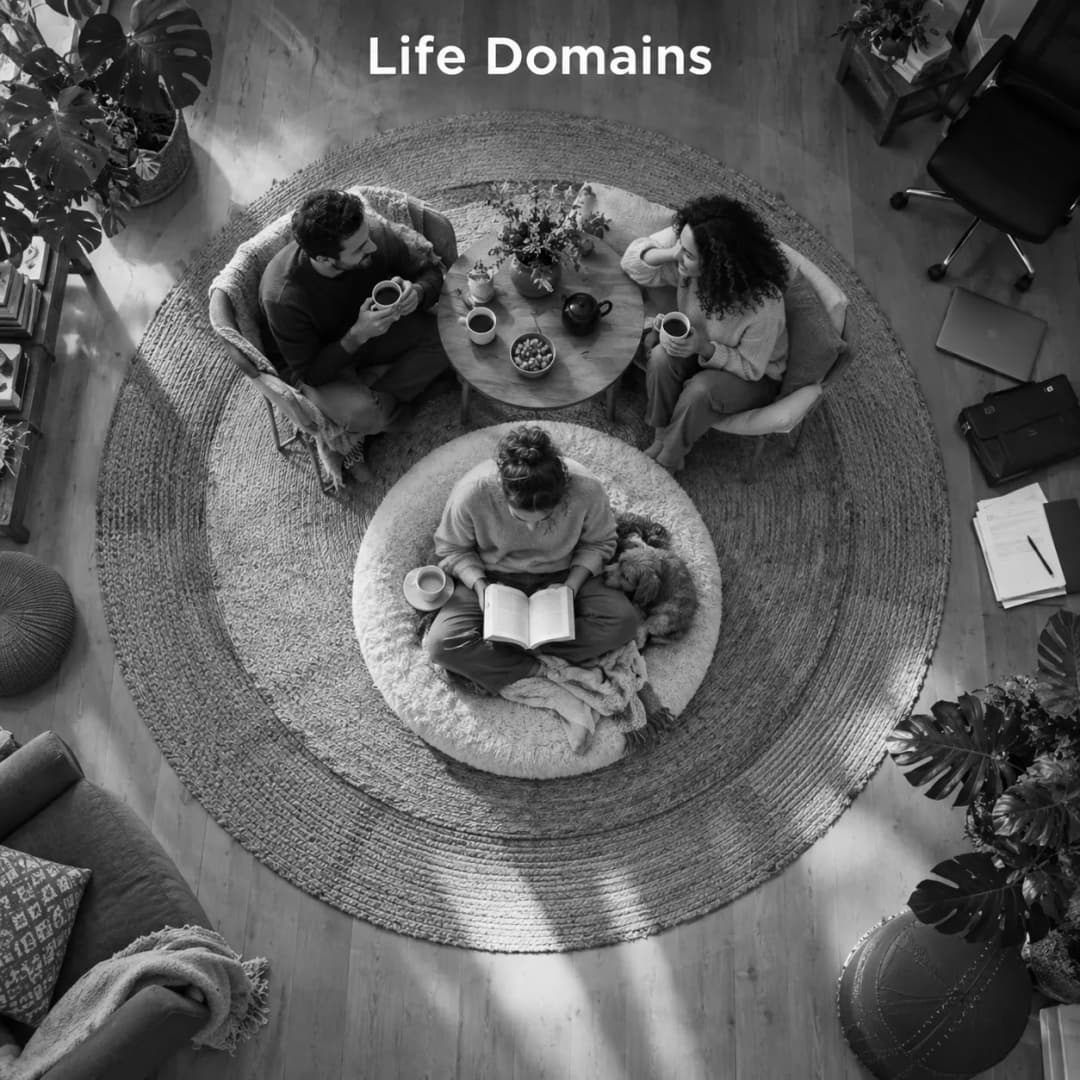
Life domains is Nir Eyal's scheduling framework from Indistractable, published in 2019: three concentric rings that a timeboxed schedule has to cover, with you at the centre, then relationships, then work. It is a framework rather than a finding, adapted from the Stoic Hierocles's circles of concern, and the ordering is the whole argument. Self-care is not the reward for finishing the other two, it is the ring the other two rest on.
What it is
The three rings are drawn in a specific order for a reason. The innermost is the self: sleep, exercise, reading, whatever maintenance the person needs to function. The middle ring is relationships: partner, children, friends, the people who will still be there when the job changes. The outer ring is work.
The claim is not that work matters least. It is that a schedule built from the outside in leaves the inner rings with whatever is left, and there is usually nothing left. Eyal's rule for the innermost ring is that you would not blow off a meeting with your boss, so you should not blow off one with yourself.
The deep lineage is ancient. Hierocles, a Stoic of the second century, described concentric circles of concern running from the self outwards to humanity, and his account survives through Stobaeus. The timeboxing application is Eyal's.
In effect
The relationships ring produces the framework's best material. Eyal describes loved ones as the residual beneficiary, the party who receives whatever time is left over after everything with a deadline has taken its share, which is a precise way of naming why domestic life degrades quietly rather than dramatically. He also recounts discovering that he had been assuming an equal share of household labour he was not in fact doing. Both are anecdotes, offered as such.
The mechanism the framework depends on is timeboxing, which is where the actual work happens. A ring on a diagram does nothing; a block in a calendar that is defended like a meeting does something. The framework's contribution is deciding what the blocks are for before deciding when they are.
Where evidence about the relationships ring is wanted, it exists independently. The long-running Harvard Study of Adult Development is the usual citation for relationships mattering to wellbeing over a lifetime, and it can be cited on its own terms. It does not validate this particular ordering of rings, which is an argument rather than a result.
What it does not say
It does not say this ordering has been tested. Nobody has compared schedules built inside out against schedules built outside in, and the framework carries no outcome claim.
It does not say the rings are equally sized. The proportions are the reader's to set, and nothing in the framework specifies them.
It does not say that time in a ring is the same as attention in it. A defended block filled with a phone satisfies the diagram and none of the purpose.
And it does not originate with the researchers whose work is sometimes attached to it. The three-ring model is Eyal's, adapted from Hierocles.
Sources
- Eyal, N. (2019). Indistractable. Chapters 9 to 12, pp. 60-87. Russ Harris supplies the definition used there of values as guidelines for action rather than end goals.
- Hierocles. Circles of concern, surviving through Stobaeus. The ancient source of the concentric-circle image.
- The vault's evidence review of 2026-09-25 grades this not a research claim and corrects the originator to Eyal. The household-labour account and the residual beneficiary framing are his anecdote. The Harvard Study of Adult Development can be cited separately for the claim that relationships matter to wellbeing, but it does not validate this ordering of rings.