Loading the Next Trigger
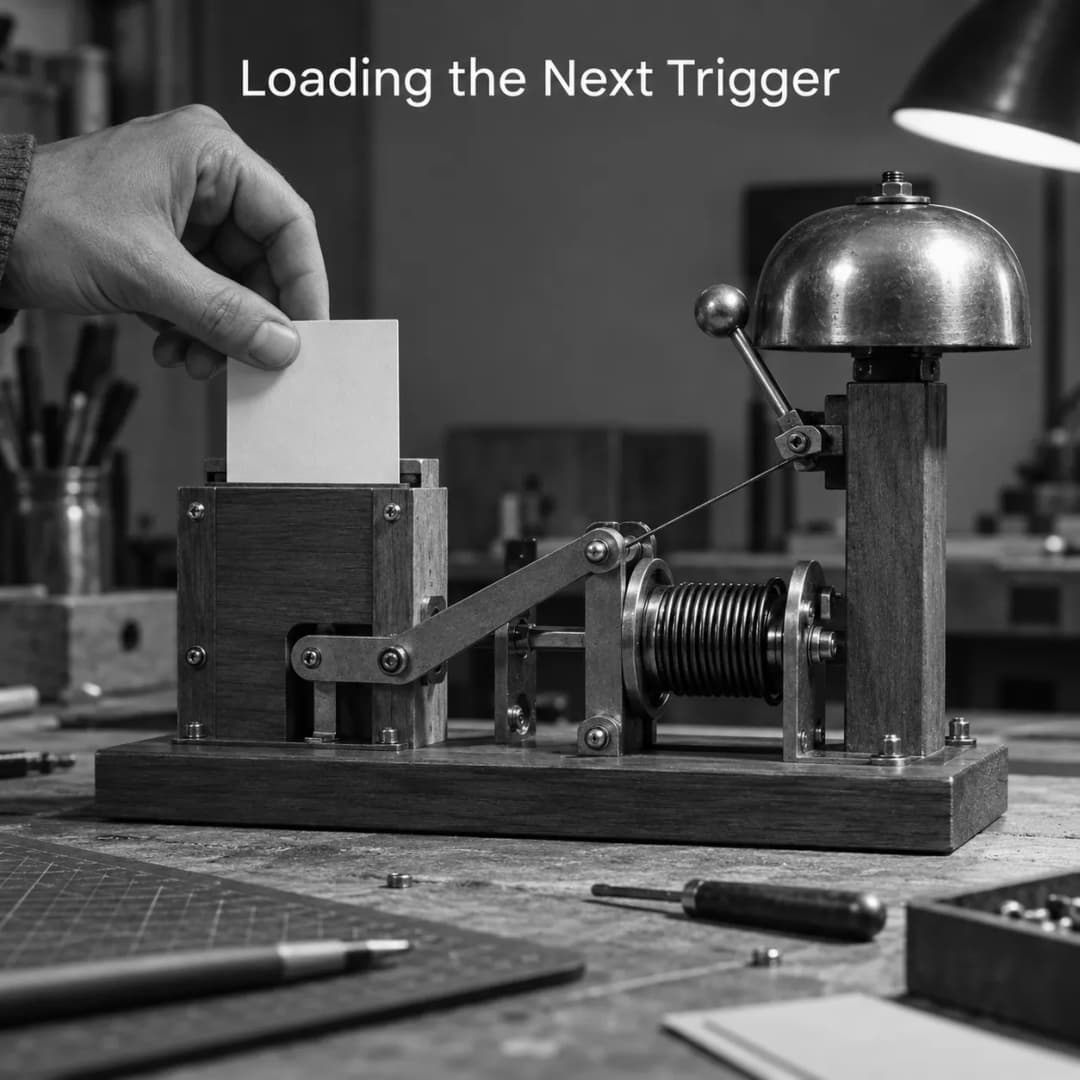
Loading the next trigger is the structural move that closes Nir Eyal's Hook Model, set out in Hooked in 2014. The investment stage does not only raise switching costs, it sets up the external trigger that restarts the cycle. It is a design prescription rather than a tested psychological effect, and the book offers no controlled evidence that the step works.
What it is
Without this move the loop is linear. A trigger arrives, the user acts, a reward lands, the user invests, and then the sequence is over. One pass, one transaction.
With it, the loop closes. The investment the user makes at the end of one pass produces the cue that starts the next, which means the user has loaded the trigger themselves. The product does not have to interrupt anybody out of the blue; it waits to fire something the user set.
That is the structural difference between a habit-forming product and a useful one, on Eyal's account. The cue is generated inside the loop rather than imposed from outside it.
In effect
The worked examples are the author's illustrations rather than studies. A task application has the user schedule tomorrow's task, which becomes tomorrow's notification. A dating application's swipe queues up a match notification for later. A messaging application's streak makes a reply obligatory, since the relationship lapses without one, and the lapse is itself a reason to open the app. A pinboard service resurfaces a saved item to other users and sends a notification back to the person who saved it when somebody engages with it. In every case the user did the loading and the product only waited.
The audit question this suggests is a good one. When a product asks you to do something at the end of a session, ask whether the artefact produced is for you or is a scheduled interruption addressed to your future self.
Where an article needs a research claim in this area, the nearest literatures are habit formation and cue-driven behaviour, and notification and streak mechanics have their own emerging evidence base. None of it is cited in the book, and none of it is about this specific step.
What it does not say
It does not say that loading a trigger raises return rates. Nobody has measured that here, and the examples are illustrations chosen after the fact.
It does not describe a psychological effect. It describes a product pattern, which is why replication does not apply to it.
It does not say the pattern is inherently harmful. A calendar reminder the user set is the same structure serving the user's own intention. The objection is to who the loaded trigger is working for.
And it does not carry evidence from the habit literature by association. That evidence belongs to the cue-and-habit notes and should be cited from them.
Sources
- Eyal, N. (2014). Hooked: How to Build Habit-Forming Products. The worked examples at pp. 154-162.
- The vault's evidence review of 2026-09-25 grades this not a research claim: a design prescription inside the Hook Model, with no controlled evidence offered for the stage and no study testing whether the loaded trigger raises return rates.