Manufactured Consent
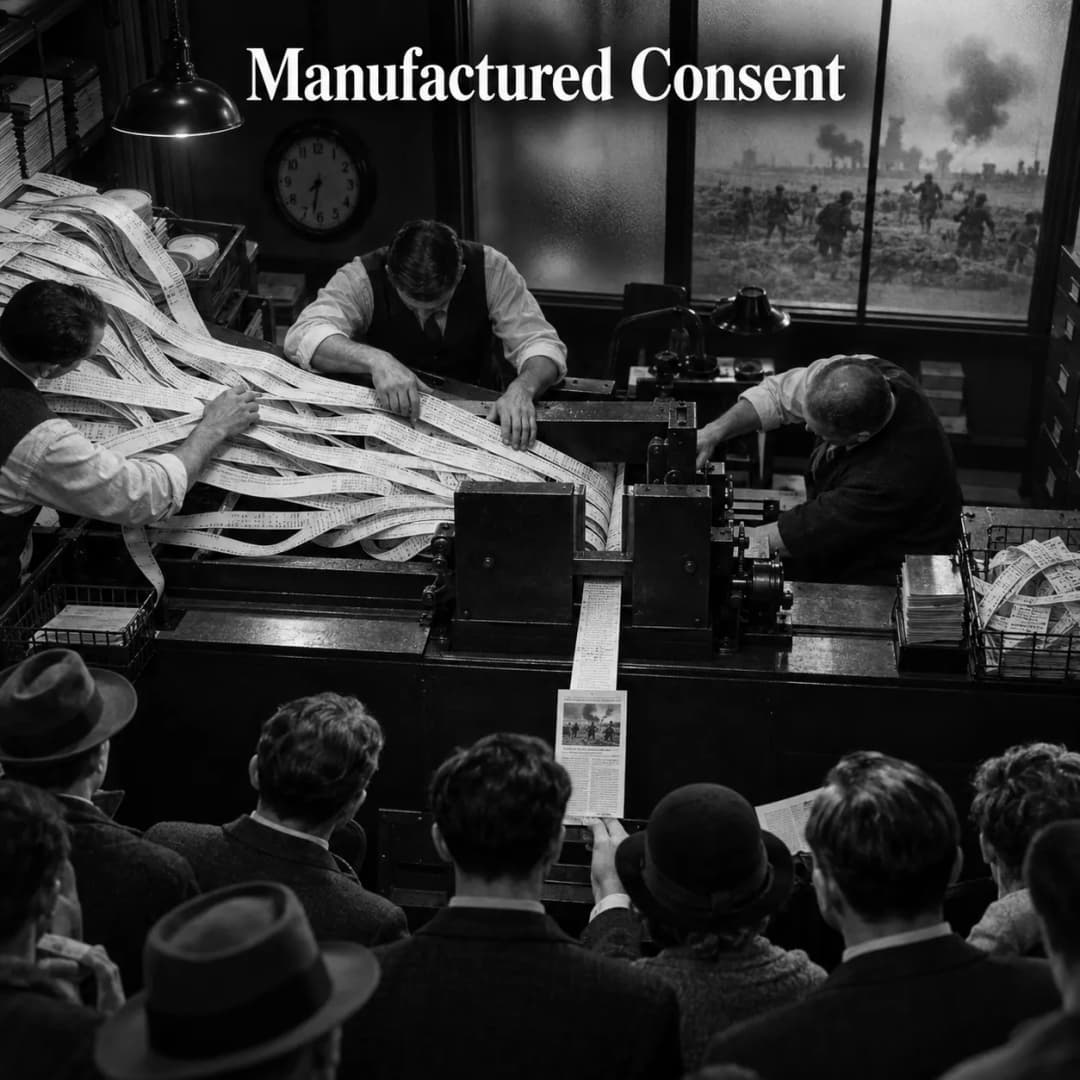
The manufacture of consent is Walter Lippmann's phrase, from Public Opinion in 1922. It is not Edward Bernays's, whose Propaganda came six years later in 1928 and drew the opposite moral from the same evidence. The argument is that the public's assent to policy is engineered rather than deliberated, because nobody has direct access to the world they are asked to have opinions about. This publication has read the primary text in full, and two things the popular version of the phrase drops are in it plainly: Lippmann says the art is ancient, and he is not recommending it.
What it is
The sentence sits in Part V, Chapter XV of Public Opinion, and it is characteristically dry: that the manufacture of consent is capable of great refinements, Lippmann writes, no one, he thinks, denies.
The argument behind it runs through the whole book. The world people must form opinions about is too big, too fast and too far away to be known directly. They navigate it through stereotypes and through what Lippmann calls the pseudo-environment, the picture in the head that stands in for the thing. Whoever supplies the pictures controls, to a real degree, what looks reasonable.
Two corrections to the popular version follow from the primary text. The first is that Lippmann explicitly denies that consent engineering was invented in his century. He calls the creation of consent a very old art, supposed to have died out with the appearance of democracy, which has instead improved enormously in technique, because it is now based on analysis rather than rule of thumb. Anyone citing him for the twentieth-century-invention claim is citing him against what he wrote.
The second is that the passage is not advice. It closes a chapter about how leaders become propagandists through the structural fact of controlling access to the facts, where every official is in some degree a censor and every leader in some degree a propagandist. Its function in the book is to finish off the older theory that public opinion rises spontaneously from the human heart.
In effect
The mechanical precondition Lippmann names is the part that travels least and is worth the most. Without some form of censorship, he writes, propaganda in the strict sense is impossible; there must be a barrier between the public and the event, and access to the real environment must be limited before anyone can create a pseudo-environment. He then makes a point easy to miss: military censorship is the weakest form of the barrier, because it is known to exist and is therefore discounted. The effective barriers are the unnoticed ones, the elastic boundary of privacy, the cost of travel, the shortness of a dispatch, the limits of a social set.
His worked case is Verdun: a French command editing an evening communiqué by committee, inserting a phrase to steady civilians, and circulating escalating enemy casualty figures in support of a theory of attrition the command had itself come to believe. His verdict is the model for how this publication writes about propaganda. A group of men who can prevent independent access to an event arrange the news of it to suit their purpose, and that the purpose was in this case patriotic does not affect the argument at all.
The Bernays split remains good history. Lippmann wrote Public Opinion after watching the American wartime propaganda apparatus work at scale, and it frightened him. Bernays watched the same machine and opened Propaganda in 1928 by calling the conscious and intelligent manipulation of the organised habits and opinions of the masses an important element in democratic society. Tim Wu's point about the pivot holds: the war's success is what rehabilitated persuasion as a legitimate profession and sent it into peacetime commerce.
What it does not say
It does not belong to Bernays. That attribution is common, it was in this vault's own frontmatter until it was corrected against the primary, and it is wrong.
It does not say the technique is new. Lippmann says the opposite, and only the method is new.
It does not endorse the practice. The phrase describes a capability he found alarming, in a chapter about why democratic theory could not survive contact with it.
And it does not establish the lineage of the later book that made the phrase famous. Herman and Chomsky's Manufacturing Consent, from 1988, is generally said to take its title from this sentence. That attribution has not been verified here and is recorded as a lead rather than a fact.
Sources
- Lippmann, W. (1922). Public Opinion. Primary, read in full from the Project Gutenberg text on 2026-09-20. The phrase and the surrounding argument at Part V, Chapter XV, section 4; the censorship precondition at Part II, Chapter II, section 3; the Verdun case at Part II, Chapter II, sections 1 and 2. No page numbers exist in this edition; cite by part, chapter and section.
- Bernays, E. (1928). Propaganda. The opening line, drawing the opposite conclusion from the same wartime evidence.
- Wu, T. The Attention Merchants. The framing of the Lippmann and Bernays split as the hinge from wartime propaganda into peacetime commerce, with the Bernays line quoted at p. 49. Upheld as history, superseded on the concept and on the attribution.
- Corrected in the vault on 2026-09-20 from the primary text: this note previously carried Bernays as originator while its own definition attributed the argument to Lippmann. The phrase is Lippmann's, 1922.