Maternal Deprivation
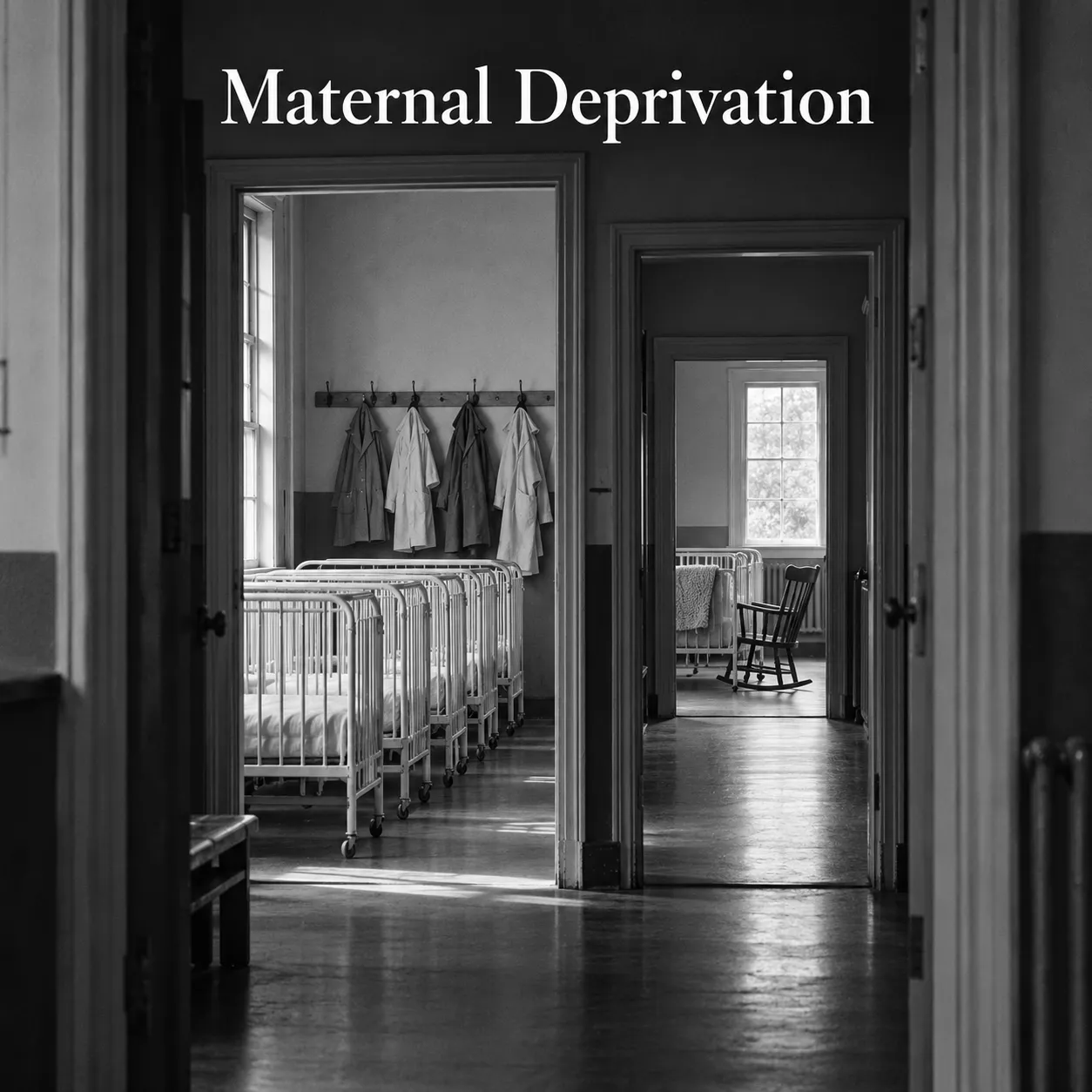
Maternal deprivation is John Bowlby's 1951 thesis, set out in Maternal Care and Mental Health, a report commissioned by the World Health Organization. It holds that a young child needs a warm, intimate and continuous relationship with one caregiver, and that the absence of one has grave effects. It was historically enormous and it has been substantially revised, chiefly by Michael Rutter, who showed that the thesis ran together three different situations with three different outcomes. This page records the 1951 position. It is not the current position and must not be used as one.
What it is
Bowlby took a temporary post at the World Health Organization in January 1950, visited France, Holland, Sweden, Switzerland, Britain and the United States, and produced the report within about nine months. It is a commissioned review with a policy annex, not a monograph of original research, and every claim from it should be read in that light.
His definition is about a relationship rather than about a mother's presence. What he says is essential for mental health is that the infant and young child should experience a warm, intimate and continuous relationship with the mother, or permanent mother-substitute, in which both find satisfaction and enjoyment. A state of affairs in which the child does not have this relationship he terms maternal deprivation.
The grading he applies is almost always lost in retelling, and it matters. Partial deprivation covers a child living at home whose mother cannot give the care small children need, and a child removed to a stranger, which he calls mild if the substitute is already known and considerable if not. Against that he sets the almost complete deprivation still common in institutions, residential nurseries and hospitals where the child has no one person caring for him in a personal way. Complete deprivation is what the report is about; partial deprivation, he says, could fill another report and does not.
He also states his own scope limit. Almost all the evidence, he writes, concerns the child's relation to the mother, and the father appears in the report only as the mother's economic and emotional support. He is describing where the literature stood, not asserting that fathers do not matter, and that distinction is regularly lost.
And he conceded reversibility, with a boundary. Babies adopted between six and nine months after a deprived first half-year recover well enough that repair is virtually certain for many, provided they receive good mothering in time. The window closes, on Goldfarb's authority, after about two and a half years, with the real limit probably before twelve months. The 1951 doctrine is therefore one of a short window rather than permanent damage, and the short window is what the revision opened.
In effect
The strongest statement in the report keeps a modal verb that almost every quotation of it drops. Bowlby submits that the evidence leaves no room for doubt regarding the general proposition that prolonged deprivation of maternal care may have grave and far-reaching effects on a child's character and future life.
Two sentences did the political work. He calls the discovery comparable in magnitude to that of the role of vitamins in physical health, and he describes deprived children as a source of social infection as real and serious as carriers of diphtheria and typhoid.
The hedges are real, specific, and sit beside the claims. He says the evidence is largely clinical in origin and neither systematic nor statistically controlled. On the same page as his strongest sentence he says there are far too few systematic studies and statistical comparisons with proper control groups, that relatively few studies taken by themselves are more than suggestive, and that how much deprivation children of different ages can withstand has yet to be determined. He then decides to act anyway, on the ground that evidence is never complete and that to await certainty is to await eternity. He also told the field, in terms, that it should henceforward be regarded as unnecessary to spend time demonstrating the validity of the general proposition, which is a striking instruction from someone who has just catalogued the gaps.
Counted rather than characterised, the evidence base is a bibliography of a hundred and fifty-nine items, six of them unpublished, with at least nineteen personal or verbal communications carrying argument in the text, and one piece of Bowlby's own original research, his study of forty-four juvenile thieves from 1944, drawn from one clinic with forty-four cases and forty-four controls. The weight rests above all on William Goldfarb, then on René Spitz and Katherine Wolf, then on Sophie van Senden Theis.
The revision is the important part. Michael Rutter's Maternal Deprivation Reassessed and the related work is the standard correction, and it is a revision rather than a refutation. Rutter showed that three different things had been run together: separation from an attachment figure, loss of one, and never having had one, each with different outcomes. Institutional harm came from several deprivations at once rather than from maternal absence alone. Delinquency tracked family discord rather than deprivation as such. Maternal deprivation is now treated as a vulnerability factor among others rather than as a specific cause. Attachment theory itself, as distinct from the deprivation hypothesis, remains central to developmental psychology, and the two should be kept apart.
The policy consequences are real history. Credited to the report, with pages: a bad home preferred to a good institution, adoption in the first two months as the rule, mothers admitted to hospital with children under three and casual frequent visiting instead of fixed hours, graded family allowances increased for younger children, foster-parents paid a real service fee, institutions capped in size and organised in small family groups, residential nurseries opposed outright, and family and child welfare unified under one authority. Two items often credited to it are not in it at all: imprisoned mothers keeping young babies, and maternity leave. Several of the policies outlived the evidence that produced them, which is the more interesting fact about them.
What it does not say
It does not say that mothers are to blame for their children's difficulties. The report is about the presence or absence of a continuous caregiving relationship, it explicitly includes a permanent mother-substitute in that role, and the revision locates institutional harm in multiple simultaneous deprivations and delinquency in family discord. Nothing here supports an inference about any individual parent.
It does not say the effects are permanent. Bowlby conceded reversibility and bounded it by age, and the revision widened that boundary considerably.
It does not say fathers do not matter. Bowlby states that the literature he reviewed concerned mothers, which is a fact about the literature.
It does not rest on strong evidence by its own account. The author catalogued the gaps and proceeded anyway, and said so.
And it does not carry over to attachment theory. That body of work survives the revision and should be read first by anyone interested in the subject.
This is material about children, families and placement decisions, and nothing on this page is guidance about any of them.
Sources
- Bowlby, J. (1951; second edition 1952). Maternal Care and Mental Health. World Health Organization. Read in full at the WHO's own repository on 2026-09-20. The definition at p. 11; the grading of partial against complete deprivation at pp. 11-12; the scope limit at p. 13; reversibility at p. 49; the strongest statement at p. 46 with its hedges on the same page; the vitamins comparison and the instruction to stop testing the proposition at p. 59; the social-infection line at p. 157; the decision to act on incomplete evidence at p. 158. Policy items at pp. 68, 90-91, 103, 118, 129-130, 132-137, 147-148 and 151.
- Bowlby, J. (1944). The forty-four juvenile thieves. One clinic, 44 cases and 44 controls. His only original research in the report.
- Rutter, M. Maternal Deprivation Reassessed. The standard correction, and the source for the revision above. Confirmed in the vault's external verification pass of 2026-09-18.
- Watson, P. (2002). The Modern Mind, pp. 498-499. Cited only for the fact that the idea existed and mattered, never as the authority for a psychological finding. His parenthetical claim that the great majority of delinquents came from broken homes is uncited and is contradicted by Rutter's work; it is not carried here.
- Evidence grade: contested. The direction of the dispute is settled: substantially revised rather than overturned, with the specific-cause claim gone and the vulnerability-factor reading standing.