Mimetic Desire
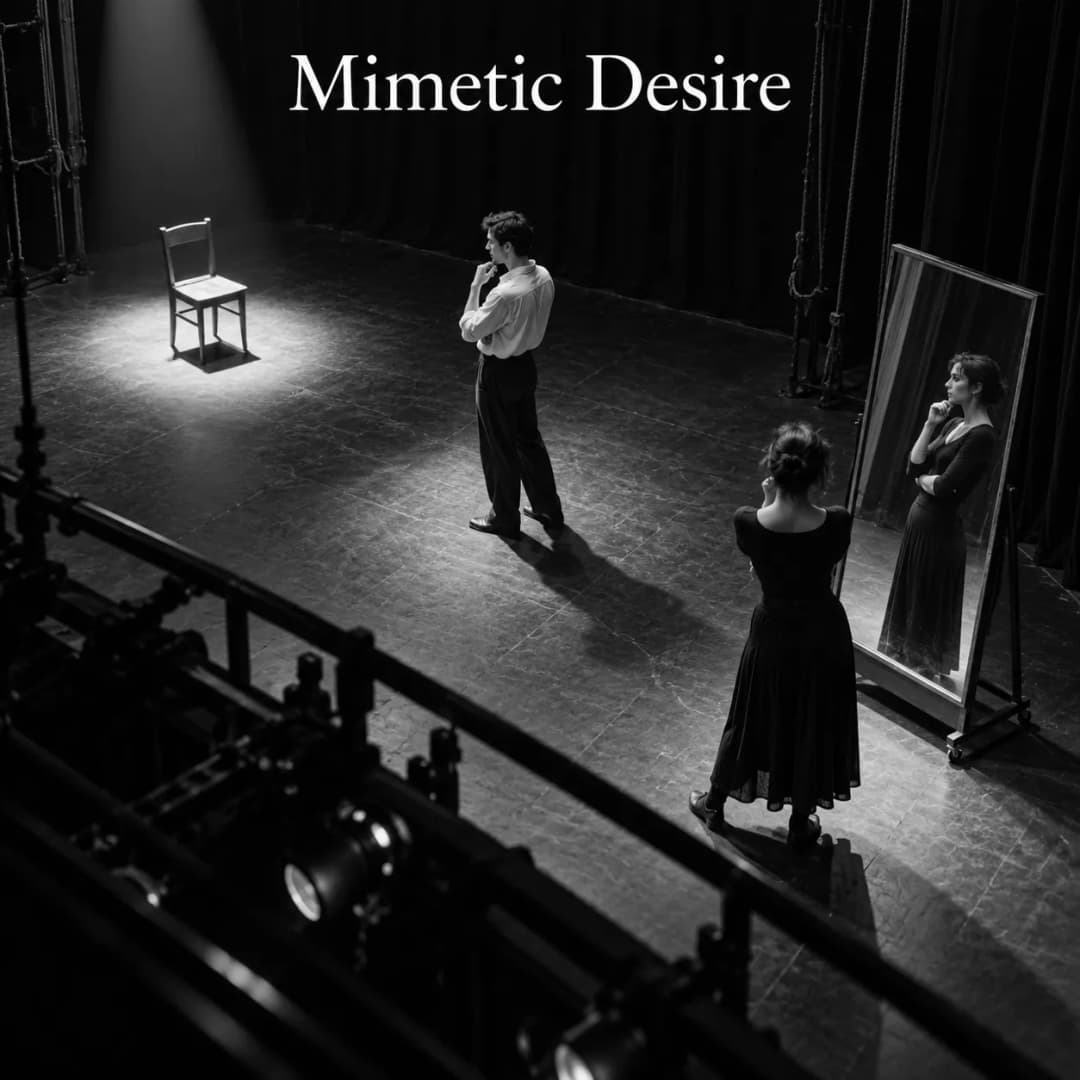
Mimetic desire is René Girard's theory, first set out in 1961, that desire is imitative: we want things because other people appear fulfilled by wanting them, not because we independently arrived at valuing them. It is a literary and philosophical theory rather than a testable effect in the form Girard states it, and this page grades it accordingly. A rival account of the same observation, from the signalling literature, converts it into something checkable, which is the most interesting thing that has happened to it recently.
What it is
Girard published Mensonge romantique et vérité romanesque in 1961, translated into English as Deceit, Desire and the Novel in 1965. The core move is to deny that desire runs straight from a person to an object. It runs through a third party, the model, whose apparent satisfaction is what makes the object desirable.
The consequence Girard draws is that you are not copying the object, you are copying the person. Desire aims at the model's being rather than at what the model has, which is why acquiring the thing so rarely settles anything.
The theory is stated at a level that makes direct testing difficult. Its home is literary criticism and philosophical anthropology, and it has been enormously influential in both without acquiring an experimental literature of its own.
In effect
The application this publication meets it through is social media. Tim Wu reaches for Girard to explain why curated self-presentation becomes compulsive: the feed is simultaneously the model everyone imitates and the audience judging the imitation, which makes the loop self-sustaining rather than self-correcting. His grounding examples are selfie culture, with "selfie" named Word of the Year by Oxford Dictionaries in 2013, and the practice of maintaining a curated public account alongside a real private one on the same platform. A hashtag count often quoted alongside these has not been traced and should not be cited.
The rival account is sharper because it is checkable. Kevin Simler and Robin Hanson argue in their consumption chapter that lifestyle advertising does not work by making you want the thing. It works indirectly, by changing what your peers will think of you for having it. A buyer can know perfectly well that a beer is just a beer and still be making a correct purchase, because the advertisement moved the audience rather than the buyer.
That matters here for a specific reason. Girard's mechanism runs through the individual's psyche and is hard to test. The signalling mechanism predicts something specific: the effect should depend on whether the purchase is visible to the relevant audience, and should vanish when nobody will see. Conspicuous-consumption research gives that prediction some support. That support does not transfer to Girard's version, and neither framework is upgraded on the strength of the comparison.
What it does not say
It does not say this has been tested. Girard's theory is not a finding, and nothing here is evidence.
It does not say that all desire is copied. The theory claims that mediated desire is the basic structure, which is a claim about how desire is organised rather than a tally.
It does not have the numbers popular retellings attach to it. The hashtag figure in circulation is untraced.
And it does not stand or fall with the signalling account. That is a different mechanism fitting the same observation, and support for one is not support for the other.
Sources
- Girard, R. (1961). Mensonge romantique et vérité romanesque. Translated as Deceit, Desire and the Novel (1965). The originating statement of the theory.
- Wu, T. (2016). The Attention Merchants. Applies Girard to social media at pp. 312 and 315. Oxford Dictionaries did name "selfie" its 2013 Word of the Year; the hashtag count given there was not traced and should not be cited.
- Simler, K., & Hanson, R. (2018). The Elephant in the Brain, pp. 179-181. The indirect signalling account of lifestyle advertising, which yields a testable visibility prediction. The book offers no test of its own.
- Evidence grade: not a research claim. The vault's review of 2026-09-25 corrects the originator from the popular author who applies it to Girard, who proposed it.